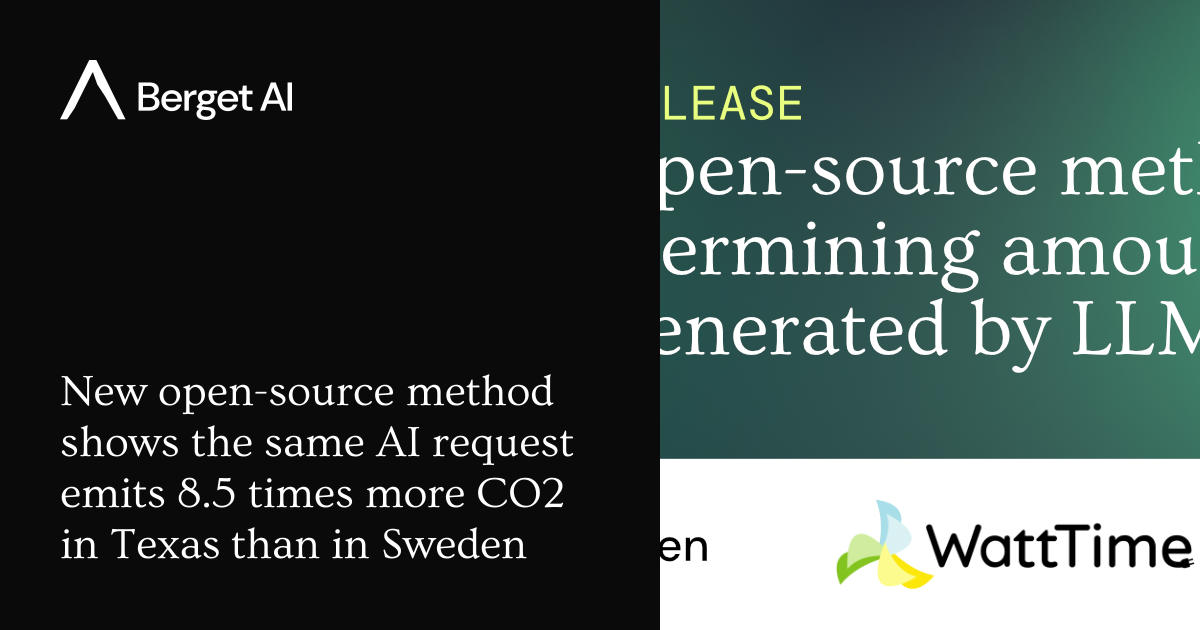
Same AI request makes 8.5 times more pollution in Texas than in Sweden
Where your AI runs matters for the climate — a method now lets you see the real carbon footprint of each request.

What you could do with it
- A customer using Berget AI's console could follow their own emissions request by request as they use the service 1.
- A buyer could compare different AI providers on real carbon figures instead of marketing claims 1.
- A researcher could analyze how a request's emissions change based on the model used, time of day, and whether the prompt is cached 1.
Picture: berget.ai
Why location changes everything
If you run a normal question through the open Kimi K3 model on identical equipment, the carbon dioxide emitted depends on where the servers are: Sweden generates 0.38 grams, Ireland 1.6 grams, Germany 2.5 grams, and Texas 3.2 grams 1. That is an 8.5 times difference.
The main reason is the electricity mix. Sweden's grid runs mostly on nuclear and hydroelectric power, giving it an emissions intensity of around 8 grams of CO₂ per kilowatt-hour 1. Texas, by contrast, still relies heavily on natural gas and coal, with an intensity of about 333 grams per kilowatt-hour .
The method also accounts for the carbon cost of building the hardware. About 89% of a request's footprint in Sweden comes from manufacturing the GPU, while in Texas 90% comes from electricity 1. Over a seven-day stretch in a live production setting, a B300 that is sitting idle still uses 236 W .
Who made the method and why
The tool was developed by Swedish AI provider Berget AI together with researchers from the Stockholm Environment Institute, and the nonprofits WattTime and Klimatkollen 1. It is published freely under an open licence on GitHub .
Berget AI says most companies using AI today have no way of knowing how much pollution their requests produce. With this method, customers can watch their own emissions request by request inside Berget AI's console 1. The company wants other providers to adopt similar reporting so buyers can compare real numbers instead of marketing claims .
"We know most European buyers would choose differently if they could see the numbers," said Andreas Lundmark, chief executive of Berget AI 1.
Why this is different from past estimates
Most public figures on AI's carbon footprint are calculated by multiplying an average emission rate by an estimated volume of use. Those numbers cannot be checked or compared properly 1.
The updated approach works out the emissions for every single request individually, factoring in which model is being used, what time of day it runs, and whether some of the prompt is already held in cache 1. It follows the Green Software Foundation's specification for measuring AI emissions .
Klimatkollen's Garbo AI assistant, which runs on Berget AI's infrastructure, is already being measured with this method 1.
What the data centres will look like in future
The International Energy Agency estimates that data centre electricity use will more than double to around 945 terawatt-hours by 2030, driven mainly by AI 1. Researchers say any efficiency gains are likely to be outweighed by higher demand, which means where the electricity comes from will matter even more .
Somya Joshi, research director at the Stockholm Environment Institute, said methodologies like this provide a transparent basis for informed decisions 1.
An updated version of the calculator will also include marginal emission rates next month, which measure the impact of adding new load to a grid rather than just using averages 1. That could change the reported numbers for Sweden significantly.
The current version does not yet cover the water and energy footprint of chip manufacturing, and training emissions are excluded because self-reported figures vary too much 1.
This story reports on a trend for information only. It is not advice or encouragement to do any of it.
Key facts
- Same Kimi K3 request: 0.38g CO₂ in Sweden, 3.2g in Texas
- Sweden grid: ~8g CO₂/kWh; Texas grid: ~333g CO₂/kWh
- Open-source method available on GitHub under MIT licence
- Data centre electricity use could double to 945 TWh by 2030
- 29% of tokens on Vercel's AI Gateway were open-weight models in June 2026
Sources
Keep reading
 How it worksFactory Droid 1.0 makes AI coding agents faster and cheaper with new 'programmatic' approachHerald of AIHow it works
Factory Droid 1.0 makes AI coding agents faster and cheaper with new 'programmatic' approach
The latest update lets one AI request run hundreds of steps at once, cutting costs and improving results on complex coding tasks.
 New modelsHugging Face's Carbon-X reads DNA like a language, answers in EnglishHerald of AI
 How it worksCoreWeave goes all-in on open-source Kubernetes as AI model launches get harderHerald of AI
 New modelsSamaya Sterling a tiny AI finance agent beats a bigger one at a fraction of the costHerald of AI
Related stories
 The weekThis Week in AI New Models Flood In and Agents Get SaferHerald of AI
This Week in AI New Models Flood In and Agents Get Safer
Big open-weight releases, speed breakthroughs, and a push to make AI agents more reliable and secure.
 New modelsMirendil launches Fern 0.1, an AI model that can read 10 million tokens at onceHerald of AI
Mirendil launches Fern 0.1, an AI model that can read 10 million tokens at once
A new coding AI can hold a whole software project in memory at once — useful for developers, but still far behind top models at actual coding tasks.
 New modelsvLLM Hyper-Optimizes Kimi K3 on NVIDIA GB300 for Blazing-FAST InferenceHerald of AI
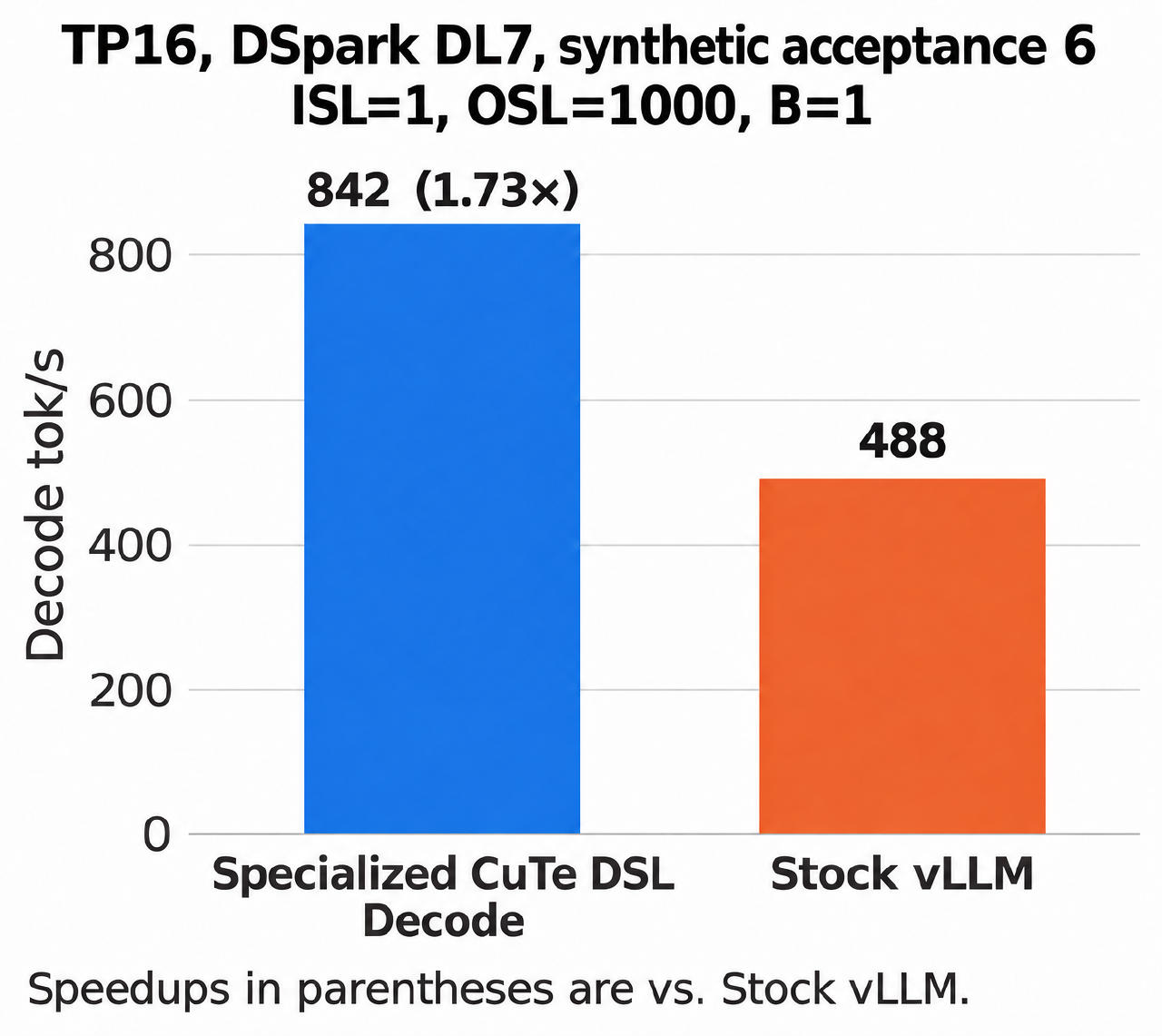
vLLM Hyper-Optimizes Kimi K3 on NVIDIA GB300 for Blazing-FAST Inference
New optimizations push Kimi K3 decode to over 840 tokens per second at batch 1 on 16 NVIDIA GB300 GPUs with DSpark.
 New modelsStepFun Releases Open Weights for Its 600B Step 5 Preview ModelHerald of AI
StepFun Releases Open Weights for Its 600B Step 5 Preview Model
The Chinese AI lab has made its large Mixture-of-Experts model available for self-hosting, targeting developers building coding agents and finance tools.