FilmFlow turns text into camera moves for 3D scenes, beat all tested baselines
A new AI system lets anyone describe a shot and get a ready-to-use camera path for 3D animation.
- Words to know: Agentic system: a setup where several AI programs work together, each handling one task, to solve a bigger problem · Cinematography: the art of planning camera movement and framing in a film or video
What you could do with it
- A game maker or animator could describe a shot in plain language and instantly receive a ready-to-use camera path for their 3D scene, without needing to learn technical camera tools 1.
- A researcher could evaluate and compare AI camera-movement systems using CinemaBench, a benchmark of 150 Blender scenes with 750 text-directed tasks and 60 video references 1.
- An aspiring filmmaker could turn a creative idea like 'slowly circle the character as the rain begins' into executable camera trajectories for a 3D environment without writing code 1.
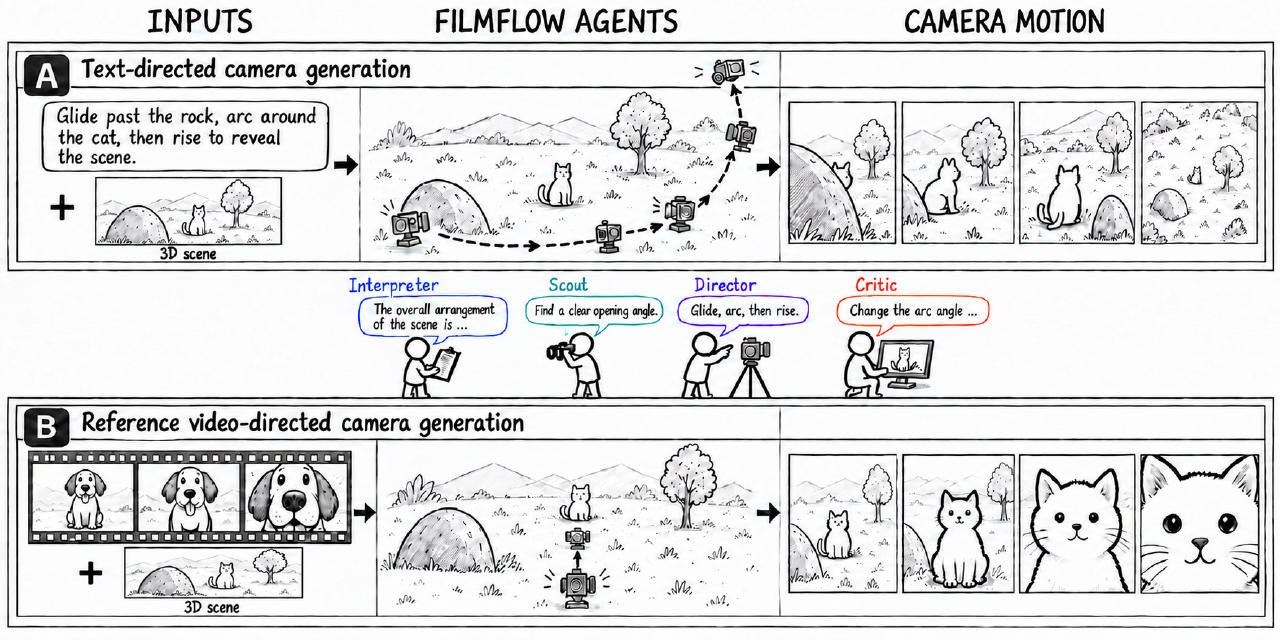
Figure: Zhang et al., arXiv:2610.30753, CC BY 4.0
How FilmFlow works
FilmFlow was designed to solve a problem familiar to anyone who has tried to animate a camera in 3D: describing exactly what you want the camera to do is hard. Translating a creative idea like "slowly circle the character as the rain begins" into numbers the computer can execute has traditionally required detailed technical knowledge 1.
The system uses what researchers call an agentic framework — a team of four AI programs that handle different parts of the job 1. One agent, called the Director, acts as the main planner. It takes a text instruction or a reference video and breaks it down into a sequence of executable camera moves, combining basic actions that control where the camera travels, how it rotates, and how it frames the subject .
Three supporting agents help the Director. An Interpreter agent reads the scene in the 3D environment and figures out what the user actually means when they give a cinematographic instruction — extracting the intent behind words like "dramatic" or "intimate" 1. A Scout agent selects the best starting point for the camera before the shot begins . And a Critic agent watches the rendered result and gives visual feedback so the Director can refine its plan iteratively .
Think of it like having a director, a camera operator, a location scout and a editor all working together, except each one is an AI specialising in one part of the process 1.
The benchmark: CinemaBench
To test whether the system actually works, the researchers created CinemaBench — a benchmark dataset made up of 150 Blender scenes, sourced from both original and licensed material 1. Each scene has five different camera instructions, giving 750 text-based tasks, plus 60 reference videos linked to a subset of the scenes for testing video-to-camera generation .
Across a range of baseline systems that were tested alongside it, FilmFlow scored the best on the benchmark and received the highest preference from human evaluators 1. The researchers say the system showed strong spatial reasoning, timing coordination and visual composition — three skills that are essential for real cinematography .
What comes next
The system was developed as a research project published on Hugging Face in October 2026 1. Whether it will be released as a tool for everyday users or stay inside research labs is not yet clear from the sources . Similar projects such as CamPilot and SemCam are also exploring AI-driven camera control, suggesting this is an area where several teams are building in parallel .
For now, FilmFlow shows that a team of specialised AI agents can handle a task that has long required trained professionals — turning creative camera ideas into precise, executable 3D movements 1.
Key facts
- FilmFlow uses four AI agents to translate text or video into 3D camera paths
- CinemaBench contains 150 Blender scenes with 750 text-directed camera tasks
- FilmFlow outperformed all tested baselines and won highest user preference
- Three helper agents interpret intent, choose viewpoints and critique results
- Research published on Hugging Face in October 2026
Sources
Related stories
 PeopleSimon Willison Updates llm-gemini to Support New Gemini 4 Argon ModelHerald of AI
Simon Willison Updates llm-gemini to Support New Gemini 4 Argon Model
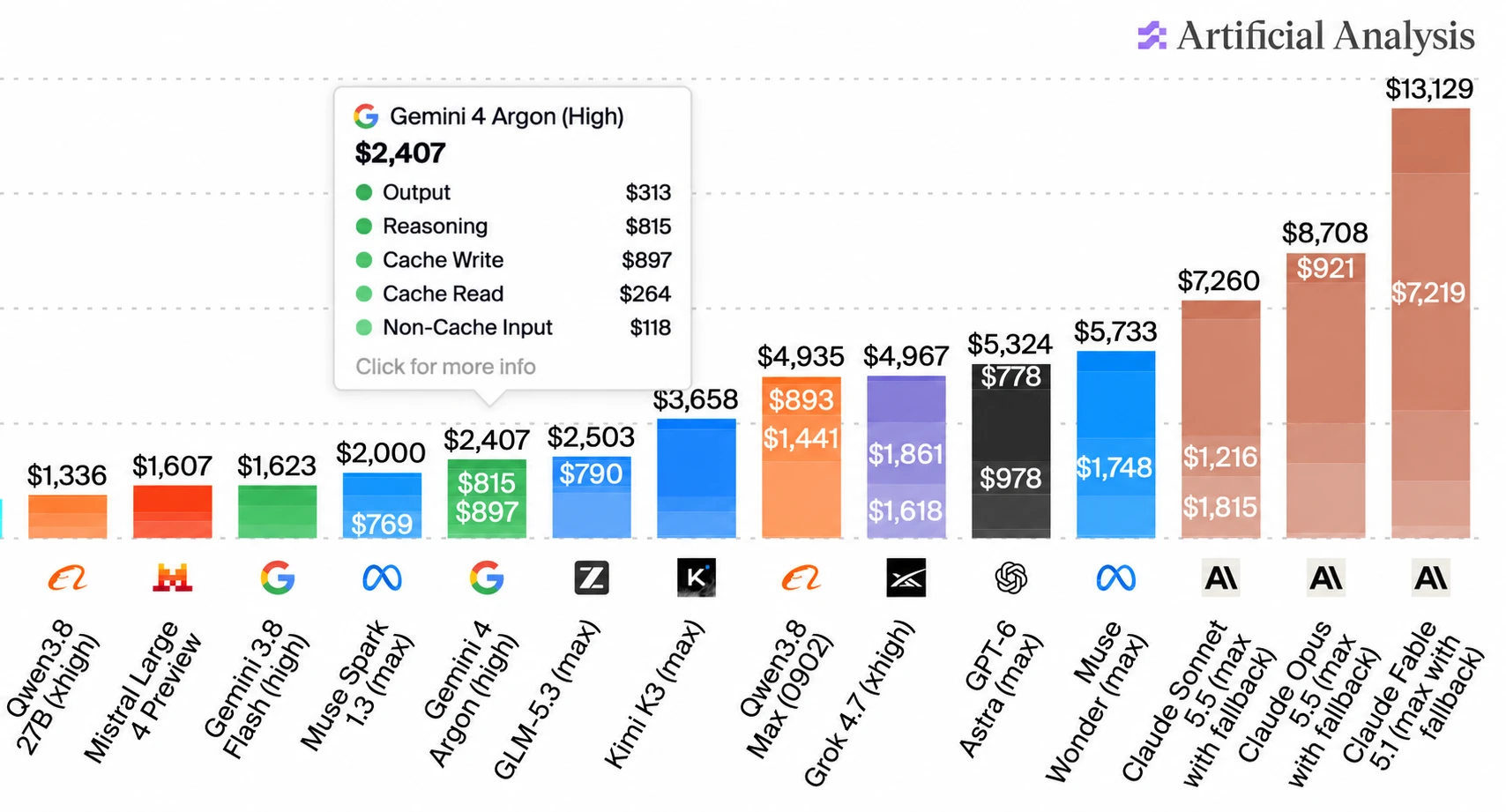
The developer behind the popular llm plugin adds Google's latest low-cost model, which promises strong performance at a fraction of rival prices — at least until December.