Samaya Sterling a tiny AI finance agent beats a bigger one at a fraction of the cost
A small post-trained model does financial research better than a large frontier model, for 11 times less money.
How it works
A program that plans financial research, calls tools to gather data, and writes reports automatically.
- Plan the research and pick which tools to call
- Call up to 37 finance tools to gather evidence
- Summarize findings and write a full research report
What you could do with it
- A finance researcher or investment analyst could conduct end-to-end financial research—planning studies, calling 37 finance tools, gathering evidence, and writing reports—using a small AI agent built by Samaya AI 2.
- A developer or company could deploy an affordable financial research agent for about 11 times less money than using Claude Fable 5.1, making research tools cheaper to run at scale 1.
- An investment team could improve screening and macro research performance, moving from 31.8 percent on the hardest questions to 45.2 percent after post-training 1.
An exampleInvented to explain it
Maya reviews stocks from her small apartment desk
MayaFind everything about NovaTech's latest revenue report
SterlingSearching 37 finance tools for evidence. I will call them now.
MayaHow long will this take and what will it cost?
SterlingPlanning the study, calling tools, gathering evidence, then writing a report. Much less than big competitors.
Sterling completed the full research workflow and delivered a report at a fraction of the usual cost.
A smaller model doing the job of a larger one
Samaya AI has released Sterling, a model designed to act as a financial research agent. It is based on Nemotron 3.5 Lightning, a model from NVIDIA that has 30 billion total parameters but only uses 3 billion at any one time — a design called a mixture of experts, where different parts of the model handle different tasks 12.
On Samaya's own FrontierFinance benchmark, which tests AI ability in real investment workflows, Sterling scores 58.9 percent accuracy 1. That beats Claude Fable 5.1's score of 55.9 percent . The main difference, though, is cost. Each research question costs 61 cents for Sterling, compared with $6.89 for Fable 5.1 — roughly 11 times cheaper 2.
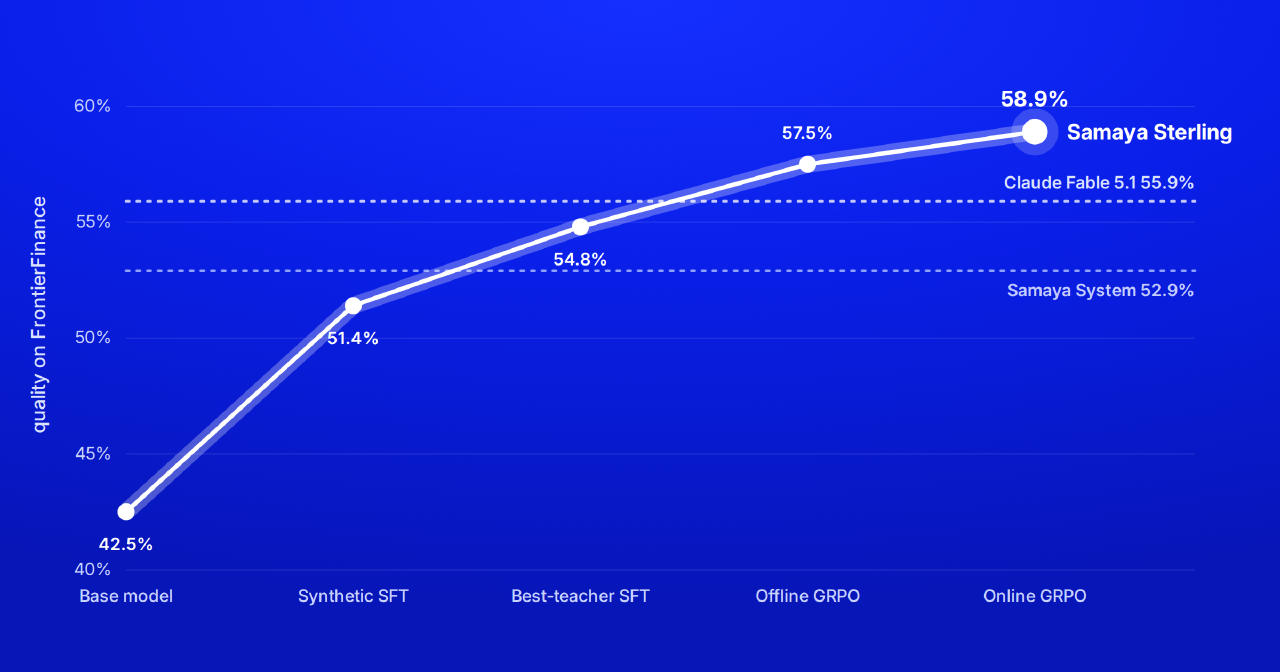
The model itself only costs about 4 cents per question; the rest covers the tools and helper models it uses 1. Samaya says every training stage added quality, moving from 42.5 percent accuracy on the base model to 58.9 percent after four stages of training . On the hardest third of questions, performance rose from 31.8 percent to 45.2 percent .
How Sterling works
A financial research agent is a program that plans research, calls tools to get data, gathers evidence, and then writes a report 2. Sterling does this by first being trained with supervised learning to call 37 different finance tools with correct inputs, then learning from improved strategies .
Samaya adapted its production finance tool system for a small model. They simplified the instructions, merged some tools to shorten prompts, and added two helper models to manage context — a condenser that shortens long tool results, and a compactor that summarizes the research trace as it grows 2. A research budget limits how long the agent works before handing findings to a separate report writer .
Training used LoRA, a method that adjusts only part of a model's parameters to save time and money, across four stages on Kimi K3 as the teacher model 12. The first stage used 968 synthetic questions. The second used 1,819 expert-written questions with eight different research strategies, keeping only the best answer per question . Two further stages used reinforcement learning, first offline scoring existing answers, then online where the model answered each question eight times and learned from graded attempts .
What is still unknown
Samaya says no benchmark question was used in training, and checkpoints were chosen on 100 internal validation questions 1. However, all results are self-reported by Samaya on their own benchmark . The model does not have public weights or an API announced yet; the base model runs on a single H100 GPU with 80 GB memory at 256K context, but Sterling's serving hardware and context are not disclosed . No figures are reported for other benchmarks beyond FrontierFinance.
The broader takeaway is that co-training a small model with its tool system can narrow the gap with larger models in specialized domains 2.
How good is it
On Samaya's own FrontierFinance benchmark, which tests AI ability in real investment workflows using 220 public queries scored against expert-written rubrics, Sterling scores 58.9 percent accuracy 1. That beats Claude Fable 5.1's score of 55.9 percent on the same test . Every training stage added quality, moving from 42.5 percent on the base model up to 58.9 percent after four stages . All results are self-reported by Samaya AI .
accuracy on real investment research workflows. Higher is better. Numbers: Samaya AI (self-reported). Chart drawn by Herald of AI.
Picture: samaya.ai
Picture: samaya.ai
Picture: samaya.ai
Key facts
- Sterling scores 58.9% on FrontierFinance, beating Claude Fable 5.1's 55.9%
- Cost per question drops 11x: $0.61 vs $6.89 for Fable 5.1
- Built on NVIDIA's Nemotron 3.5 Lightning with 30B total / 3B active parameters
- Trained in 4 stages using LoRA with Kimi K3 as teacher model
- No public weights or API announced; base model fits on single H100 80GB
Sources
Keep reading
 New modelsKimi K3.1 Pro, a Chinese AI model anyone will be able to download, nearly matches Claude Opus 5.5Herald of AI▶New models
Kimi K3.1 Pro, a Chinese AI model anyone will be able to download, nearly matches Claude Opus 5.5
Moonshot AI's 2.8-trillion-parameter model scores 55 on Artificial Analysis, three points behind Claude Opus 5.5, costs half as much, and its full weights — the files that let anyone run it themselves — arrive by November 4.


Related stories
 New modelsMirendil launches Fern 0.1, an AI model that can read 10 million tokens at onceHerald of AI
Mirendil launches Fern 0.1, an AI model that can read 10 million tokens at once
A new coding AI can hold a whole software project in memory at once — useful for developers, but still far behind top models at actual coding tasks.
 How it worksA new engine makes small AI models respond in under 50 millisecondsHerald of AI▶
A new engine makes small AI models respond in under 50 milliseconds
Liquid AI says its tool lets generative AI replace old models for fraud checks, payments and search — without slowing things down.
 New modelsRecursive Releases Flint, a 40B Open-Weight Local Coding Model for AgentsHerald of AI▶
Recursive Releases Flint, a 40B Open-Weight Local Coding Model for Agents
Flint is Recursive Superintelligence's first model: a fast local coding agent running on consumer hardware.
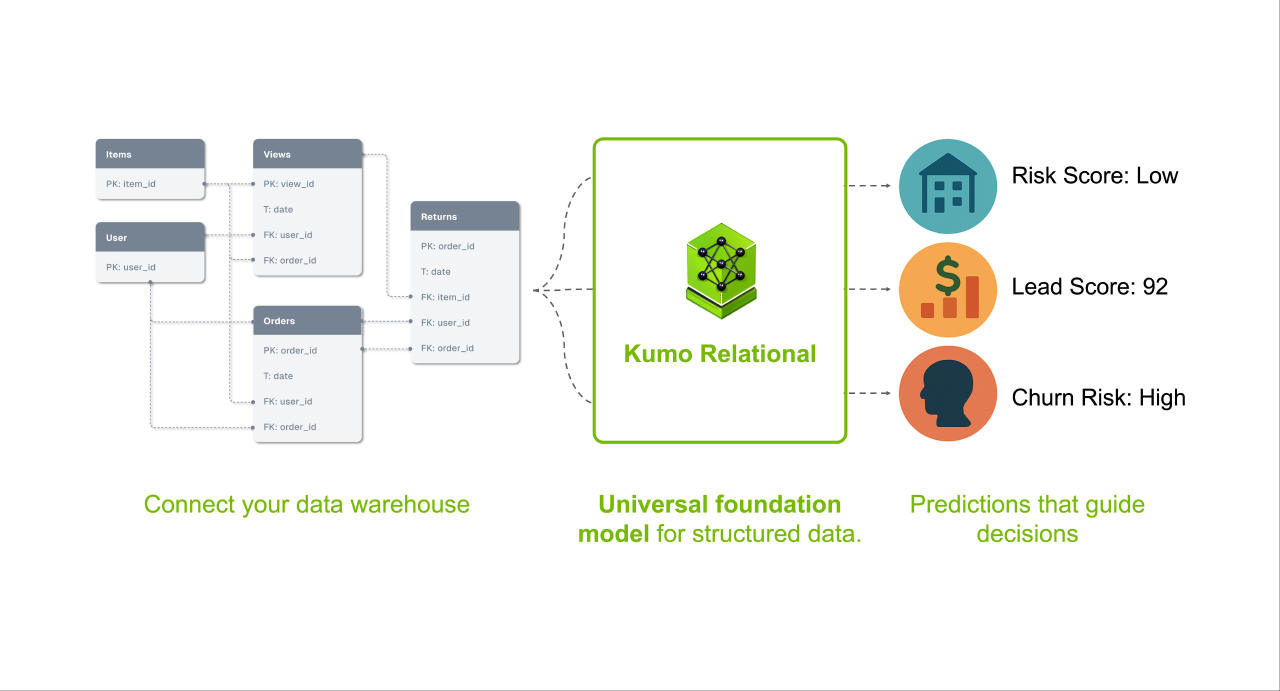 New modelsNVIDIA Kumo Relational beats supervised ML on relational data without trainingHerald of AI▶
NVIDIA Kumo Relational beats supervised ML on relational data without training
A new pre-trained foundation model predicts outcomes directly on enterprise databases, requiring no feature engineering or task-specific training.