A new engine makes small AI models respond in under 50 milliseconds
Liquid AI says its tool lets generative AI replace old models for fraud checks, payments and search — without slowing things down.

What you could do with it
- A payments company could swap its old fraud-check models for a generative AI model and still get answers in under 50 milliseconds, keeping the user flow smooth 1.
- An e-commerce site like Shopify could run real-time search improvements on live traffic with sub-20 ms inference, giving shoppers faster, smarter results 1.
- An adtech platform could rewrite user search queries on the fly inside a 50 ms latency budget, improving ad relevance without slowing down the page 1.
What RIPL actually does
Most AI serving tools like vLLM are built for long, batched jobs — think chatbots or agentic workflows where a few seconds is acceptable. RIPL is built for the opposite: search ranking, fraud checks, payment authorization — paths where every millisecond counts 1.
Liquid AI says its LFMs (Liquid Foundation Models) are hybrid architectures mixing convolution blocks with GQA (grouped-query attention) blocks. The LFM2.5-1.2B model has 16 layers; the LFM2.5-2.6B has 30 1. RIPL optimizes the full path from request arrival to completed response, not just inference speed .
How fast is it?
Liquid ran benchmarks on a single NVIDIA B200 GPU 1. Here are the numbers the company reports:
| Workload | LFM2.5 on RIPL | Qwen3.5 on vLLM | Gap |
|---|
- Processing 32 input tokens into 32 output tokens at roughly 1,000 requests per second: the 1.2B model takes 34.6 ms while the 0.8B model takes 498 ms, giving a 14.4x speedup.
- Processing 256 input tokens into 128 output tokens at about 400 requests per second: the 1.2B model takes 155.8 ms compared with 4,431 ms for the 0.8B model, a 28.4x speedup.
- Processing 32 input tokens into 32 output tokens at around 1,000 requests per second: the 2.6B model takes 76.4 ms versus 586.8 ms for the 2B model, a 7.7x speedup.
- Processing 256 input tokens into 128 output tokens at roughly 300 requests per second: the 2.6B model takes 449.1 ms compared with 2,499 ms for the 2B model, a 5.6x speedup.
Liquid also claims that using the same LFM2.5-350M model, RIPL outperforms vLLM — meaning the engine itself adds speed, not just the model architecture 1.
Real-world use cases
Liquid mapped several real-time workloads against latency budgets 1:
- Adtech query rewriting: 32 in, 32 out, 50 ms budget
- Search intent classification: 128 input tokens, 1 output token, 20 ms budget.
- Payments risk scoring: 512 input tokens, 16 output tokens, 50 ms budget.
- Credit decisioning: 8,000 input tokens, 64 output tokens, 150 ms budget.
- Image alt text (LFM2.5-VL-450M): 512×512 image, 100 ms budget.
Who is using it?
According to Liquid AI, Shopify is deploying LFMs in production. The company says search enhancement runs with sub-20 ms inference on live traffic, using about 50% fewer parameters than alternatives and delivering 2 to 10× faster inference 1.
Liquid AI stresses that RIPL is enterprise-only and all figures are self-reported 1. The LFM models use the LFM Open License v1.0, while the Qwen baselines use Apache 2.0 .
How good is it
Liquid AI reports p95 latency 5.6 to 28.4 times lower than Qwen3.5 running on vLLM, measured on a single NVIDIA B200 GPU 1. In the biggest gap, a 1.2B model on RIPL took 155.8 ms versus 4,431 ms for a smaller 0.8B model on vLLM, a 28.4x difference . Even when using the same LFM2.5-350M model, RIPL outperformed vLLM, meaning the engine itself adds speed beyond just the model design . Shopify is already running LFMs in production search with sub-20 ms inference on live traffic, according to Liquid AI .
Key facts
- RIPL returns answers in under 50 ms for short requests on a single NVIDIA B200
- Up to 28.4× lower p95 latency than Qwen3.5 on vLLM, per Liquid's benchmarks
- Shopify reportedly runs LFM search inference at sub-20 ms on production traffic
- RIPL is enterprise-only; all benchmark figures are self-reported by Liquid AI
- LFM2.5 models range from 230M to 2.6B parameters and use a hybrid conv+GQA design
Sources
- Liquid AI Launches RIPL, a Real-Time Inference Engine for Sub-50 ms LFMs — marktechpost.com
Related stories
 New modelsRecursive Releases Flint, a 40B Open-Weight Local Coding Model for AgentsHerald of AI
Recursive Releases Flint, a 40B Open-Weight Local Coding Model for Agents
Flint is Recursive Superintelligence's first model: a fast local coding agent running on consumer hardware.
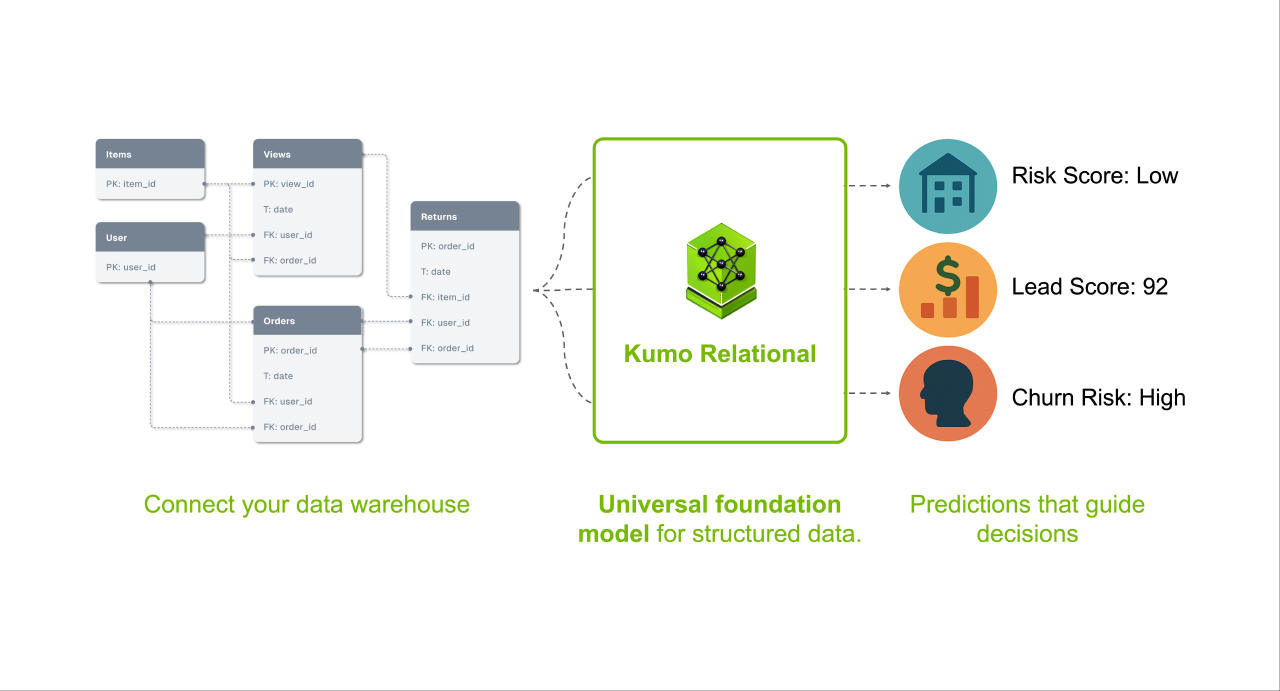 New modelsNVIDIA Kumo Relational beats supervised ML on relational data without trainingHerald of AI
NVIDIA Kumo Relational beats supervised ML on relational data without training
A new pre-trained foundation model predicts outcomes directly on enterprise databases, requiring no feature engineering or task-specific training.
 How it worksGoogle opens TorchTPU, a native PyTorch backend for cloud TPUsHerald of AIhttps://github.com/soumith, CC BY-SA 4.0, via Wikimedia Commons
Google opens TorchTPU, a native PyTorch backend for cloud TPUs
A new open-source stack lets developers run PyTorch models directly on Google's TPU chips, replacing the older PyTorch/XLA system.
 The weekThis Week in AI Agentic Tools, Cheaper Models, and Growing PainsHerald of AI
This Week in AI Agentic Tools, Cheaper Models, and Growing Pains
OpenAI reports agentic adoption in the EU, new models push one-million-token outputs, and developers wrestle with faster-but-opaque code.