NVIDIA Kumo Relational beats supervised ML on relational data without training
A new pre-trained foundation model predicts outcomes directly on enterprise databases, requiring no feature engineering or task-specific training.
A New Model for Database Predictions
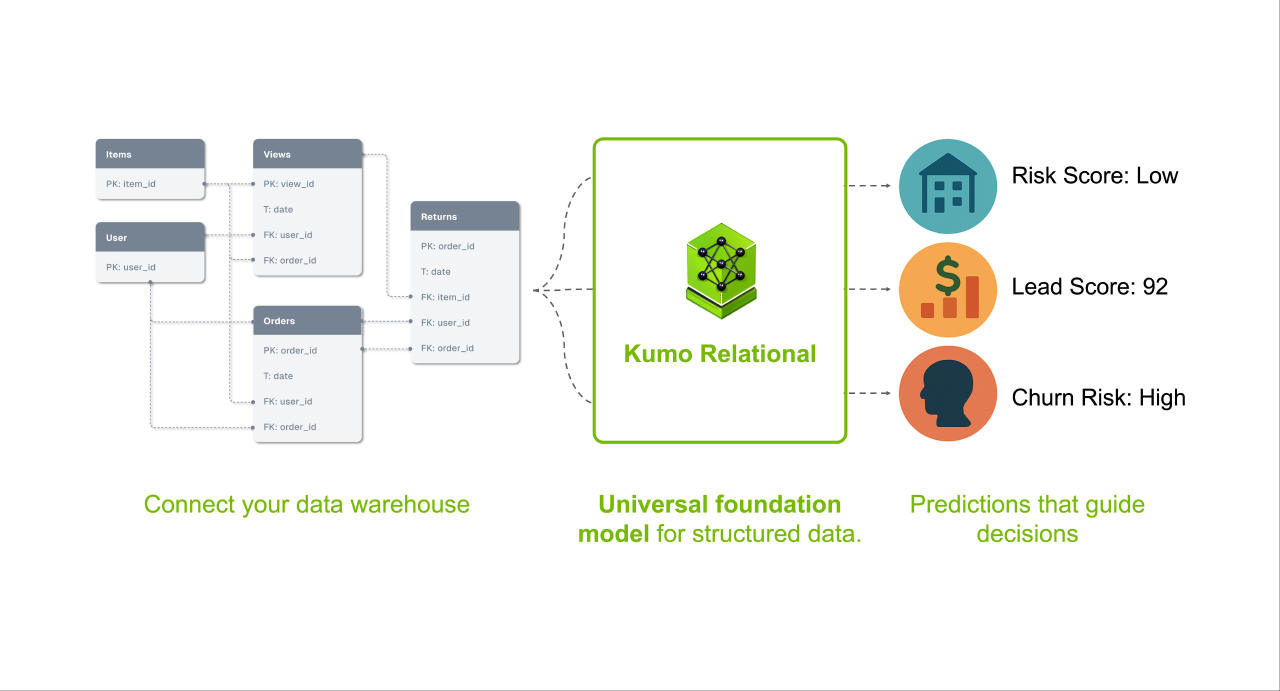
NVIDIA has released Kumo Relational, a pre-trained foundation model designed to work directly with relational databases. Instead of requiring weeks of feature engineering and model tuning for each new task, the model can generate predictions in a single step after a user describes what they want to forecast 1.
The system pulls up to 10,000 historical examples from a database as context for any given query, then outputs predictions for outcomes such as customer churn, product demand, or fraud in one forward pass 1. It is available as an open-source model through NVIDIA's GPU-native structured-data-models library and as an NVIDIA NIM endpoint .
How It Works
Most existing foundation models for structured data operate on single flat tables. Kumo Relational instead respects the actual structure of relational databases, working with tables, foreign keys, and timestamps without flattening them into a single wide row 1.
The model uses in-context learning, meaning it learns from the context examples it gathers at prediction time rather than relying on task-specific training 1. It applies graph attention mechanisms to reason within individual tables and across tables simultaneously, connecting records through the relationships already defined in the database schema .
For time-based prediction tasks, the system replays historical states of the database and samples entity-centric subgraphs around the records being analyzed 1. A built-in Predictive Query Language lets users express what to predict in natural terms rather than writing complex data transformation code .
Performance Benchmarks
On tests covering 41 tasks drawn from 15 databases, Kumo Relational beat both supervised relational deep learning models and expert-built gradient-boosted tree pipelines 1. On the RelBench V1 classification tasks, it beat gradient-boosted trees using hand-engineered features by nearly four AUROC points on average .
On the SAP SALT enterprise benchmark, Kumo Relational surpassed AutoGluon ensembles by eight percentage points in mean reciprocal rank out of the box, and by 13 points after fine-tuning 1. The model is designed to scale horizontally and handle databases containing over 500 billion rows .
Researchers at NVIDIA developed the model and published their findings on arXiv 1.
Key facts
- Kumo Relational is a pre-trained foundation model that predicts directly on relational databases with no task-specific training required
- It gathers up to 10,000 historical context examples at inference time and uses in-context learning
- It outperforms supervised deep learning and gradient-boosted tree pipelines across 41 tasks on 15 databases
- - On the SAP SALT benchmark it beats AutoGluon ensembles by 8% in mean reciprocal rank without fine-tuning
- It scales to databases with over 500 billion rows and is available as open-source software and via NVIDIA NIM
Sources
Related stories
 New modelsRecursive Releases Flint, a 40B Open-Weight Local Coding Model for AgentsHerald of AI
Recursive Releases Flint, a 40B Open-Weight Local Coding Model for Agents
Flint is Recursive Superintelligence's first model: a fast local coding agent running on consumer hardware.
 The weekThis Week in AI Agentic Tools, Cheaper Models, and Growing PainsHerald of AI
This Week in AI Agentic Tools, Cheaper Models, and Growing Pains
OpenAI reports agentic adoption in the EU, new models push one-million-token outputs, and developers wrestle with faster-but-opaque code.
 How it worksDeepSeek Open-Sources DeepInfer, Its High-Performance Inference EngineHerald of AI
DeepSeek Open-Sources DeepInfer, Its High-Performance Inference Engine
The Chinese AI lab released the framework behind its production services under an Apache 2.0 license, giving developers access to large-scale serving optimizations.
 New modelsvLLM Hyper-Optimizes Kimi K3 on NVIDIA GB300 for Blazing-FAST InferenceHerald of AI
vLLM Hyper-Optimizes Kimi K3 on NVIDIA GB300 for Blazing-FAST Inference
New optimizations push Kimi K3 decode to over 840 tokens per second at batch 1 on 16 NVIDIA GB300 GPUs with DSpark.