Physicists now use AI to build neural networks directly from the laws of physics
A new method lets Physics2Weight create neural networks that solve real-world physics problems without the slow trial-and-error training most AIs need today.
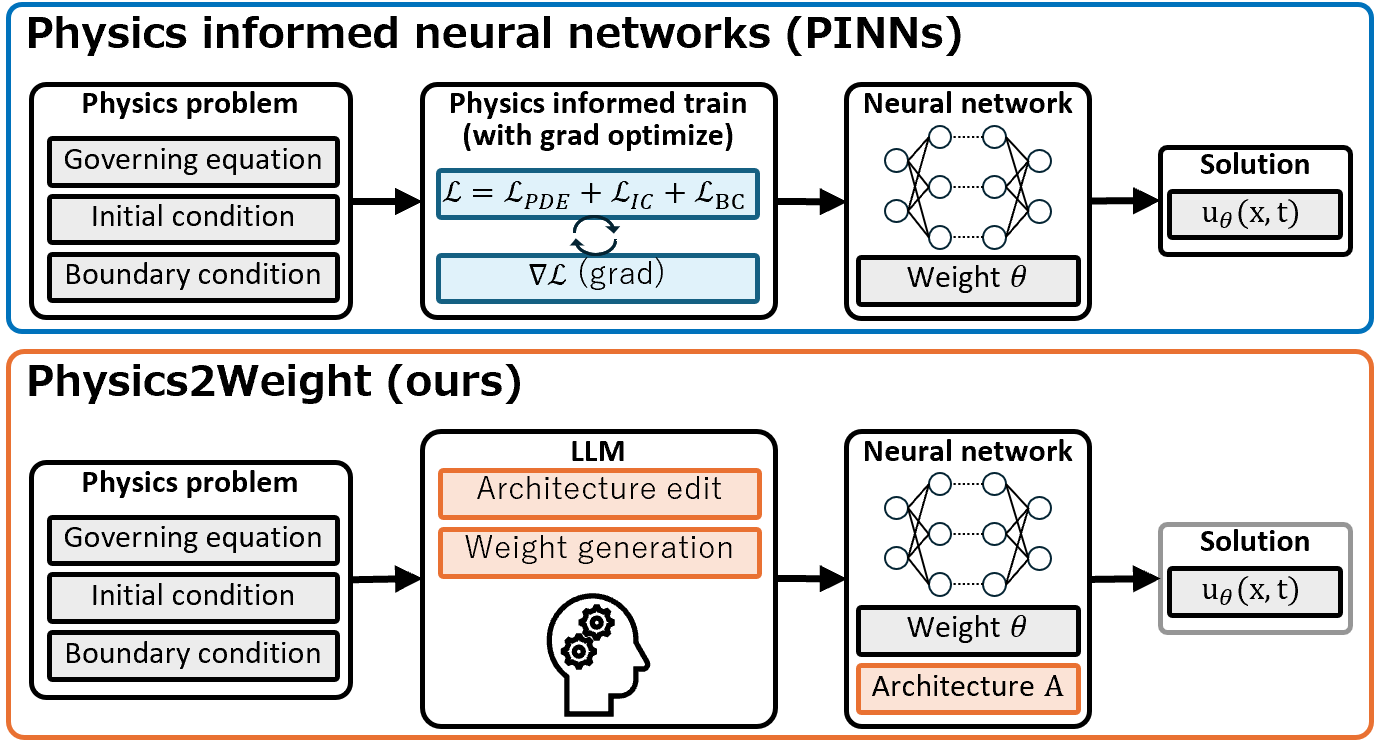
How it works
A method that uses AI to build neural networks directly from physics equations, skipping slow trial-and-error training.
- Feed physical equations into the AI system
- AI writes the network structure and sets weights
- Adjustments are made without slow training
- Check if the solution matches the physics
What you could do with it
- A researcher could quickly build neural network models for physics problems like heat flow or fluid motion by feeding physical equations into the system instead of spending days slowly training an AI 1.
- A scientist could produce neural networks with structures and weights set by large language models following physical constraints, then refine them through iterative adjustments without gradient-based optimization 1.
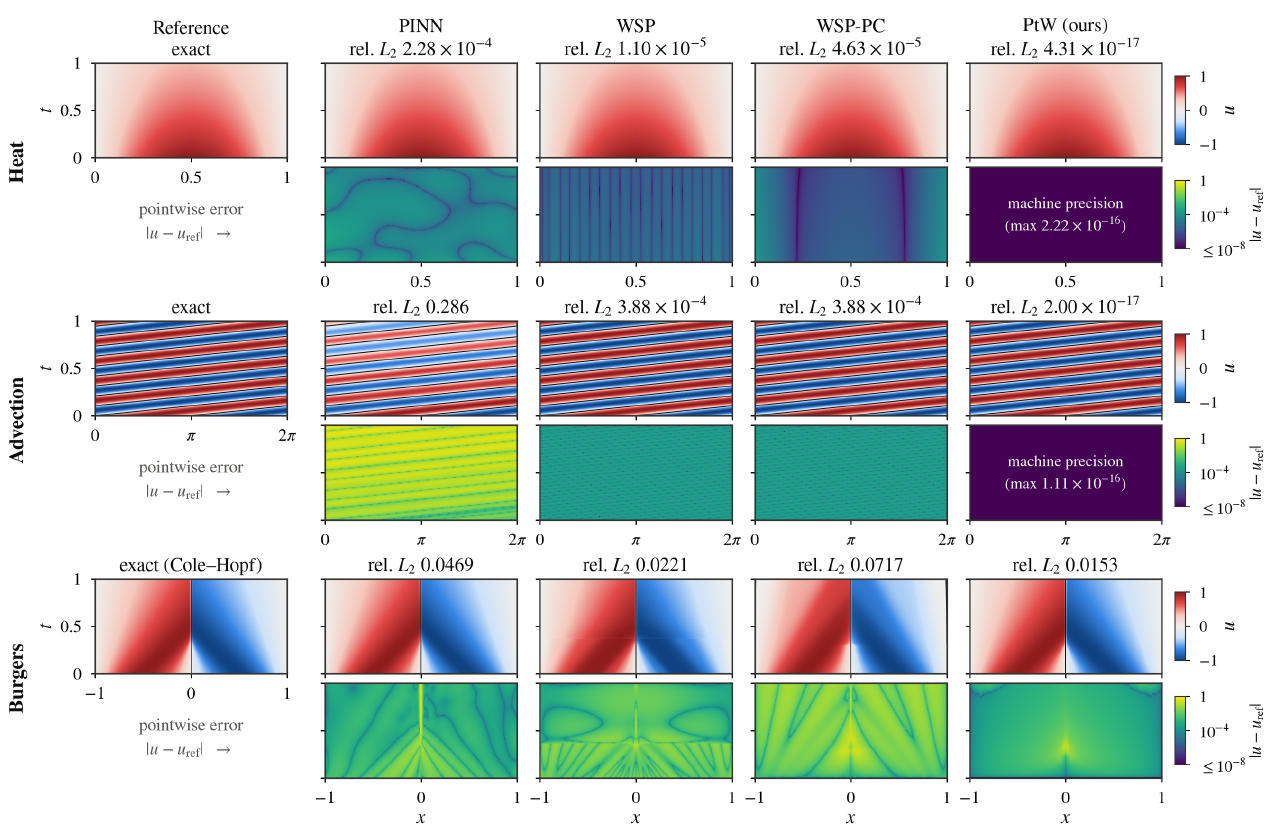
Figure: Sato et al., arXiv:2611.12954, CC BY 4.0
How physics meets AI
Traditional neural networks learn by slowly adjusting their weights through a process called gradient-based optimization, essentially trial and error over many iterations. This can take enormous computing power and time 1.
Physics2Weight, or PtW, takes a completely different approach. Rather than training a network from scratch, it asks a large language model to write the network's structure and set its weights directly based on physical laws 1. The researchers combine three main ideas: "physics-constrained prompting", where the AI is instructed to respect known equations; "physics-guided architecture editing", where the AI adjusts the network layout based on those same laws; and iterative weight refinement using existing weight-space programming methods .
Think of it like building a bridge. Instead of stacking bricks and hoping the bridge holds, you first consult the laws of physics and let an AI lay out the blueprint 1.
Tested on four classic problems
The team tested their framework on four well-known partial differential equations 1. These are fundamental formulas used across science and engineering: the heat equation (describing how temperature spreads), the advection equation (modeling how substances move with a flow), Burgers' equation (used in fluid dynamics), and the Allen–Cahn equation (describing changes in material structures) .
On all four problems, Physics2Weight produced more accurate solutions than conventional physics-informed neural networks, which are another approach that tries to bake physical laws into AI training 1. However, the method showed clear limitations when handling nonlinear partial differential equations, struggling to satisfy the governing equations in every case .
Who made it and where
The research was written by Shogo Sato, Tomoyasu Shimada, Kazuhiko Murasaki and Takashi Sano, and published on the preprint server arXiv on 7 November 2026 1 . The full paper is available at https://doi.org/10.48550/arXiv.2611.12954 .
Because the results come from a single preprint study before peer review, the findings are not yet independently confirmed. The approach currently appears aimed at researchers working in computational physics and scientific machine learning, but the authors suggest it could eventually reach broader audiences as the technology matures 1.
How good is it
The framework was tested on four classic partial differential equations—the heat equation, advection equation, Burgers' equation, and Allen-Cahn equation—and produced more accurate solutions than conventional physics-informed neural networks on all four 1. However, it struggled with nonlinear partial differential equations, failing to satisfy the governing equations in every case .
Key facts
- Physics2Weight generates neural network weights and architecture directly from physical equations using large language models
- It outperformed conventional physics-informed neural networks on four test equations: heat, advection, Burgers', and Allen–Cahn
- The method struggles with nonlinear partial differential equations, failing to satisfy governing equations in every case
- Four researchers published the work on arXiv on 7 November 2026
Sources
Keep reading
 How it worksLLM s make AI text harder to read because they optimize for info, not chatHerald of AIHow it works
LLM s make AI text harder to read because they optimize for info, not chat
A new study shows frontier GPT-6, Claude and similar models use complex grammar and rare words more than humans, making their output tougher to follow.