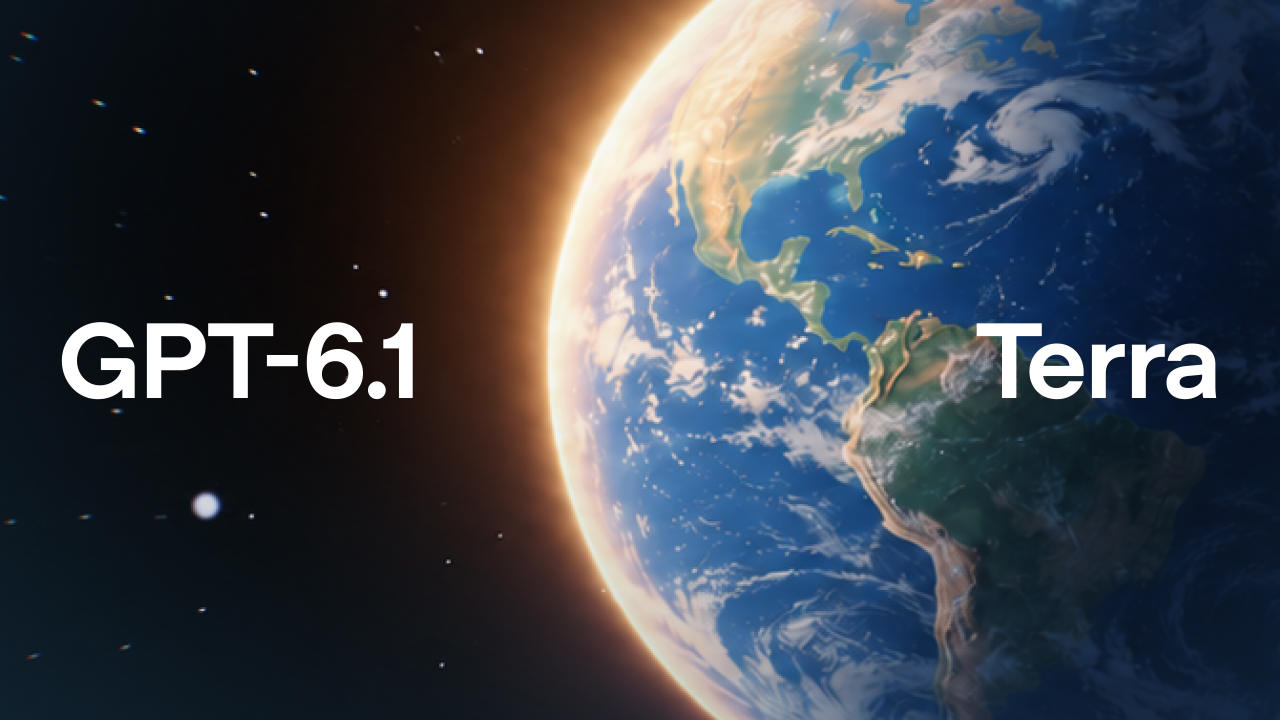
OpenAI releases GPT-6.1 Terra, a cheaper AI model that can use your computer
It costs half as much as the last version and can handle tasks like reading invoices, editing videos, and filling out forms — all cheaper than ever.
How it works
An AI that can see your screen, control your computer, and handle everyday work tasks for half the old price.
- You describe what you need done.
- It reads, clicks, types, and edits on your computer.
- The task finishes at about half the cost.
What you could do with it
- A business could automate reading incoming invoices and entering their details into accounting software, at half the cost of the previous model 1.
- A professional could draft proposals, interpret technical drawings, fill out forms, and edit videos on ChatGPT Work or Codex 1.
By writing code to handle tasks like monitoring cell division in time-lapse videos, a researcher can get scores just five points below Opus 5.5 while spending less than one‑fifth of what is estimated 1.
An exampleInvented to explain it
Maya, checking her freelance expenses at her desk
MayaCan you read these three invoices and put them into my spreadsheet?
TerraSure. I will open the PDFs, read each invoice, and fill in the table now.
MayaDo not change any dates or amounts, just copy them exactly.
TerraGot it. I am entering the data exactly as shown on the invoices.
MayaThanks. How much did this cost compared to the last one?
TerraAbout half the price of the previous model for the same work.
Maya got all three invoices entered correctly and saved half the money she used to spend.
What you can do with it now
GPT‑6.1 Terra is now ready for all users subscribed to Plus, Pro, Enterprise, or Edu plans in both ChatGPT Work and Codex. Developers may also reach the model via the OpenAI API, where it is listed as gpt‑6.1‑terra 1.
The model is designed around the kinds of tasks that fill a typical workday: drafting proposals, interpreting technical drawings, filling out forms, and editing videos 1. OpenAI says it delivers clearer and more natural writing than previous versions, alongside stronger visual reasoning and more precise computer use .
How much cheaper?
Pricing is the big change. The standard API costs $1 per million input tokens, $0.05 per million for cached input tokens, and $5 per million output tokens 1. That is 50% lower than both GPT-5.6 Terra and GPT-6.1 Sol .
For people who pay by the task rather than by the token, the savings are even steeper. At maximum reasoning effort, GPT-6.1 Terra is more than three times as token-efficient as Anthropic's Claude Opus 5.5, costs one-fourth per token, and comes out to roughly nine times cheaper per completed task 1. It completes work more than three times quicker than either GPT‑6 Astra or GPT‑6.1 Sol .
Even compared to OpenAI's most capable model, GPT-6 Astra, Terra performs on par at only one-tenth the price per token 1.
Benchmarks and improvements
OpenAI tested Terra on several benchmarks. On Agents' Last Exam — which includes tasks like turning architectural drawings into 3D models and reviewing films shot by shot — Terra scored 15 percentage points higher than GPT-5.6 Terra at medium reasoning effort, at about one-third the cost 1.
On MMMU-Pro, a visual reasoning test, Terra outperformed GPT-5.6 Terra at every reasoning setting and nearly matched GPT-6 Astra and GPT-6.1 Sol 1. On the OSWorld 2.1 test, which measures how effectively AI agents operate desktop applications, Terra beat the highest score previously set by GPT‑5.6 Terra while costing only a small fraction of the price .
Factuality also improved dramatically. Using OpenAI's own set of prompts meant to trigger errors, the failure rate under low reasoning effort dropped from 53.6% for GPT‑5.6 Terra to 16.7% for GPT‑6.1 Terra — nearly a 37 percentage point reduction 1. At maximum reasoning effort, the mistake rate decreased by 18 percentage points to 4.3%, coming close to the levels seen with GPT‑6 Astra and GPT‑6.1 Sol .
In coding, Terminal-Bench 4.0 tests how well AI agents solve problems from the command line. When operating at top reasoning effort, GPT‑6.1 Terra completed 50.3% of tasks, which is more than twice the 21.5% reported for GPT‑5.6 Terra 1. OpenAI notes that for the hardest programming jobs, GPT‑6.1 Sol and GPT‑6 Astra are still the preferred options .
On Terminal-Bench-Science 0.1, which tests AI agents using code for scientific research, Terra surpassed GPT-6.1 Sol at lower cost and came within five points of Claude Opus 5.5 at less than one-fifth the estimated cost 1.
percent of tasks solved or error rate on prompts designed to induce mistakes. Lower is better. Numbers: OpenAI. Chart drawn by Herald of AI.
Safety and alignment
OpenAI says GPT-6.1 Terra meets the Critical threshold in cybersecurity under its Preparedness Framework and keeps the protections developed for GPT-6 Astra 1. The model also shows stronger resistance to prompt-injection attacks — attempts to trick the AI into ignoring the user's instructions — and is more likely to stay within scope and honestly disclose its limitations .
Key facts
- GPT-6.1 Terra costs 50% less than GPT-5.6 Terra on the API
- At max effort, tasks cost roughly 9x less than with Claude Opus 5.5
- Error rate dropped from 53.6% to 16.7% at low reasoning effort
- Solves 50.3% of command-line coding tasks, double the previous model
- Available now for Plus, Pro, Enterprise, and Edu users in ChatGPT Work and Codex
Sources
Keep reading
 New modelsSullivan & Cromwell partners with OpenAI on AI agreement-review toolHerald of AINew models
Sullivan & Cromwell partners with OpenAI on AI agreement-review tool
A law firm built an AI system with OpenAI that reviews contracts using its own precedents and playbooks.

Related stories
 How it worksUber, DoorDash, and Airbnb say barely anyone uses AI agents yetHerald of AI
Uber, DoorDash, and Airbnb say barely anyone uses AI agents yet
Popular apps say personal AI helpers have placed only hundreds of orders among millions, showing the AI assistant hype still has a long way to go before reaching ordinary users.
Google launches Gemini Decision 1 — an AI that scores answers without writing them out
It lets apps and developers get fast yes-or-no answers across text, images, audio, video and PDFs, priced like a utility bill instead of per word.
 How it worksMicrosoft patent would pay you to use your computer's spare power for AI trainingHerald of AI
Microsoft patent would pay you to use your computer's spare power for AI training
It could mean getting paid or getting free software credits if you let Microsoft borrow your idle graphics card to train its AI models.
 How it worksOpenAI lets businesses get verified profiles and AI chat agents in ChatGPTHerald of AI
OpenAI lets businesses get verified profiles and AI chat agents in ChatGPT
Companies can now have their own AI assistant on ChatGPT that answers customer questions using real product details.