This Week in AI Agentic Tools, Cheaper Models, and Growing Pains
OpenAI reports agentic adoption in the EU, new models push one-million-token outputs, and developers wrestle with faster-but-opaque code.

Models with bigger outputs and lower prices
This week set a new bar for context length. Google DeepMind launched Gemini 4 Argon, which can generate up to one million tokens in a single response — far beyond the 64,000-token limit of earlier Gemini versions. It helped refactor six million lines of Chrome code in weeks instead of months. DeepSeek followed with DeepSeek V4.1 Flash 1017 (Max), an open-weight reasoning model with a one-million-token context that ran at about 209 output tokens per second. MiniMax also released MiniMax M3.1 Flash, featuring a one-million-token window at just $0.15 per million input tokens and $0.60 per million output, half the price of its predecessor.
On the open-source side, NVIDIA unveiled the 120-billion-parameter Nemotron 3.5 Super VL, a vision-language model that reads text, images, documents and video, and runs on a single GPU. Mistral introduced Timestral, a family of time-series forecasting models, with its largest variant having only 209 million parameters but ranking first on all three major benchmarks. Black Forest Labs made its FLUX.3 Image Klein model available through Hugging Face's Diffusers library, while The Forecasting Company released T0, a 256-million-parameter open-weights forecasting model producing probabilistic outputs.
Agentic AI moves from chat to action
OpenAI published data showing EU businesses shifting from simple Q&A toward agentic tools that plan and execute multi-step tasks. Among ChatGPT Enterprise customers in the bloc, agentic features — specifically Codex and ChatGPT Work — now generate more than half of all output tokens. Since May 2026, weekly active small and medium-sized businesses using these tools have grown more than eightfold across every EU member state, though adoption remains uneven.
Stack Overflow for Agents reported tripling its signups after releasing a ChatGPT plugin that lets users discover the tool directly inside the app. Meanwhile, Google Cloud AI Research open-sourced Harness², a framework that improves AI agents by adjusting prompts, memory, tools and guardrails without retraining the underlying model. A team behind Claude Code described treating code review as a continuous process, with Claude catching routine mistakes before humans ever see the code.
Speed comes with growing pains
The week also surfaced questions about what faster AI development costs. Jeremy Scheff, an independent game developer known for Basketball GM, published an essay calling it an obituary for programming, saying agents let him fix bugs and reorganize code faster than ever — but left him wondering whether his own work still mattered. A Meta engineer echoed similar unease on LinkedIn, writing that AI-generated code feels like a "black box" where developers understand the high level but not every detail. On the tooling side, a developer gave Claude Code access to their website and an ad budget, and watched what the autonomous agent built on its own.
Researchers also pushed efficiency forward: PRIME combined pruning and merging of mixture-of-experts models to shrink them without losing accuracy, Echo cut training communication costs by sending just four bits instead of sixteen, and TurboMamba hybridized Mamba and Transformer architectures for faster inference.
This story reports on a trend for information only. It is not advice or encouragement to do any of it.
The week in short
- One million tokens: Gemini 4 Argon, DeepSeek V4.1 Flash 1017 (Max), and MiniMax M3.1 Flash all reached this output or context milestone this week
- Half the price: MiniMax M3.1 Flash costs half its predecessor; Gemini 4 Argon is half the price of Claude Opus 5.5 at launch
- Eightfold growth: weekly active EU small businesses using agentic ChatGPT tools grew more than eight times since May 2026
- 209 million parameters: Mistral's Timestral tops all major forecasting benchmarks at this size
- First in three: Timestral ranked number one on GIFT-Eval, TIME, and fev-bench
Every story this week
- EU's AI adoption shifts to agentic tools, report finds
- PRIME A new way to shrink AI models without losing smarts
- Engineer Your Game As an AI Harness
- Google says Gemini 4 Argon helped Chrome engineers do months of work in weeks
- AI model breaks the two-week weather forecast barrier
- New Plugin Lets You Use Meta’s Muse Wonder AI Models
- How Echo lets big AI models train faster using ultra-low 4-bit data
- Simon Willison Updates llm-gemini to Support New Gemini 4 Argon Model
- T0 A 256M open-weights model redefines time-series forecasting
- Simon Willison releases web-edit for browser-based file editing
- New attention method speeds up AI models with mathematical shortcuts
- Simon Willison Codes a Game With One Prompt to Claude
- ClawLoop AI agents that teach themselves to get better
- FLUX.3 Image Klein Arrives in Hugging Face Diffusers
- Simon Willison builds two-player pong game that communicates via audio chirps
- Graphicle brings fast code graphs and memory to coding agents
- OpenAI Brings GPT-Rosalind to Academic Research Labs Through New Free Plan
- TurboMamba combines Mamba and Transformer for faster, smarter language models
- Pulse Local runs AI budgeting entirely on your Mac
- New AI plugin lets Claude design PCB boards inside KiCad 10
- NVIDIA Releases Open 120B Nemotron 3.5 Super VL Model
- Liquid AI Unveils d1-ultra Decision Model Ranking 1 on AI Benchmark
- A developer gave Claude Code a website and an ad budget. Here is what it did.
- How the Claude Code team reinvented code review with AI
- Google Open-Sources Harness² , a Framework That Improves AI Agents Without Retraining Models
- DeepSeek launches Search and Fetch APIs for $0.75 per 1000 requests
- AI Is Decompiling Games Faster Than Ever. Here's Why That Matters.
- How GPT-6 Astra Helped Turn an Old Kindle Into a Photo Frame
- Google Unveils Gemini 4 Argon with 1 Million Token Output
- MIT builds AI that can see crystal structures in 3D
- Your boss is automating their messages into the void
- Stack Overflow for Agents triples signups after launching ChatGPT plugin
- New AI agents switch between latent reasoning and text, cutting costs in tests
- DeepSeek releases V4.1 Flash 1017 Max with 1M token context and reasoning ability
- Mistral releases Timestral, a new family of time-series forecasting models
- MiniMax launches M3.1 Flash a cheap agentic AI model with a 1 million token context
- doubleAI introduces Maxwell, a model that runs inside code to speed it up
- NVIDIA Opens Source Run ai for Kubernetes GPU Management
- TorchNeuron makes Hugging Face models run natively on AWS Trainium chips
- Engineers wrestle with AI code they can no longer fully understand
- A game developer writes an obituary for programming, the puzzle AI agents now solve
- How Language Models Slowly Forget the Start of Their Prompts
- Image Models Trained Without Language Pretraining Matched Rivals in a Controlled Test
- Modder Brings VHS to Life by Running Doom and Super Mario Bros on Tape
Related stories
 New modelsRecursive Releases Flint, a 40B Open-Weight Local Coding Model for AgentsHerald of AI
Recursive Releases Flint, a 40B Open-Weight Local Coding Model for Agents
Flint is Recursive Superintelligence's first model: a fast local coding agent running on consumer hardware.
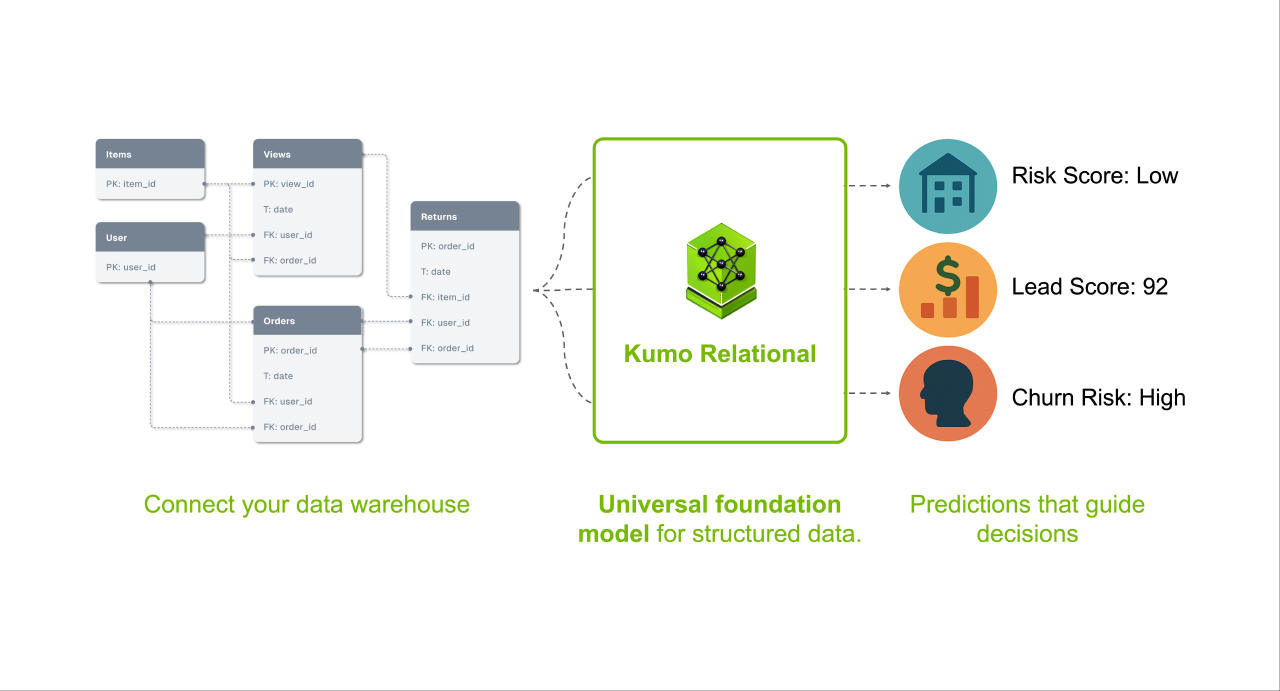 New modelsNVIDIA Kumo Relational beats supervised ML on relational data without trainingHerald of AI
NVIDIA Kumo Relational beats supervised ML on relational data without training
A new pre-trained foundation model predicts outcomes directly on enterprise databases, requiring no feature engineering or task-specific training.
 How it worksGoogle opens TorchTPU, a native PyTorch backend for cloud TPUsHerald of AIhttps://github.com/soumith, CC BY-SA 4.0, via Wikimedia Commons
Google opens TorchTPU, a native PyTorch backend for cloud TPUs
A new open-source stack lets developers run PyTorch models directly on Google's TPU chips, replacing the older PyTorch/XLA system.
Agentic RL Has a Scaling Law — And It Changes How You Should Spend Your Budget
A new study finds that in agentic reinforcement learning, diversifying the worlds your agent trains in beats grinding out more trajectories — and the right mix can yield up to 1.7× compute efficiency.