MIT's AI copilot lets engineers guide structural designs in real time
A new tool shows building-designers the draft AI is making and asks their input — producing stronger, buildable structures in just 15 extra seconds.
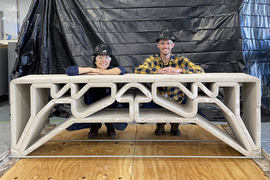
A computer program that lets engineers guide AI-generated building and bridge designs while they're being created
- AI drafts a structure design
- System pauses to ask for your input
- You thicken or thin certain areas
- Design finishes stronger and buildable
What you could do with it
- A practicing structural engineer could review an AI-generated building or bridge design as it develops and guide changes to make it easier to build and trust 1.
- An engineering team could use the copilot to adjust identified regions of a complex structure by making them thicker or thinner before the final design locks in 1.
- Researchers and students in academia could apply the collaborative approach to topology optimization tasks that previously required high computational resources and deep expertise 1.
Picture: news.mit.edu
Making computers design with human help
Engineers have long used algorithms to come up with new parts for ultralight aircraft, high-bandwidth antennas and F1 racing cars 1. But top algorithmic design methods usually need a lot of computing power and time . Until recently, designers had to wait until the entire computer design was finished before seeing anything — and if they did not like it, they had to start over completely . Even worse, those final designs were sometimes difficult to actually build or hard to trust as structurally safe .
That has made it difficult for people who design buildings and bridges to rely on purely automatic tools 1. "Engineers are always very skeptical of computer programs, especially if they give you very weird-looking or unexpected designs," said Dat Ha PhD '26, lead author of the new study and now a structural designer at LeMessurier .
Human input beats pure automation — for almost no delay
MIT test results; buckling load = force before sudden collapse
Asking humans for feedback as the design grows
The MIT team decided to make topology optimization — the technique that generates these advanced shapes — work more like a collaborative process 1. Instead of waiting until the end, the system pauses during the design and highlights areas where a human would likely want to make changes . A machine-learning model, trained on thousands of synthetic examples of where humans normally alter computer-generated designs, predicts those spots quickly .
The goal is to draw on designers' thinking and have them bring their domain-specific knowledge into the work as the design progresses,
In tests, this human-in-the-loop approach improved how easy the designs were to manufacture and increased linear buckling load by 39 percent, while adding only about 15 seconds to the total design time compared with fully automated runs 1.
What the tool can do today
At present, the system allows users only to make identified regions of a structure thicker or thinner 1. The researchers hope future versions will offer additional ways for humans to change the design . They believe the approach could make advanced algorithmic design accessible to a much wider range of practicing engineers .
Markus Buehler holds the title of MIT Jerry McAfee (1940) Professor of Engineering, while Faez Ahmed is an associate professor of mechanical engineering at MIT. Ferdous Alam, who previously worked as an MIT postdoc, is now an assistant professor at Georgia Tech. The findings appeared in an open-access paper in Communications Engineering 1.
How good is it
In tests run by the MIT researchers, the human-in-the-loop system increased linear buckling load — the force a structure can take before suddenly collapsing — by 39 percent compared with fully automated runs 1. It also made the resulting designs easier to manufacture . The improvement came for only about 15 extra seconds added to the total design time versus an all-algorithmic approach .
Key facts
- The MIT AI copilot asks human engineers for feedback while a structural design is still being generated.
- The approach improved manufacturability and linear buckling load by 39 percent.
- It added only about 15 seconds to total design time compared with fully automatic methods.
- Currently users can only make parts of the structure thicker or thinner; more options are planned.
Sources
If this story concerns you or your company, or uses something that belongs to you, ask for a correction or for it to be taken down. How requests work
Keep reading
 Apps and productsYogurt lets you record and summarize meetings with AI that runs entirely on your own computerHerald of AI
Yogurt lets you record and summarize meetings with AI that runs entirely on your own computer
A free open-source app turns your calls into transcripts and summaries without sending any data to the cloud.
 How it worksNew method makes AI text detectors 93% accurate, catching disguised AI writingHerald of AI
New method makes AI text detectors 93% accurate, catching disguised AI writing
A training trick lets detection tools adapt in real time so they stay accurate as AI and human writing styles keep changing.
 How it worksMIT researcher wants AI to explain itself instead of hiding how it worksHerald of AI
MIT researcher wants AI to explain itself instead of hiding how it works
Jacob Andreas is training AI to talk about what it learned — giving everyday users a way to understand how these systems make decisions, not just relying on complex debugging tools.