Google Research uses wearable data to predict heart, kidney and metabolic risk with personalized coaching
A new system turns your smartwatch data into a health age you can improve and simulates how changing habits could affect your body over three months.
How it works
A system that uses smartwatch data to calculate a 'coachable health age' and simulates how habit changes could affect it.
- Track daily activity and rest.
- Calculate a coachable health age from those metrics.
- Simulate effects over 12 weeks.
- Get plain-language coaching advice.
Heart disease, kidney trouble and metabolic disorders such as type 2 diabetes do not usually appear alone; researchers increasingly group them together as cardiovascular-kidney-metabolic, or CKM, syndrome because they feed into each other 1. The damage often starts years before anyone feels sick, shaped slowly by movement, sleep and everyday activity . Smartwatches already record those habits, but turning the numbers into advice has been much harder than counting steps .
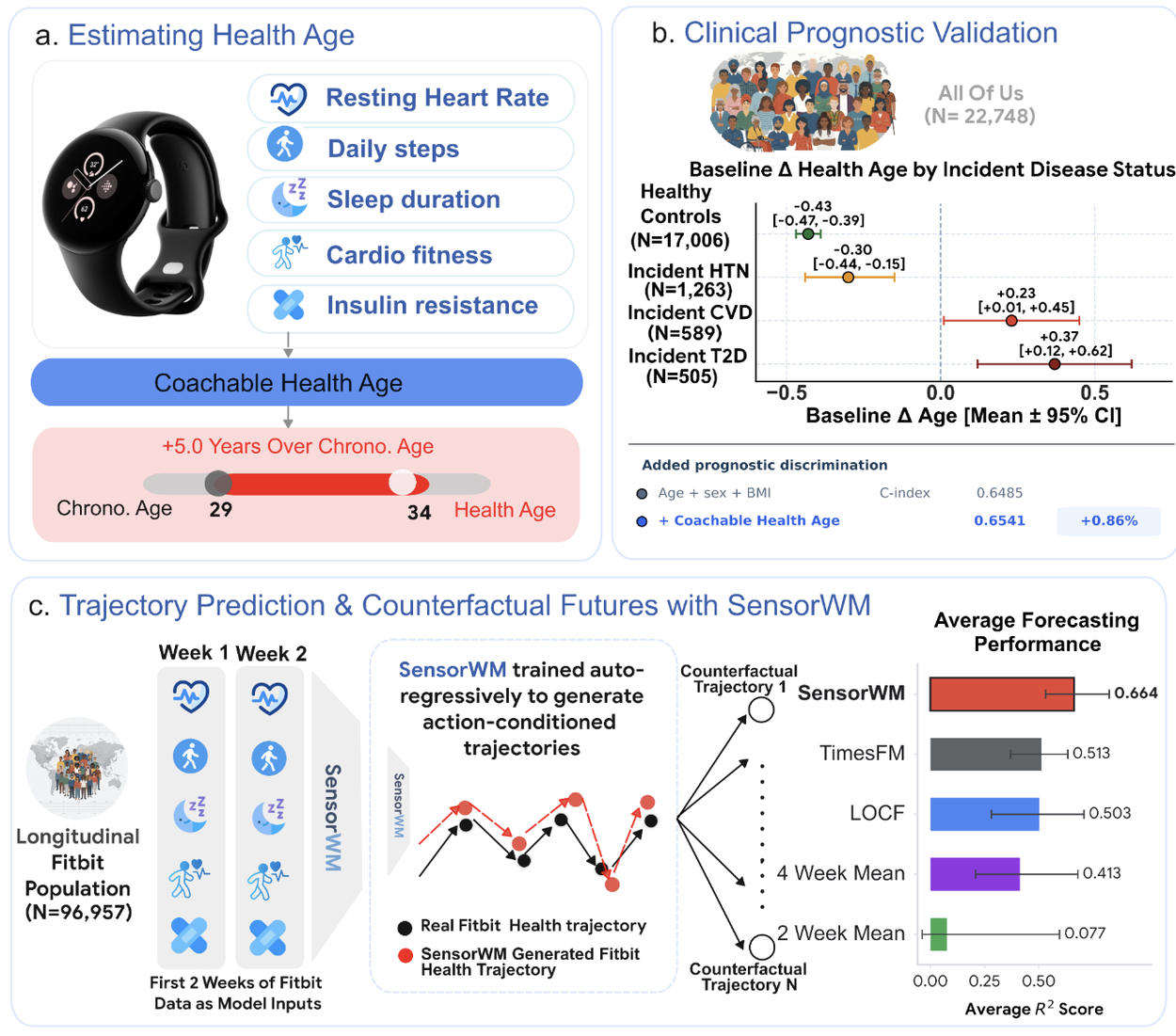
In two papers posted online, Google Research scientists described an investigational framework that closes that gap 12. It produces a coachable health age built only from signals people can change, then runs simulated "what-if" futures so users can see how different choices might play out over three months . When blood tests are available, it also layers in lab markers to check the heart, kidneys and metabolism at once .
Picture: research.google
A health age made from things you can move
Instead of training a model to guess someone's birth year, the system ties its metric to behaviors linked in epidemiological studies to cardio-metabolic risk 1. It feeds four core wearable readings, all recorded passively by consumer devices, into the calculation . - Heart rate while at rest, how many steps you take each day, how long you sleep, and weekly Active Zone Minutes — a measure of vigorous exercise done within a target heart-rate zone. Optional inputs include VO2max, sleep-schedule regularity and insulin resistance when the data exist . Because these measures overlap, the math separates each signal so no single habit double-counts its share of the result .
The outcome is a delta between coachable health age and calendar age 1. A negative number means the physiology looks younger than the birthday on the ID; a positive number signals accelerated aging . In the All of Us research program, tracking more than 68,000 person-years, participants whose health age was higher than their actual age at the start were far more likely to be diagnosed with hypertension, cardiovascular disease or type 2 diabetes within eight years. Adding the metric to standard clinical factors improved prediction, particularly for adults under 50 . Among 1,464 Fitbit users tracked over two years, sustained habit changes drove the health age down in subsequent quarters . The score also aligned better than earlier wearable clocks with established clinical indices such as the modified American Heart Association Life's Essential 8 and metabolic syndrome severity scores 2.
Guess
How many person-weeks of wearable data trained the sensor world model?
The model was trained on more than 2.2 million person-weeks of wearable data.
An exampleInvented to explain it
Maya, a 45-year-old office worker checking her watch.
MayaWhat's my coachable health age?
SystemYour health age is 52; six years above your actual age.
MayaCan you show me how to lower it?
SystemSimulating adding 30 minutes of brisk walking daily for 12 weeks.
MayaWhat result do you expect?
SystemHealth age could drop to around 49 if consistent.
Maya starts walking daily and sees her health age improve after three months.
Simulating personalized futures
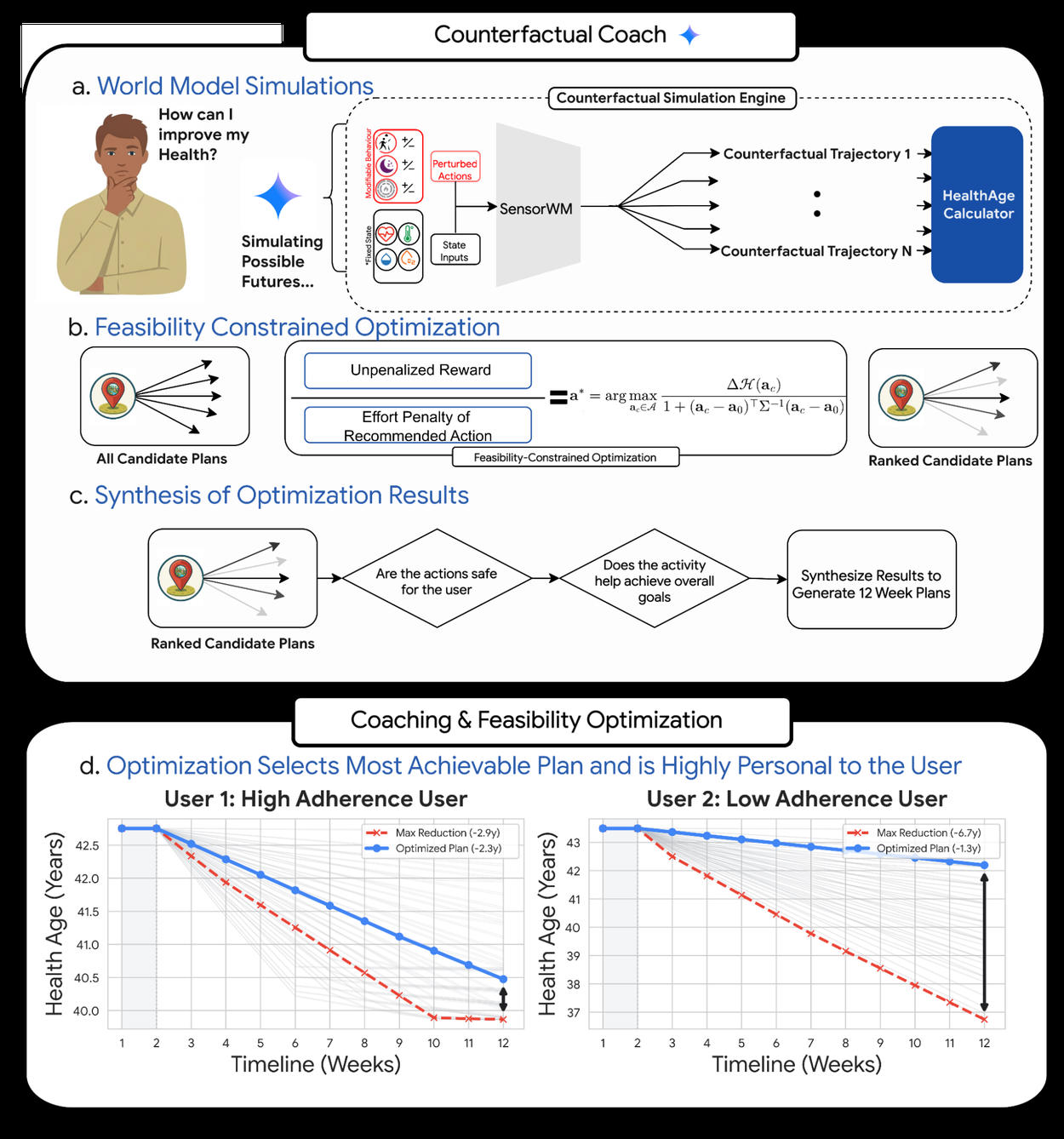
To turn the number into a plan, the team trained a sensor world model called SensorWM on more than 2.2 million person-weeks of wearable data 1. Rather than predicting any single outcome, it learns how daily habits connect over time and can replay plausible alternative paths . Given a person's current readings, the model generates individualized 12-week trajectories for scenarios like adding a brisk walk or going to bed half an hour earlier . A companion language-model agent then translates those simulations into structured coaching suggestions vetted by clinicians .
Blood tests add organ detail
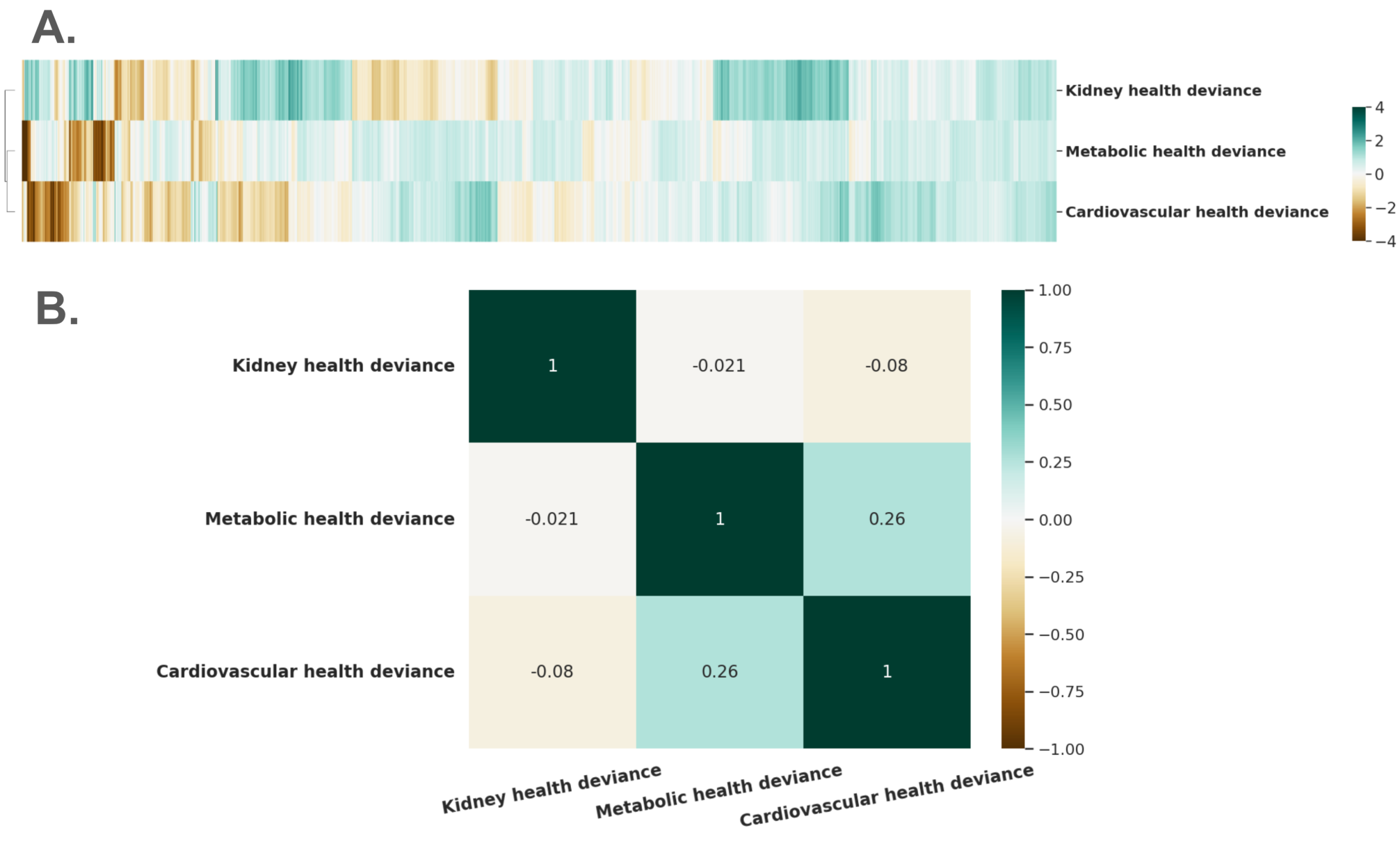
In a companion study using a US cohort of 819 participants, the researchers showed how combining wearables with routine laboratory values could pinpoint which organs show early strain 2. They evaluated cardiovascular risk, kidney function through estimated glomerular filtration rate and cholesterol-to-HDL ratio, and metabolic health via an insulin-resistance index . Metabolic and cardiovascular disruptions correlated with each other, but kidney impairment sometimes appeared on its own . Nearly a third of participants carried significant multi-system deviation, with cardiovascular profiles the most common single pattern and dual organ involvement relatively rare . Step count, Active Zone Minutes and resting heart rate emerged as the strongest wearable predictors of decline .
Both systems remain investigational and are designed to complement, not replace, clinical evaluation 12.
Picture: research.google
Picture: research.google

Picture: research.google
What comes next
Google has not announced a commercial product, and the framework still needs testing in broader populations before it could reach consumers 12. If developed further, however, it would represent one of the first attempts to move wearable tracking beyond dashboards into actual behavior change, giving people a clearer sense of whether today's habits are bending tomorrow's health .
Corrections and updates
- Corrected on 11 November 2026. An earlier version claimed a mobile app interface with health tracking panels existed; no such screenshot was described or referenced in the sources.
Key facts
- Google Research trained a sensor world model on more than 2.2 million person-weeks of wearable data
- In the All of Us cohort of nearly 23,000 participants, higher coachable health age predicted more hypertension, cardiovascular disease and type 2 diabetes over eight years
- About 29 percent of the companion cohort showed significant multi-system CKM deviation
- Step count, Active Zone Minutes and resting heart rate were found to be the most powerful indicators from wearables for predicting how cardiovascular and metabolic health may worsen.
- The framework remains investigational and is not yet a consumer product
Sources
Keep reading
 How it worksGoogle Open-Sources Harness², a Framework That Improves AI Agents Without Retraining ModelsHerald of AIHow it works
Google Open-Sources Harness², a Framework That Improves AI Agents Without Retraining Models
A new open-source tool from Google Research lets agents get better at tasks by tweaking their setup instead of their core model.
 How it worksAI reasoning explained thinking longer means finding a better path, not just taking more stepsHerald of AI
 How it worksiOS 27.3 adds smarter Siri actions, redesigned Health app and Fitness+ workoutsHerald of AI▶
 New modelsGoogle launches Polar Peaks quest to teach kids how AI maps the human brainHerald of AI
Related stories
 PeopleEmTech Future 2026 Explores How AI Meets EverythingHerald of AI
EmTech Future 2026 Explores How AI Meets Everything
Speakers at MIT's latest tech conference explore how AI is reshaping science, industry, and daily life through convergence with other fields.