Engram researchers found a way to predict how big a LoRA adapter needs to be for any dataset
A practical guide so anyone who fine-tunes models spends less time guessing hyperparameters and more time training.
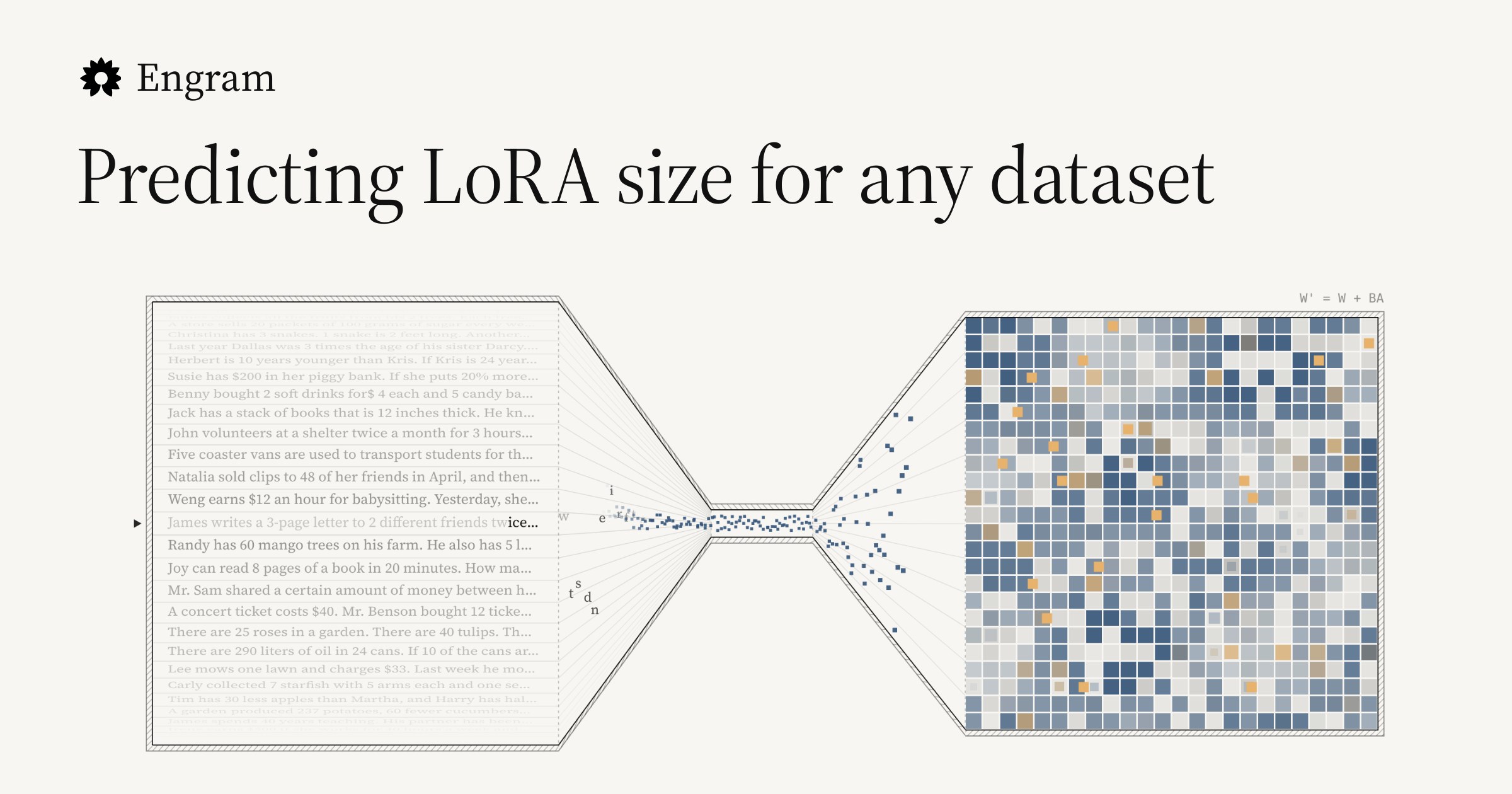
A method that calculates how large a lightweight model-adaptation adapter should be before you train it.
- Calculate how many bits your dataset adds
- Plug the number into the prediction formula
- Train the LoRA adapter at the predicted rank
- Deploy without wasting compute on guesswork
What you could do with it
- A researcher could predict how large a LoRA adapter needs to be before training starts, saving compute and avoiding guesswork about rank selection 2.
- A practitioner fine-tuning models could estimate adapter rank by running a few quick calculations on their target data instead of training dozens of small models to discover by mistake whether rank four is sufficient or rank sixty-four is actually required 2.
- An ML engineer could customize large language models at scale while freezing original weights and injecting only lightweight trainable matrices, cutting trainable parameters by roughly ten thousand times and GPU memory needs by three times compared to full fine-tuning 1.
Picture: engram.com
Words to know
LoRA: Lightweight fine-tuning that adds small trainable matrices to a frozen pretrained model · rank: The size setting inside a LoRA adapter; higher numbers mean more capacity · bits: Standard unit of information used here to measure how much data a model must encode
Picking a LoRA rank used to be blind, now it can be estimated first
Based on Engram researchers' findings and previously common community practice as described in the story.
The problem nobody could answer cleanly
When people customize large language models, they often use low-rank adaptation. The method was first introduced in a 2021 paper by researchers at Microsoft titled "Low-Rank Adaptation of Large Language Models" 1. Instead of retraining all parameters, LoRA freezes the original weights and injects trainable rank-decomposition matrices into each Transformer layer . That cuts the number of trainable parameters by thousands and reduces GPU memory use, while matching full fine-tuning quality on benchmarks like RoBERTa, DeBERTa and GPT-2 .
Despite that success, the community still lacks a clean rule for picking the adapter rank. Everyone agrees that very large datasets sometimes require larger ranks, and everyone also agrees that smaller adapters load faster, generate text faster, take less disk space and are cheaper to ship around 2. Beyond that, advice is mostly trial and error .
Turning datasets into bits
The core idea is to measure everything in the same unit 2. A dataset tells a model something new only to the extent that the base model did not already expect it. Measured against the base model, that new content is simply a certain number of bits . The authors build a predictive formula that says exactly how many bits a single LoRA adapter of a given rank can learn, based on how information shrinks per parameter during adaptation .
Transformer reasoning does not bend neatly to pure math, however, because deep networks behave in nonlinear ways 2. To bridge theory and practice, the team generated synthetic datasets that contain precisely N bits under the base model, trained LoRA on them, and measured how much the adapters actually absorbed . The theoretical predictions held up on those controlled experiments and continued to hold on real datasets drawn from a range of settings .
What this looks like in practice
In everyday terms, the takeaway is simple: run a few quick calculations on your target data, and you get a reasonable estimate for the adapter rank instead of training dozens of small models to find out by mistake whether rank four is enough or rank sixty-four is required 2. The authors also note that reinforcement-learning-style data often fits inside very small ranks, sometimes even within rank-one, because it carries comparatively few bits under the base model . Tasks with richer, more diverse supervision signals may push the requirement higher.
The full analysis appears on Engram's engineering page 2. As with most research notes on adaptation methods, the post is aimed at teams that train many custom models and want to size adapters deliberately rather than randomly .
How good is it
According to the original authors' evaluation, LoRA performs on par or better than full fine-tuning on model quality across RoBERTa, DeBERTa, GPT-2, and GPT-3 benchmarks, despite having far fewer trainable parameters and no additional inference latency at deployment time 1. The method reduces the number of trainable parameters by approximately ten thousand times and cuts GPU memory requirements by three times relative to standard full fine-tuning approaches on GPT-3 175B . Higher rank values give more adaptation capacity but cost more to store and load, so finding the minimum sufficient rank through Engram's predictive approach avoids wastefully oversized adapters 2.
Key facts
- Researchers at Engram propose a method to predict the correct LoRA adapter rank before training starts
- The approach measures datasets in bits relative to a base model and derives an exact formula for single-adapter capacity
- Synthetic datasets validated the theory; real-dataset tests confirmed the predictions across multiple settings
- Smaller LoRA adapters load faster, generate text faster and use less storage than larger ones
- The original LoRA paper from Microsoft showed up to a ten-thousand-fold reduction in trainable parameters versus full fine-tuning
Sources
If this story concerns you or your company, or uses something that belongs to you, ask for a correction or for it to be taken down. How requests work
Keep reading
 How it worksNew paper says many AI failures come from missing context, not weak modelsHerald of AI
New paper says many AI failures come from missing context, not weak models
A researcher argues the next practical step in making AI reliable is not bigger models but better information delivery to the model at the moment it acts.
 How it worksAI designed a brand-new CPU that beats conventional chips 4.5 times better on power useHerald of AI
AI designed a brand-new CPU that beats conventional chips 4.5 times better on power use
Architect Labs says its AI system discovered and built a completely new CPU architecture from scratch, promising a dramatic jump in efficiency that could change how computer chips are made.
 How it worksAI proves Riemann Hypothesis, but humans can't read the proofHerald of AI
AI proves Riemann Hypothesis, but humans can't read the proof
Anthropic's Claude helped solve one of math's biggest problems, but the answer is now locked away in millions of lines of machine-checkable code.