AI designed a brand-new CPU that beats conventional chips 4.5 times better on power use
Architect Labs says its AI system discovered and built a completely new CPU architecture from scratch, promising a dramatic jump in efficiency that could change how computer chips are made.
A new computer chip designed entirely by AI instead of humans.
- Write a program in a special language
- AI converts it into small connected parts
- Parts run locally and share nothing
What you could do with it
- A researcher could ask AI agents to co-design a complete CPU architecture from interaction net theory all the way to a final silicon blueprint called GDS 1.
- A chip designer could build processors that run programs as local graph interactions instead of relying on shared memory and complex cache systems 2.
- A company developing computing systems could take advantage of AI-discovered designs that emerge runtime behaviors like work stealing without manually programming them 1.
Picture: architectlabs.com
A CPU born inside an AI loop
Conventional CPUs assume the worst case: any piece of code might read or write any piece of memory at any time. To cope, they spend a huge amount of area and power on complex caching systems and on constantly figuring out which instructions really depend on each other 1.
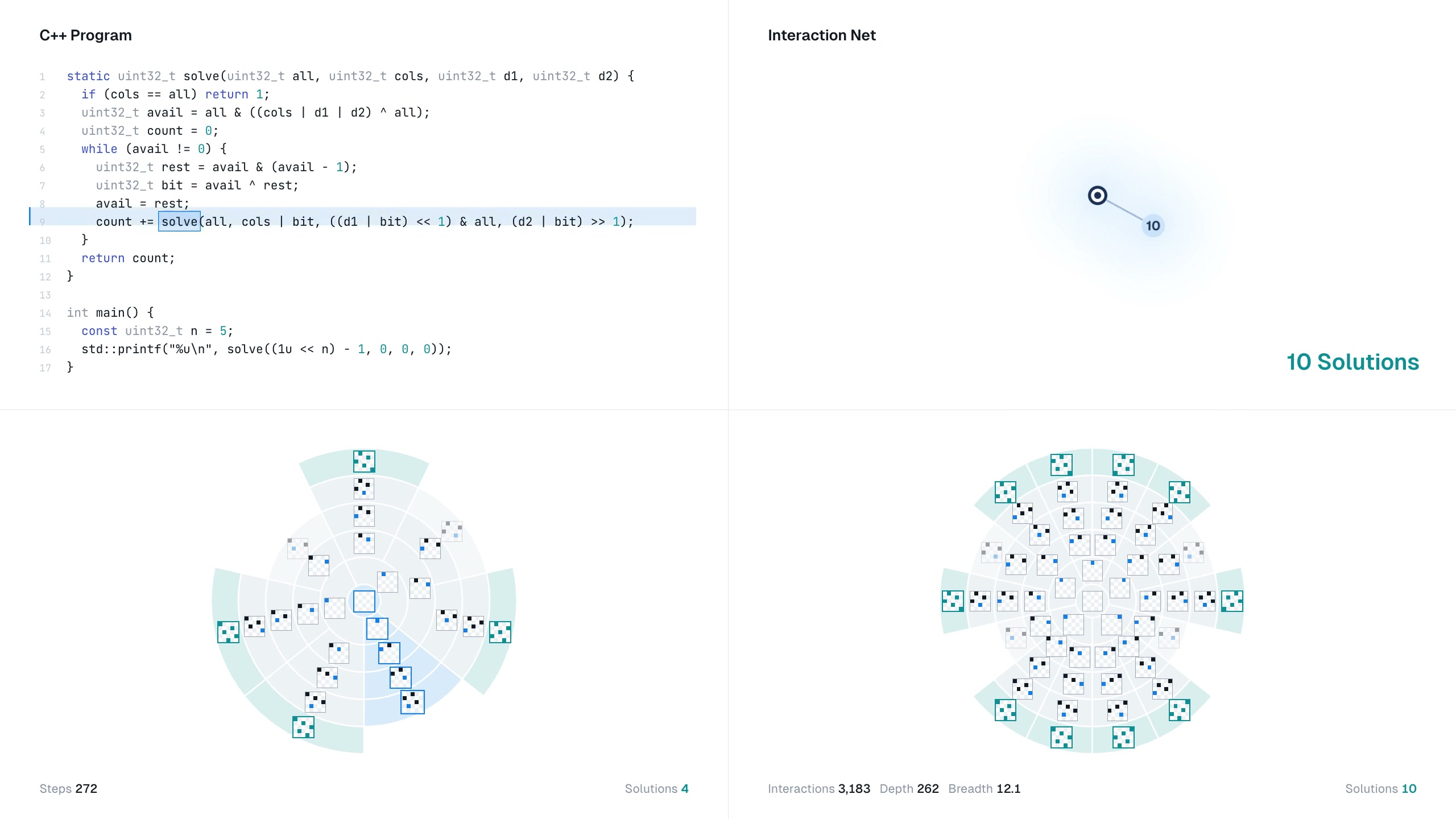
Frostbite takes the opposite approach. It is built around interaction nets, a concept first described by researcher Yves Lafont in 1990. An interaction net turns a program into a graph of connected nodes. Each step of the computation only touches a small local part of the graph, and every value has exactly one owner — no shared, changing state for the hardware to guard 12.
That may sound like pure theory, but it has a concrete advantage. Because active parts of the graph never overlap, they can all fire at the same time without threads, locks, or race conditions. A simple five-queens puzzle, for example, produces about twelve independent interactions ready to run at every step, giving it a critical path of only 262 steps across 3,183 total interactions 1.
In practice, ordinary-looking programs written in Vine — a Rust-like language — compile through an intermediate representation called Ivy directly into these nets 2.
From the official announcementIntroduction to interaction nets
From the official announcementArchitectural novelty
What the AI found
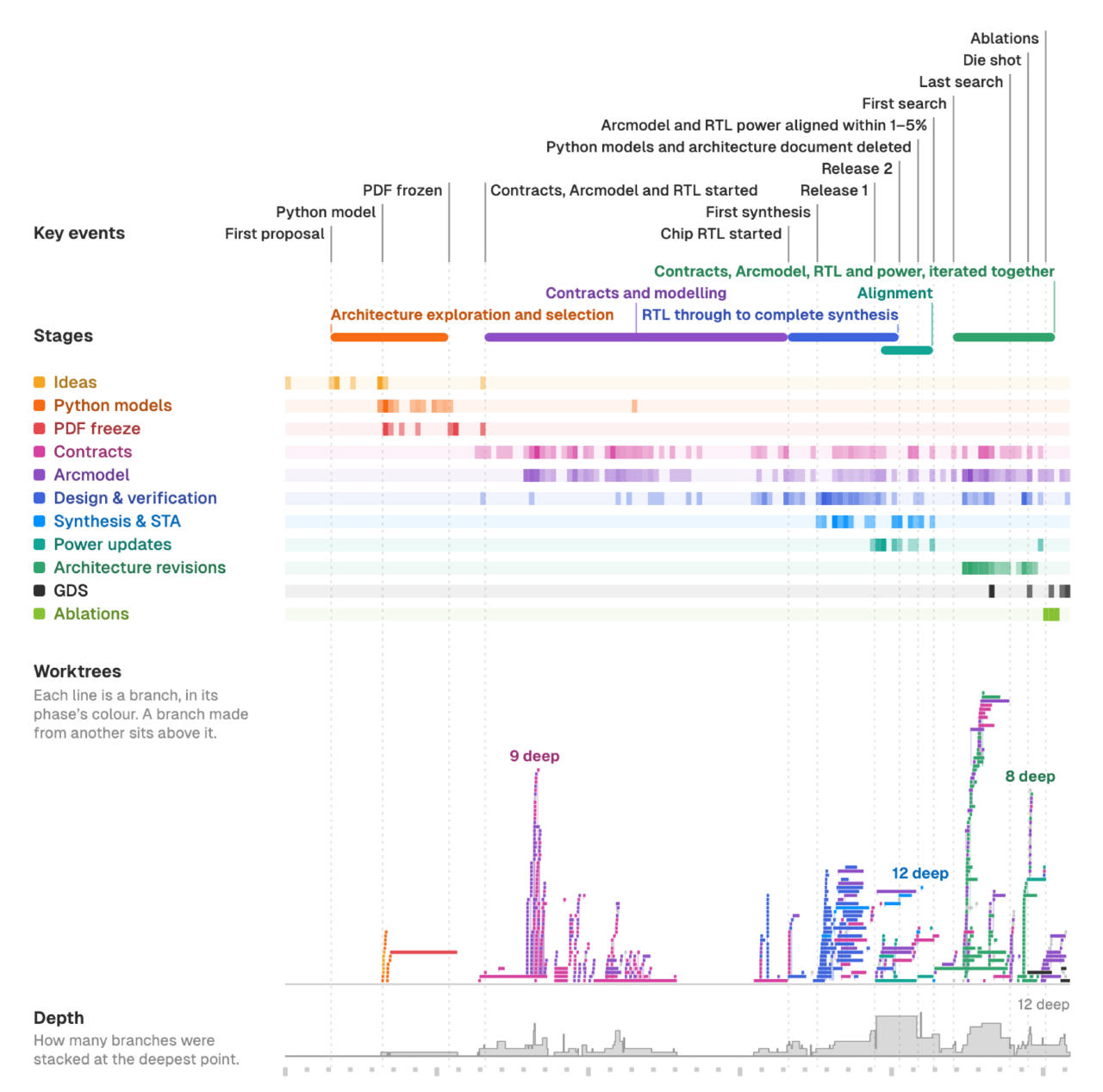
Architect Labs gave its AI agents no preconceived ideas about what the chip should look like. The agents moved through every stage themselves: defining the instruction set, designing the architecture, writing the microarchitecture, generating the register-transfer-level code, verifying it, and producing the final GDS file 1.
One thing the agents stumbled on by themselves was a work-stealing behaviour. Each tile in Frostbite's mesh runs its own queued work first; if it finishes early, it reaches over to a neighbour for more. When nothing is available, it goes inactive and saves power. The company says this behaviour was not programmed by hand — it emerged during the AI's exploration 2.
On 25 workloads, including fifteen the agents never saw during design, Frostbite showed a geometric mean of 4.59× better performance per watt than a modern in-order dual-issue CPU core 12. On convolution operations (conv2d), the gain reached 23.12× . Against the same comparison chip measured by area, the average improvement was 8.77× .
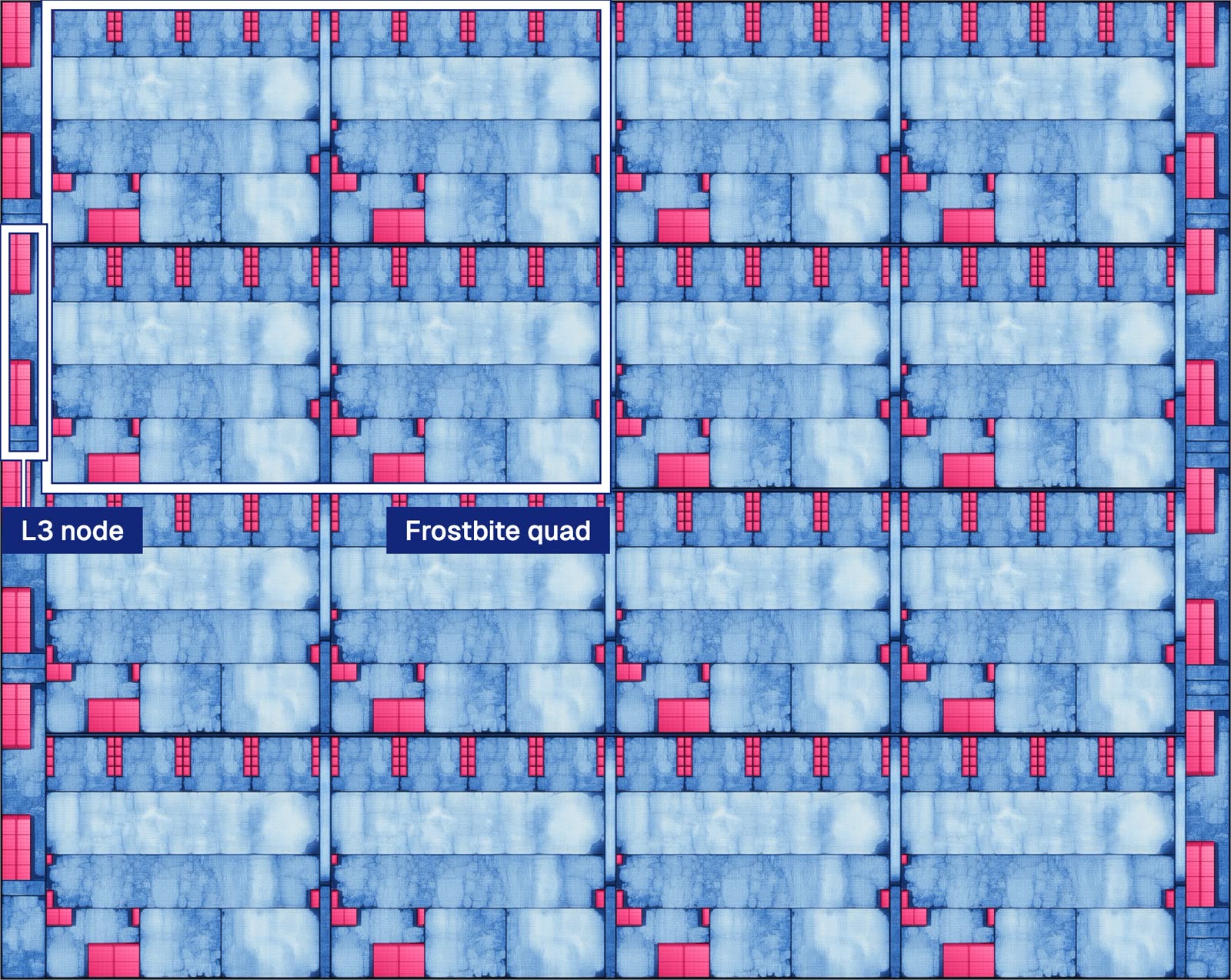
At full size — one quad made of four tiles plus four L3 memory nodes — Frostbite would occupy 0.792 square millimetres on a 7 nm process and is planned to run at 500 MHz 2. For now it exists only as pre-silicon simulation; an FPGA playground version is coming later .
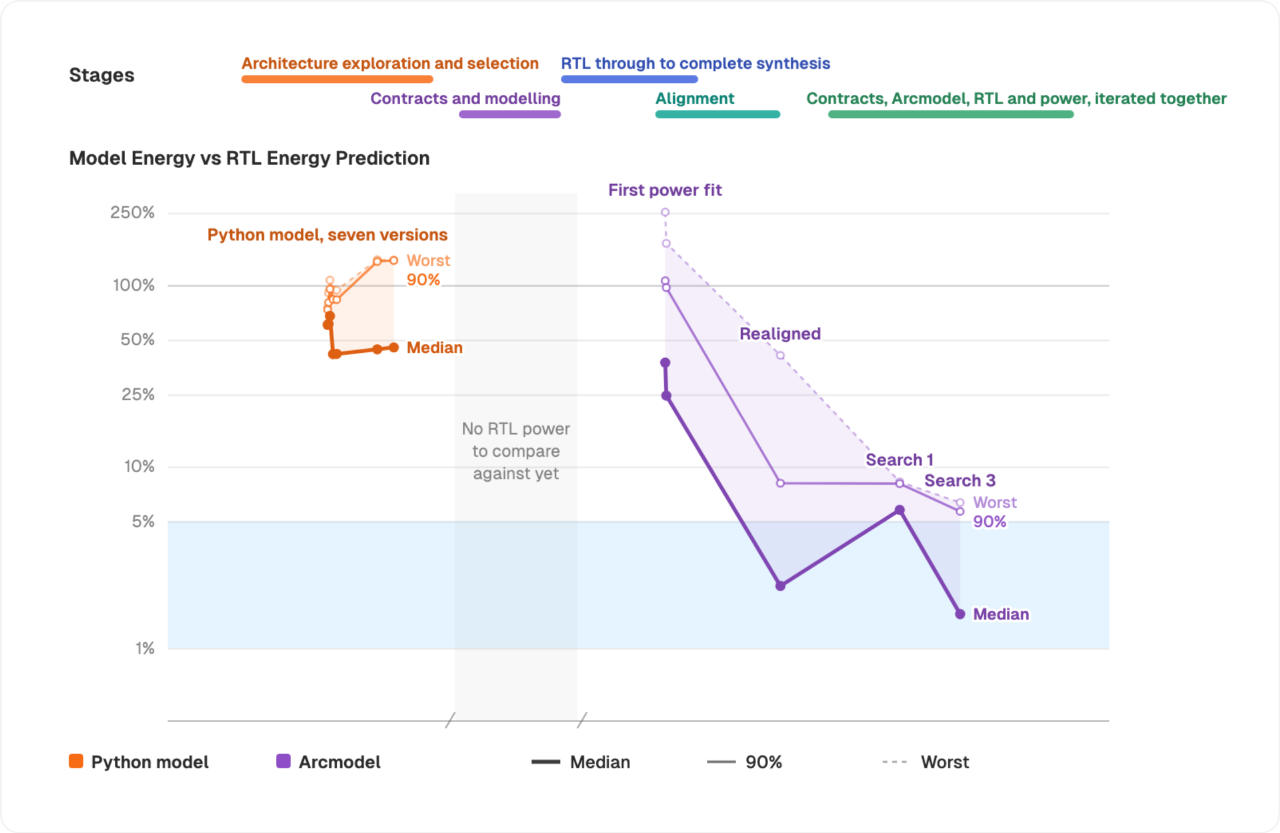
From the official announcementContracts, Arcmodel, RTL, and power, iterated together
From the official announcementEmergent property: stealing work
Why this could shift how chips are built
Human-designed CPU cores have seen very little speed improvement per core for two decades 1. That has pushed the industry toward cramming many cores onto one chip, which brings its own problems: keeping all those cores agree on a single view of memory eats area and power, and does not scale well .
Interaction nets avoid much of that overhead because values live in small local memories right beside the logic that uses them, and there is no coherence protocol to maintain 1. Architect Labs believes the same kind of AI-driven rediscovery will eventually touch every class of chip — datacentre processors, AI accelerators, networking switches and NICs .
This story reports on a trend for information only. It is not advice or encouragement to do any of it.
How good is it
Frostbite achieved a geometric mean of 4.59× better performance per watt than a modern in-order dual-issue CPU core across 25 workloads, including 15 that the AI never saw during design 1. According to the company, it also delivered 8.77× better performance per area compared with a single in-order core 2. On convolution operations alone, Frostbite reached 23.12× better performance per watt than the rival chip . These numbers were reported pre-silicon at 500 MHz on a 7 nm process according to the company .
Picture: architectlabs.com
Picture: architectlabs.com
Key facts
- Frostbite is a CPU whose instruction set and hardware were designed entirely by AI agents at Architect Labs
- It scores 4.59× better performance per watt and 8.77× better performance per area than a modern in-order CPU core across 25 workloads
- Best result: 23.12× performance per watt gain on conv2d operations
- Runs on interaction nets, where every value has one owner and computation happens in local graph rewrites instead of shared memory
- Currently only pre-silicon; final GDS targets 500 MHz on 7 nm with an FPGA playground planned
Sources
If this story concerns you or your company, or uses something that belongs to you, ask for a correction or for it to be taken down. How requests work
Keep reading
How it worksAI designs a brand-new CPU that runs 4.6× faster per watt than modern chipsHerald of AI
AI designs a brand-new CPU that runs 4.6× faster per watt than modern chips
A team used AI to invent a whole new processor design from scratch — and it could change how every chip is built.
 How it worksNew paper says many AI failures come from missing context, not weak modelsHerald of AI
New paper says many AI failures come from missing context, not weak models
A researcher argues the next practical step in making AI reliable is not bigger models but better information delivery to the model at the moment it acts.
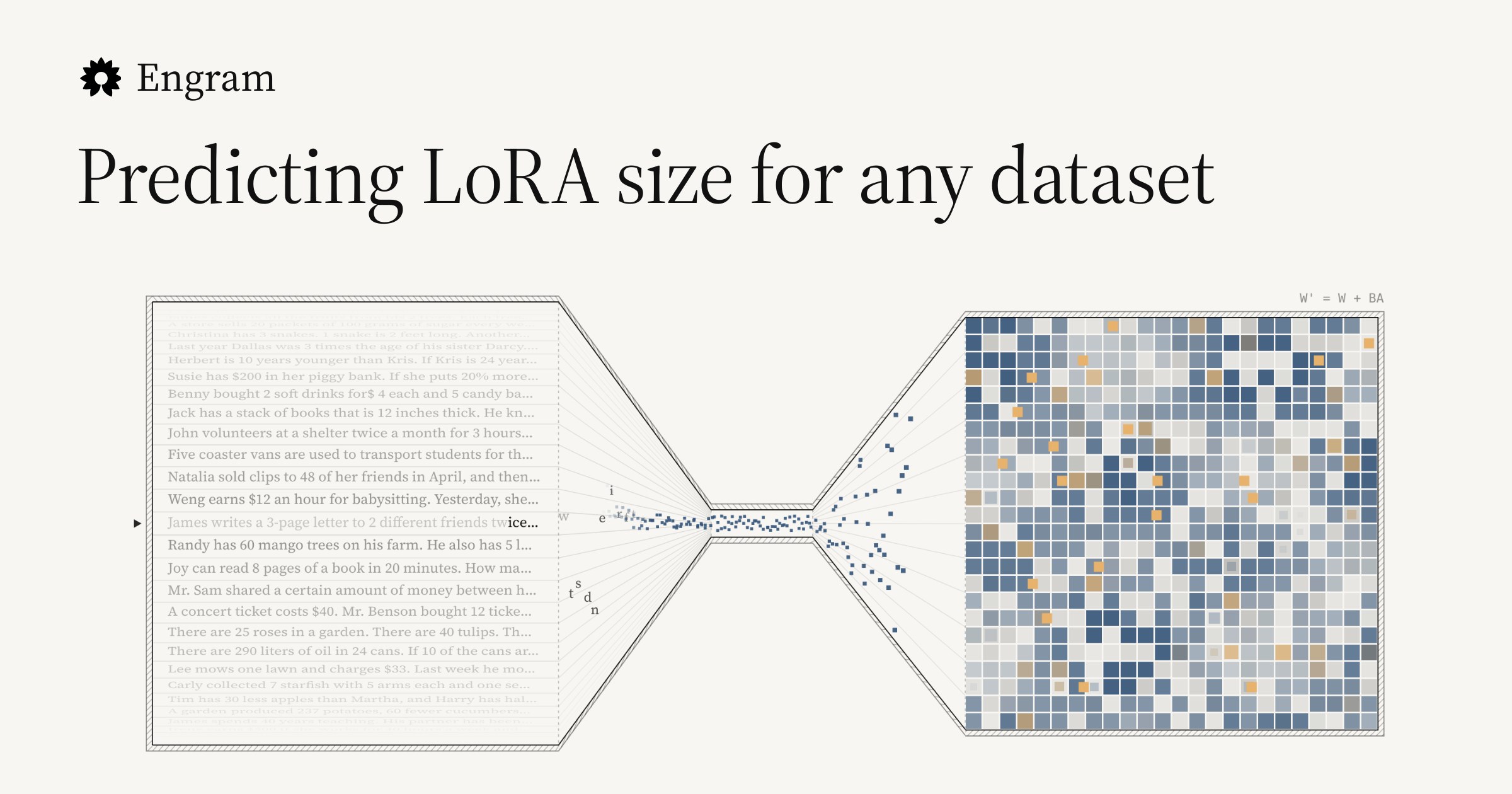 How it worksEngram researchers found a way to predict how big a LoRA adapter needs to be for any datasetHerald of AI
Engram researchers found a way to predict how big a LoRA adapter needs to be for any dataset
A practical guide so anyone who fine-tunes models spends less time guessing hyperparameters and more time training.