Sakana's 30B model outscores Nvidia's 4x-larger rival on 25 tests
It is built to search the web and read long documents, and it is small enough to run on hardware you already own.
A chatbot you run on your own computer that searches the web and reads long documents.
- You type a question or hand it documents.
- It searches the web across many sources.
- It reads long text and pulls out answers.
- It gives you a summary with citations.
What you could do with it
- A business analyst could hand it a stack of internal reports and ask it to summarise them with citations, pulling together the information it needs from multiple sources 1.
- A researcher could ask it to track down the latest industry trends and it will keep searching the web across many sources until it pieces together an answer, even when a single search is not enough 1.
- A person could use it for everyday conversation and routine day-to-day tasks 1.
Picture: sakana.ai
A 30B model that beats a 120B one
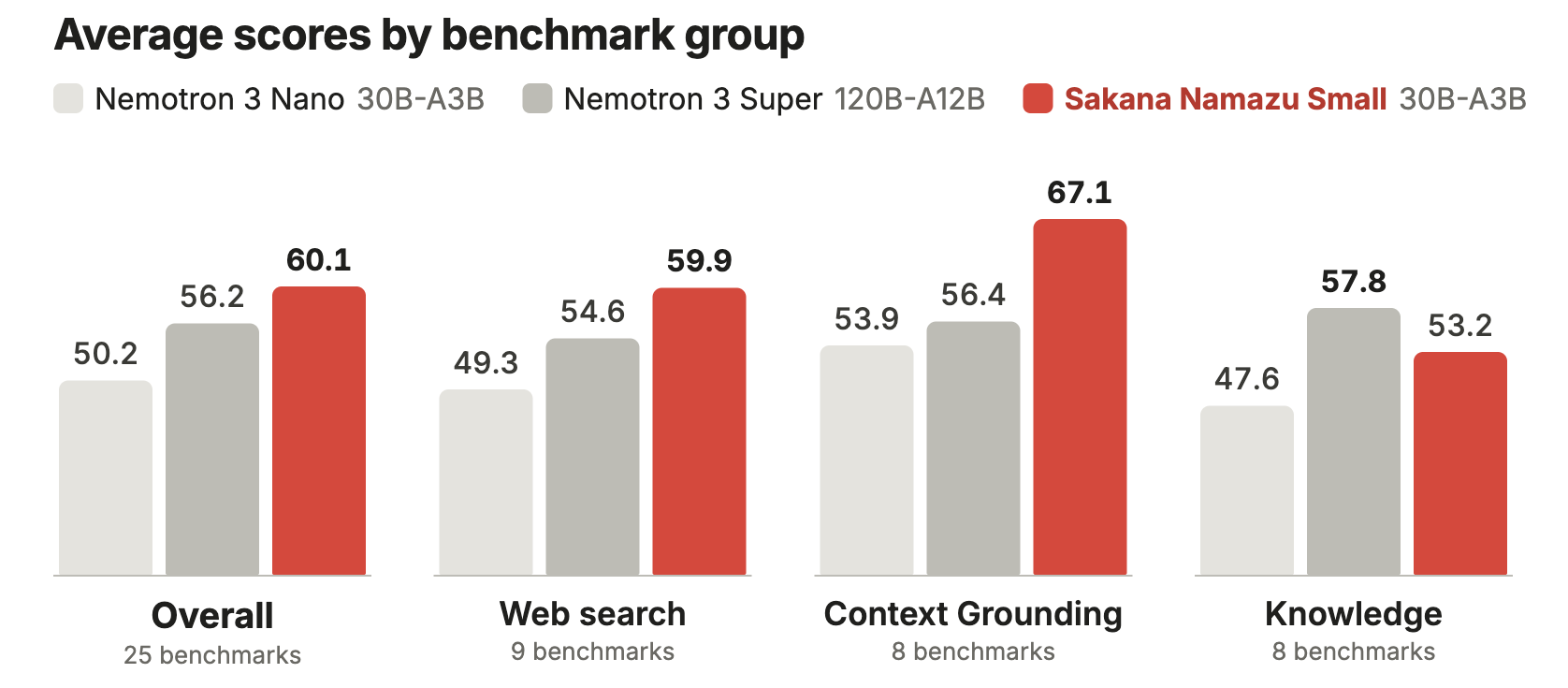
Sakana AI says Namazu Small scores 60.1 on average across 25 benchmarks, ahead of Nemotron 3 Super, a 120-billion-parameter model from NVIDIA, which scores 56.2, and ahead of Nemotron 3 Nano itself at 50.2 13. In everyday terms, a model with one-fifth the parameters of its rival wins on the overall test.
The company built Namazu Small by starting from NVIDIA's pre-trained Nemotron 3 Nano base and then running its own continued pre-training and post-training in-house 1. The base architecture uses a hybrid Mamba (a type of neural-network layer good for long text) and Mixture of Experts design, with 31.6 billion total parameters but only about 3.6 billion active per word, which keeps it fast 2.
A 30B model beats a 120B one on most tests
Self-reported by Sakana AI
What it does better (and worse)
The strongest results show up in web-search research. On BrowseComp, a test where the model must hunt through the web to answer questions, Namazu Small scores 73.5, nearly double Nemotron 3 Super's 36.1 13. In plain words: you can ask it to track down the latest news across many sources and it will keep searching until it pieces together an answer, something the smaller rivals struggle with.
For long documents, the advantage is also clear. On LLM-jp LongBench, which asks the model to read a very long Japanese text and answer from it, Namazu Small scores 86.0 versus 60.0 for Nemotron 3 Super 1. You could hand it a stack of internal reports and ask it to summarise them with citations; Sakana says that is exactly the kind of job the model targets .
Where Namazu Small trails is internal knowledge. On SimpleQA Verified, a test of factual recall without web access, it scores 6.8, below Nemotron 3 Nano's 9.1 and Nemotron 3 Super's 18.1 13. Sakana acknowledges this and says it plans to improve knowledge recall in future versions .
How it was tested
Sakana ran the 25 benchmarks in three groups: web-search research, long-context reading and instruction following, and general plus domain knowledge 1. The model was tested in reasoning mode, with a context window of 262,144 tokens and a maximum output of 32,768 tokens . NVIDIA's comparison models were tested with their recommended settings . All scores are self-reported by Sakana 3.
When and how you can get it
Sakana says Namazu Small is small enough to run on your own hardware and plans to offer an on-premises version in early-to-mid December 2026 1. The Nemotron 3 Nano base was designed to run on DGX Spark, H100 and B200 GPUs 3. The model's development was supported by Japan's METI and NEDO through their GENIAC programme, which funds domestic generative-AI research .
How good is it
According to the company, Namazu Small averages 60.1 across 25 benchmarks, beating NVIDIA's four-times-larger Nemotron 3 Super (56.2) and its own base model Nemotron 3 Nano (50.2) 13. On the web-search test BrowseComp, where the model must hunt through the web to answer questions, it scores 73.5, nearly double Nemotron 3 Super's 36.1 . Where it trails is internal knowledge: on SimpleQA Verified, which tests factual recall without web access, it scores 6.8, below both Nano (9.1) and Super (18.1) . All numbers are self-reported by Sakana AI .
How well the model answers questions that require searching the web; higher means better. Higher is better. Numbers: Sakana AI. Chart drawn by Herald of AI.
Picture: sakana.ai
Picture: huggingface.co
Key facts
- Sakana Namazu Small has 30B parameters (3B active) and was trained on top of Nemotron 3 Nano's base model
- It averages 60.1 across 25 benchmarks, beating Nemotron 3 Super's 56.2 despite being four times smaller
- Its strongest area is web-search research (BrowseComp 73.5 vs 36.1 for Super) and long-document reading (LLM-jp LongBench 86.0 vs 60.0)
- Its weakest area is factual recall without external tools (SimpleQA Verified 6.8 vs 18.1 for Super)
- On-premises availability is planned for early-to-mid December 2026
Sources
If this story concerns you or your company, or uses something that belongs to you, ask for a correction or for it to be taken down. How requests work
Keep reading
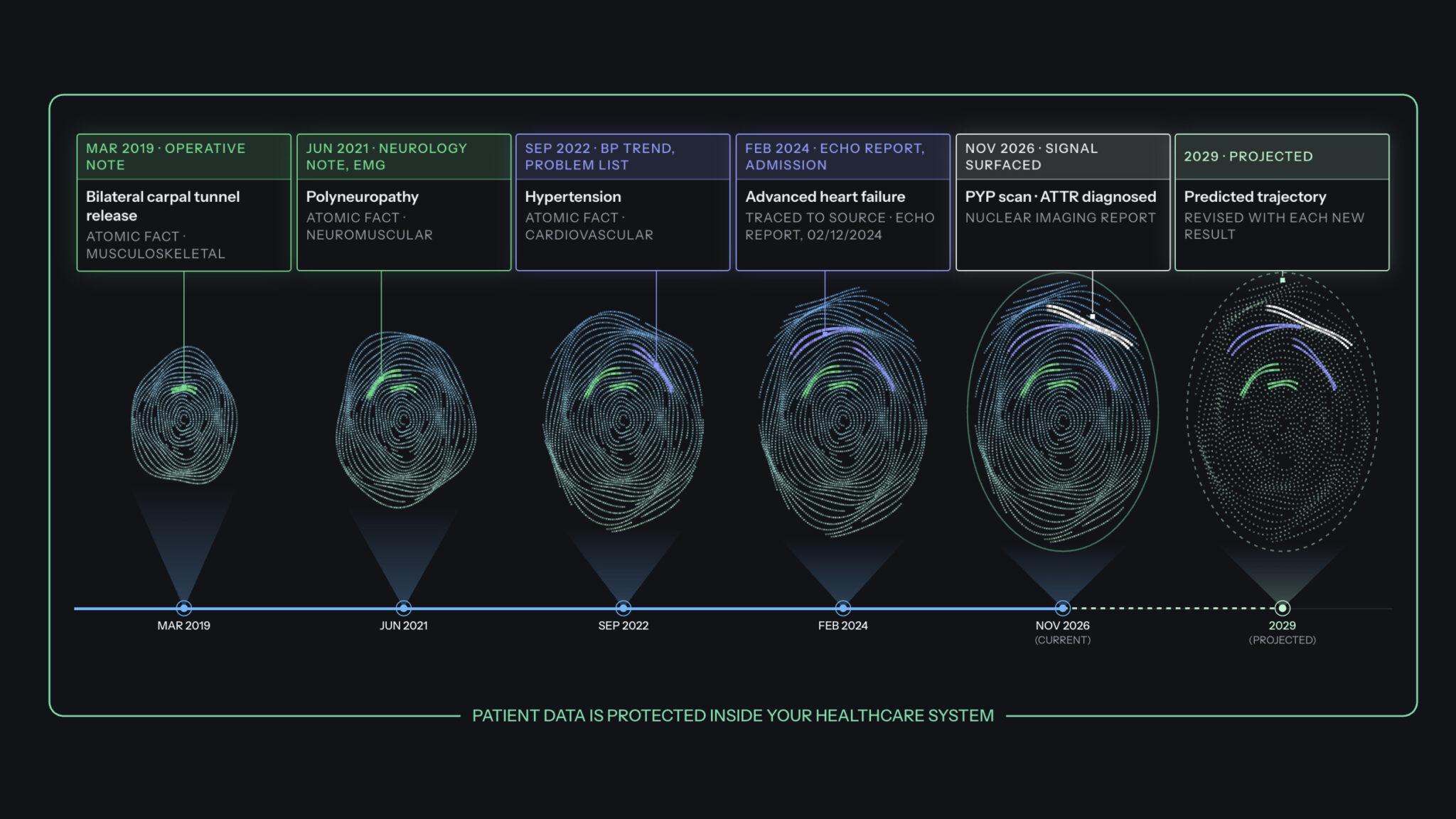 Apps and productsDyania's Synapsis AI reads 16 years of patient charts on hospital servers at Cleveland ClinicHerald of AI
Dyania's Synapsis AI reads 16 years of patient charts on hospital servers at Cleveland Clinic
An AI tool that can search through years of handwritten doctor notes inside hospital walls — doctors still decide everything.
 Apps and productsNVIDIA opens two free tools to run GPU-powered cloud computing for AIHerald of AI
NVIDIA opens two free tools to run GPU-powered cloud computing for AI
NVIDIA released its cluster-management software for free so companies can let customers rent AI-ready computers on their own graphics cards.
 New modelsSamaya Sterling a tiny AI finance agent beats a bigger one at a fraction of the costHerald of AI
Samaya Sterling a tiny AI finance agent beats a bigger one at a fraction of the cost
A small post-trained model does financial research better than a large frontier model, for 11 times less money.