Lute-0, a new touch-powered robot model, handles snacks 98% of the time; Lute raises $20M
A Warsaw startup has released a robot AI that learns to handle objects by feeling them, not just seeing them, and says it matches or beats the leading open-source rival in real retail tests.
An AI model for robots that learns to grip and place objects by sensing touch and pressure.
- Robot's soft sensors feel the object's pressure
- The model turns sight and touch into movements
- The robot grips, moves, or places the item
- A remote human steps in when the robot fails
What you could do with it
- A system integrator could use Lute's platform to select hardware, define a task, and retrain a robot on site for a healthcare or manufacturing client, without needing an in-house AI team 1.
- A large retailer could deploy Lute's models on their shop floor to grip, sort, and place items like vegetables and soft snacks without a human steadying them 1.
- A researcher could use Lute's portable tactile data-collection rig to capture touch signals in any environment, from a warehouse aisle to a lab bench 1.
Why a robot needs more than eyes
Most robot AI today watches the world through cameras. A camera shows where a box is, but it cannot tell how firmly the gripper is holding it, whether the item is starting to slip, or whether it is a fragile egg or a bouncy ball. You feel a cup start to slide from your hand before you can see it move; most robots cannot. 1
Lute says it is building a family of foundation models trained on tactile input to close that gap. With partners, the company co-designed compact, soft (elastomer, or stretchy-rubber, based) tactile sensors and built them into a portable data-collection rig that can capture touch signals in any environment – a warehouse aisle, a retail backroom, a lab bench. 1
How Lute-0 fared against the leading open-source robot in store tests
Lute's own tests; no independent benchmark yet
What Lute-0 does better, and where the numbers come from
Lute-0 is the company's first video-action model: it watches a video of a scene and turns what it sees and feels into robot movements. In Lute's own tests on retail pick-and-place tasks, it matched or beat π0.5, the leading open-source robot model from Physical Intelligence. 12
The concrete results, all from Lute's internal evaluation:
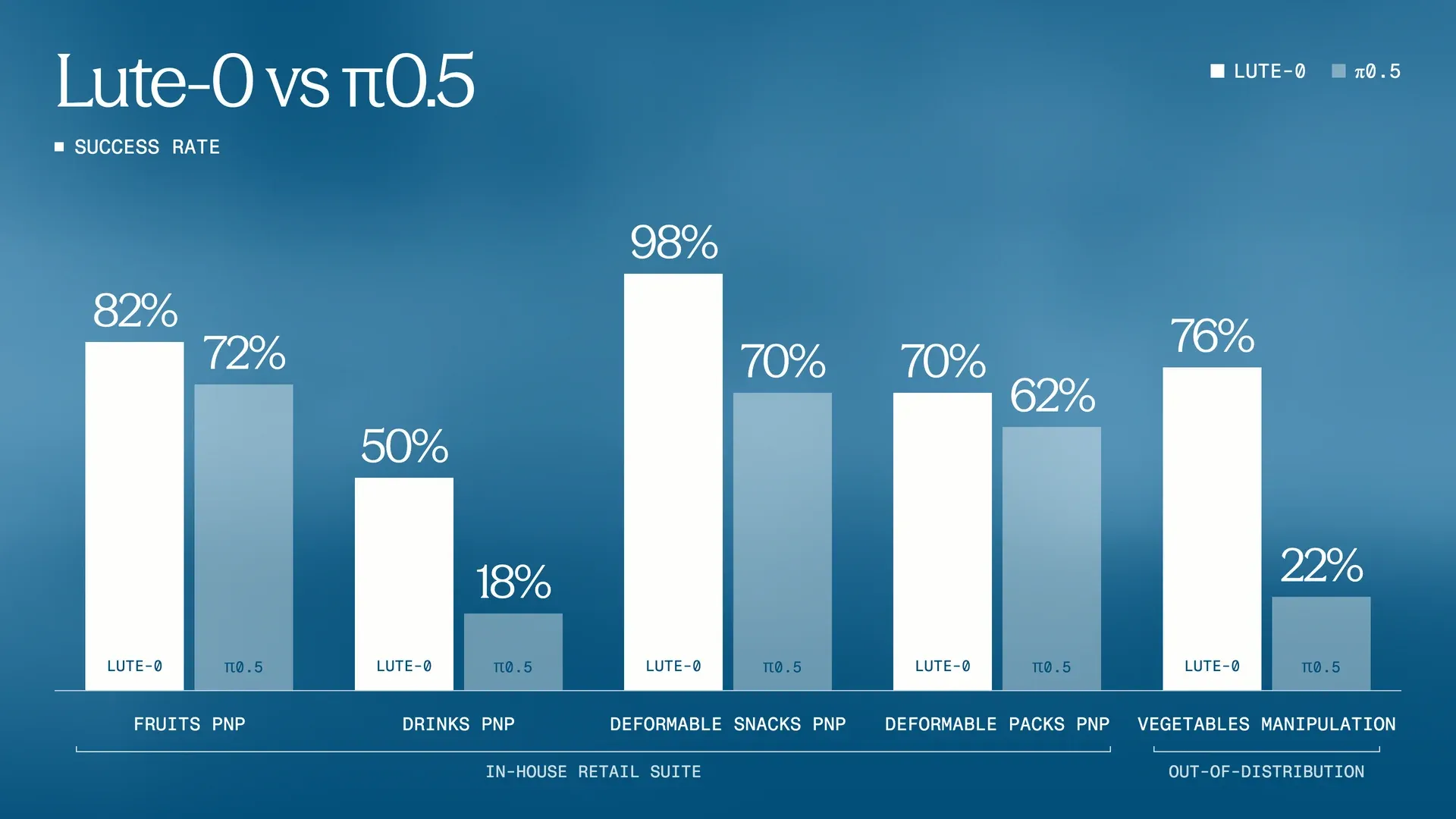
- Handling vegetables: Lute-0 succeeded 76 % of the time; π0.5 managed 22 %.
- Handling soft snacks (think a bag of chips that crinkles and shifts in your hand): Lute-0 got 98 %; π0.5 got 70 %.
- Lute-0 reacted twice as fast (half the latency) as π0.5 on the same tasks. 12
Lute also says it pre-trained Lute-0 on far less data than π0.5, with a much shorter training run. Its two lead investors give slightly different figures: OTB Ventures puts it at roughly one-twentieth of the data and a quarter of the training steps; FORWARD.one says about one-tenth of the pre-training data. The Next Web has not seen an independent benchmark; these numbers come from Lute's own testing. 2
Paweł Budzianowski, Lute's chief executive, summed up the pitch in a statement published by FORWARD.one: "We believe touch is the missing signal that lets robots handle real work reliably." 2
Zurich-based Enact is chasing the same idea and raised $30 million in October to give robots a sense of touch. 2
Already on the shop floor
Ten months after the company was founded, Lute's models are running at what it calls Europe's largest automotive-parts distributor – a firm OTB Ventures describes as having roughly $6 billion in annual revenue. Lute also reports on-site work with some of the world's largest retailers, and, according to OTB, its models operate in hospital corridors. The startup partners with integrators – the companies that install robots for clients – starting in healthcare and manufacturing. 12
On any site the robot works autonomously when it can. When it hits an edge case or a failure, a remote human operator steps in. Those mistakes and fixes flow back into training, so each deployment makes the next one smarter. 1
What the $20 million buys
The round was co-led by OTB Ventures and FORWARD.one at the seed stage, with Credo Ventures and Seedcamp leading the pre-seed. Inovo VC, Borusan Ventures, ff Venture Capital and investor Naval Ravikant also took part. Lute says the money will go to scaling touch-data collection, training and improving its models, and putting more robots on customers' sites. The company is hiring across research, engineering and deployment in Warsaw and San Mateo, California. 12
Kris Pałucki, investment director at OTB Ventures, noted in Lute's announcement that while many system integrators are looking to put AI-driven robots into use, only a small number of them have the machine learning expertise needed to pull that off. Lute removes that barrier." Boy de Jonge of FORWARD.one added: "In physical AI, the slow and the perfect will both lose." 1
How good is it
In Lute's internal retail pick-and-place tests, Lute-0 matched or beat π0.5, the leading open-source robot model from Physical Intelligence, on both vegetable and soft-snack handling 12. For soft snacks, Lute-0 succeeded 98% of the time versus 70% for π0.5, and for vegetables it succeeded 76% versus 22% . Lute-0 also reacted twice as fast (half the latency) as π0.5 on the same tasks, meaning it sensed an item slipping or shifting and corrected its grip roughly twice as quickly . These figures come from Lute's own evaluation; The Next Web noted it had seen no independent benchmark .
Percentage of times the robot successfully picks up and places a soft snack (e.g. a bag of chips). Higher is better. Numbers: Lute internal evaluation. Chart drawn by Herald of AI.
Picture: lute.one
Key facts
- Lute raised $20M in combined seed and pre-seed funding, co-led by OTB Ventures and FORWARD.one
- Lute-0 handled soft snacks 98% of the time in Lute's internal retail test, versus 70% for Physical Intelligence's π0.5
- Lute-0 was pre-trained on roughly one-tenth to one-twentieth the data of π0.5, per its two lead investors
- Ten months after founding, Lute's models already operate at Europe's largest automotive-parts distributor and in hospital corridors
- Zurich-based rival Enact raised $30M in October on a similar touch-for-robots thesis
Sources
If this story concerns you or your company, or uses something that belongs to you, ask for a correction or for it to be taken down. How requests work
Keep reading
 New modelsSakana's 30B model outscores Nvidia's 4x-larger rival on 25 testsHerald of AI
Sakana's 30B model outscores Nvidia's 4x-larger rival on 25 tests
It is built to search the web and read long documents, and it is small enough to run on hardware you already own.
 New modelsOpenAI adds GPT-6.2 Sol to ChatGPT — better photos and safer chats for teensHerald of AI
OpenAI adds GPT-6.2 Sol to ChatGPT — better photos and safer chats for teens
ChatGPT users on paid plans can now use a new version that reads small text in images more clearly and responds more safely in conversations with younger people.
 New modelsA 750 billion-parameter Chinese AI matches much bigger rivals by reusing parts of itselfHerald of AI
A 750 billion-parameter Chinese AI matches much bigger rivals by reusing parts of itself
Z.ai's new GLM-5.4 model thinks twice over its own steps, letting a smaller system rival ones far larger — and opens doors to making videos, games and 3D scenes.