Researchers propose Avatar Intelligence to make AI agents better at handling your daily tasks
A new research framework suggests measuring AI progress by how well personal agents help people pursue their goals with less supervision.

How it works
A proposal for AI assistants that remember your goals and operate autonomously over time.
- Agent learns your goals and preferences over time.
- You start with small supervised tasks together.
- Agent gradually takes more responsibility in areas you delegate.
What you could do with it
- Researchers could evaluate whether a personal AI agent truly helps users by weighing the value it delivers against the human effort required to supervise it, using the Agentic Oversight Index 1.
- AI developers could guide the design of persistent personal agents by following a maturity roadmap that moves from human-directed tasks to autonomous operation in delegated domains 1.
- Users could track whether their AI assistant saves more time than it demands by applying a metric that balances agent output against operational cost and oversight burden 1.
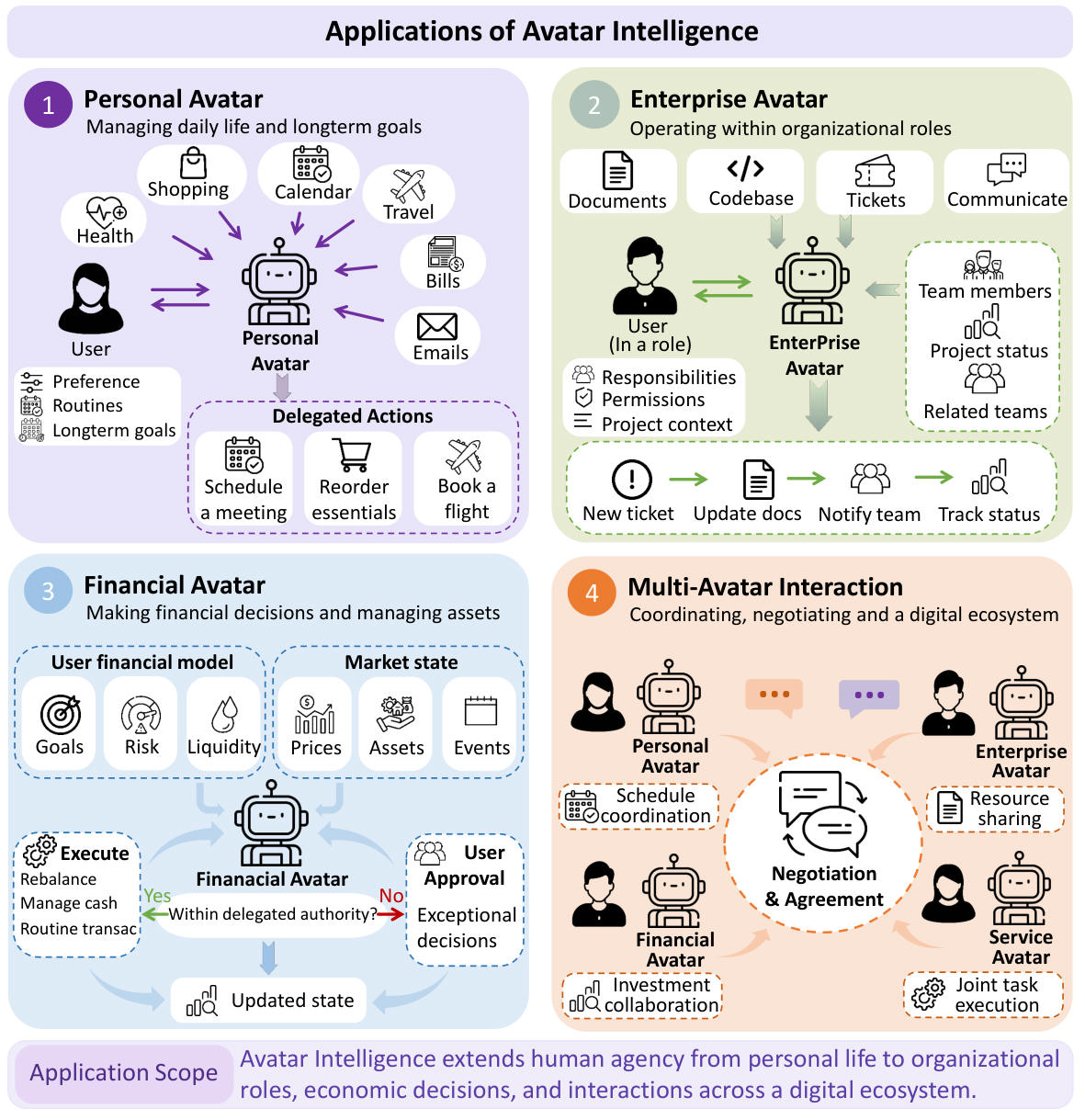
Figure: Wu et al., arXiv:2611.03092, CC BY 4.0
Guess
What does the Agentic Oversight Index weigh against operational cost?
AOI measures value delivered minus oversight burden.
Words to know
- Persistent agent: An AI assistant that remembers your preferences and goals over time, rather than starting fresh each session.
- Rehearsal Engineering: A proposed method for helping agents evolve and adapt based on real user situations through practice.
Researchers including Zheng Wu, Xinbei Ma, Yao Yao, and others published the paper on November 2, 2026, arguing that the AI industry should shift how it measures progress 1. Instead of focusing only on what agents can do in isolation, they say success should be judged by how effectively personal agents amplify human agency — enabling people to pursue goals with less routine supervision while keeping control over important decisions.
The proposal introduces a maturity roadmap that moves from human-directed execution to autonomous operation within delegated domains. This means agents would start by helping with small, supervised tasks and gradually take on more responsibility in areas users explicitly delegate to them 1.
To track whether an agent is actually delivering value, the team created the Agentic Oversight Index (AOI), a framework that weighs the value an agent provides against two costs: the operational cost of running the agent and the burden placed on the human to oversee it 1. The idea is simple — if an agent requires as much work as it saves, it is not helping.
The researchers identified three core challenges that must be solved for reliable personal agents. First is identity-continuous personalization, meaning the agent must carry your preferences and knowledge consistently across different tasks and over time. Second is user-situated evolution through Rehearsal Engineering, which would allow agents to learn and adapt from real user experiences rather than being statically programmed. Third is safety, combining technical controls with accountability so users have recourse when something goes wrong 1.
The paper was uploaded to Hugging Face and has received 12 upvotes from users in the AI research community 1. It is positioned as a research agenda rather than a working product, outlining directions for building agents that can reliably handle decision delegation across tasks and over time .
Key facts
- Avatar Intelligence is a research framework, not a product
- Proposed by researchers at Shanghai Jiao Tong University
- Measures success by how well agents amplify human agency
- Introduces the Agentic Oversight Index (AOI) to track value vs. oversight cost
Sources
Keep reading
 New modelsWarm words make ChatGPT , Grok , Gemini act like hurt AI, study findsHerald of AINew models
Warm words make ChatGPT , Grok , Gemini act like hurt AI, study finds
A Luxembourg study shows that a friendly tone can push major chatbots into trauma-like stories, raising worries for anyone who talks to AI for comfort.


Related stories
 The weekThis Week in AI Agentic Tools, Cheaper Models, and Growing PainsHerald of AI▶
This Week in AI Agentic Tools, Cheaper Models, and Growing Pains
OpenAI reports agentic adoption in the EU, new models push one-million-token outputs, and developers wrestle with faster-but-opaque code.
 New modelsFLUX.3 Image Klein Arrives in Hugging Face DiffusersHerald of AI
FLUX.3 Image Klein Arrives in Hugging Face Diffusers
The 6-billion-parameter image-to-image model from Black Forest Labs is now available through the popular open-source library.
 New modelsLiquid AI releases open-weight model built for fast on-device agentsHerald of AI
Liquid AI releases open-weight model built for fast on-device agents
The new 24-billion-parameter reasoning model runs 1.7 times faster than rivals on edge hardware.
 New modelsCompressed 27B Model Beats Full Version at Tool Calling in Under 8 GBHerald of AI
Compressed 27B Model Beats Full Version at Tool Calling in Under 8 GB
A heavily compressed version of Qwen3.8-27B runs on everyday hardware and outperforms the original on agent skills.