How Dyania Health's AI reads years of patient records so doctors don't have to
A new tool lets hospitals scan decades of notes and test results automatically — giving clinicians the key information faster without moving patient data off-site.
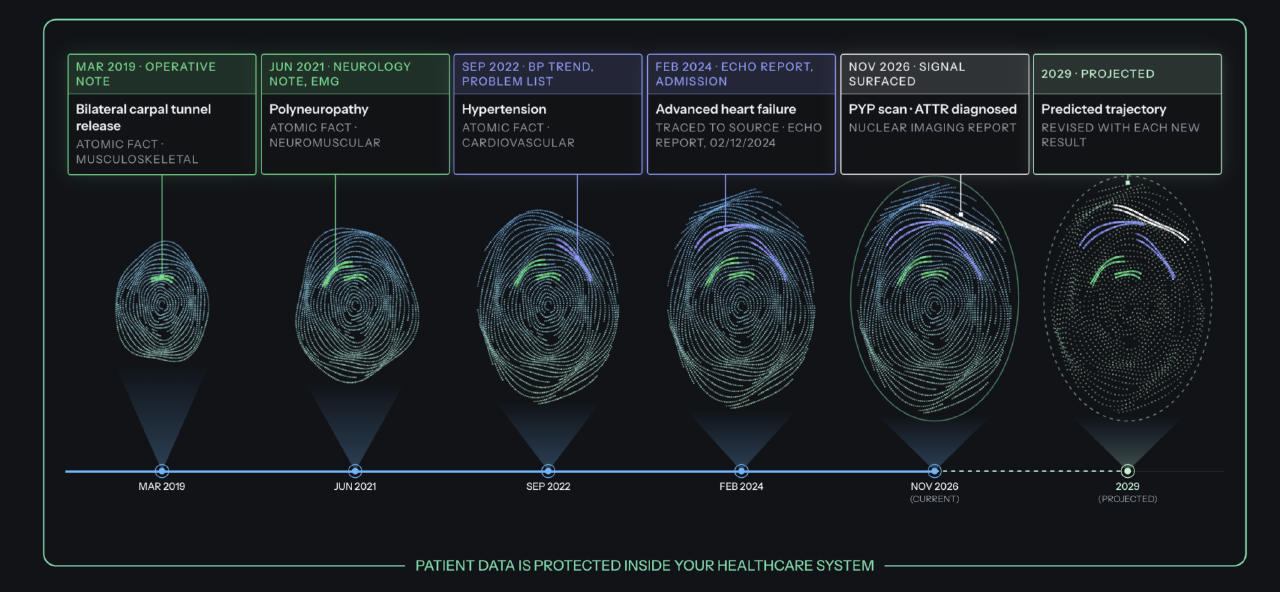
A computer program that reads through patients' years of medical notes and highlights the most important details for doctors.
- Load all patient records into the system.
- AI scans decades of notes automatically.
- It surfaces key findings for the doctor.
What you could do with it
- Clinicians could review a patient's entire multi-year medical history to surface key findings faster, potentially speeding up diagnosis and treatment decisions 1.
- Hospitals could process all of a health system's patient records on their own GPU servers behind their firewall, so no sensitive data ever leaves the building 1.
- Researchers could build predictive models—such as estimating heart valve decline and reintervention risk at three, five, and ten years after surgery—that would have taken clinicians years to complete by reading charts by hand 1.
Reading the whole chart at once
Every patient has a long history: doctor's notes, surgery reports, imaging scans, pathology results and discharge summaries. Today, understanding one person's full story means someone has to read through years of charts by hand 1.
Dyania Health created Synapsis AI as a "clinical reasoning engine" — essentially software designed to think through a patient's record the way a specialist would when reviewing a file. It looks across every note, report and lab result, connecting dots that may be months or years apart, and returns a set of actionable clues about which patients need attention and why 1.
Clinicians still make every decision. The AI does not diagnose or treat on its own; it surfaces evidence that a doctor must confirm and act on 1.
Keeping data inside the hospital
One of Synapsis AI's most notable features is where it lives. It runs on NVIDIA-accelerated computing equipment installed inside a health system's own firewall. The entire hospital's patient record can be processed onsite, meaning patient data never leaves the building and is never shared externally 1.
For patients, this means the kind of powerful analysis that normally requires sending sensitive medical records to a third-party cloud service can now happen entirely behind hospital walls 1.
Dyania builds its models using NVIDIA's NeMo open-source libraries, then optimizes them with NVIDIA's TensorRT and TensorRT-LLM tools so they run faster and more efficiently on the hospital's own GPU servers 1.
A real-world test at Cleveland Clinic
The tool has already been put to work at Cleveland Clinic, which used Synapsis AI in a study of more than 7,800 patients who received aortic valve replacements between 2005 and 2021 1.
By reviewing each patient's entire medical history — every echocardiogram taken after their surgery over the following years — the AI created a predictive model estimating the likelihood of valve decline and the need for another procedure at three, five, and ten years following the original operation 1. Completing that kind of chart review by hand would have taken clinicians years .
"Using technology to bring together and analyze information that can help us predict the duration of implanted heart valves is a promising step towards enhanced outcomes and more personalized care for patients," said Dr. - Lars Svensson is chief of the Heart, Vascular & Thoracic Institute at Cleveland Clinic 1.
Cleveland Clinic noted the same approach could apply to other challenges where answers hide inside medical records — such as finding patients eligible for clinical trials, closing gaps in cardiology and oncology care, or filling out clinical registries 1.
This story reports on a trend for information only. It is not advice or encouragement to do any of it.
Key facts
- Synapsis AI reads across every note, report and lab result in a patient's record
- It runs inside a hospital's own firewall — patient data never leaves the building
- Built by New Jersey-based Dyania Health using NVIDIA NeMo, TensorRT and TensorRT-LLM
- Cleveland Clinic tested it on 7,800+ aortic valve replacement patients from 2005–2021
Sources
If this story concerns you or your company, or uses something that belongs to you, ask for a correction or for it to be taken down. How requests work
Keep reading
 Apps and productsDyania's Synapsis AI reads 16 years of patient charts on hospital servers at Cleveland ClinicHerald of AI
Dyania's Synapsis AI reads 16 years of patient charts on hospital servers at Cleveland Clinic
An AI tool that can search through years of handwritten doctor notes inside hospital walls — doctors still decide everything.
 Apps and productsNVIDIA opens two free tools to run GPU-powered cloud computing for AIHerald of AI
NVIDIA opens two free tools to run GPU-powered cloud computing for AI
NVIDIA released its cluster-management software for free so companies can let customers rent AI-ready computers on their own graphics cards.
 Apps and productsHow Meta built TLX to help regular engineers squeeze more speed out of AI hardwareHerald of AIFigure: Guan et al., arXiv:2605.10905, CC BY 4.0
How Meta built TLX to help regular engineers squeeze more speed out of AI hardware
A new tool lets everyday AI developers write GPU code that matches specialist-level performance, powering the systems behind Facebook, Instagram and other services.