SpecWM turns AI video verification into improvement, speeding generation
A new method makes AI-generated videos faster and higher quality by fixing mistakes instead of starting over.
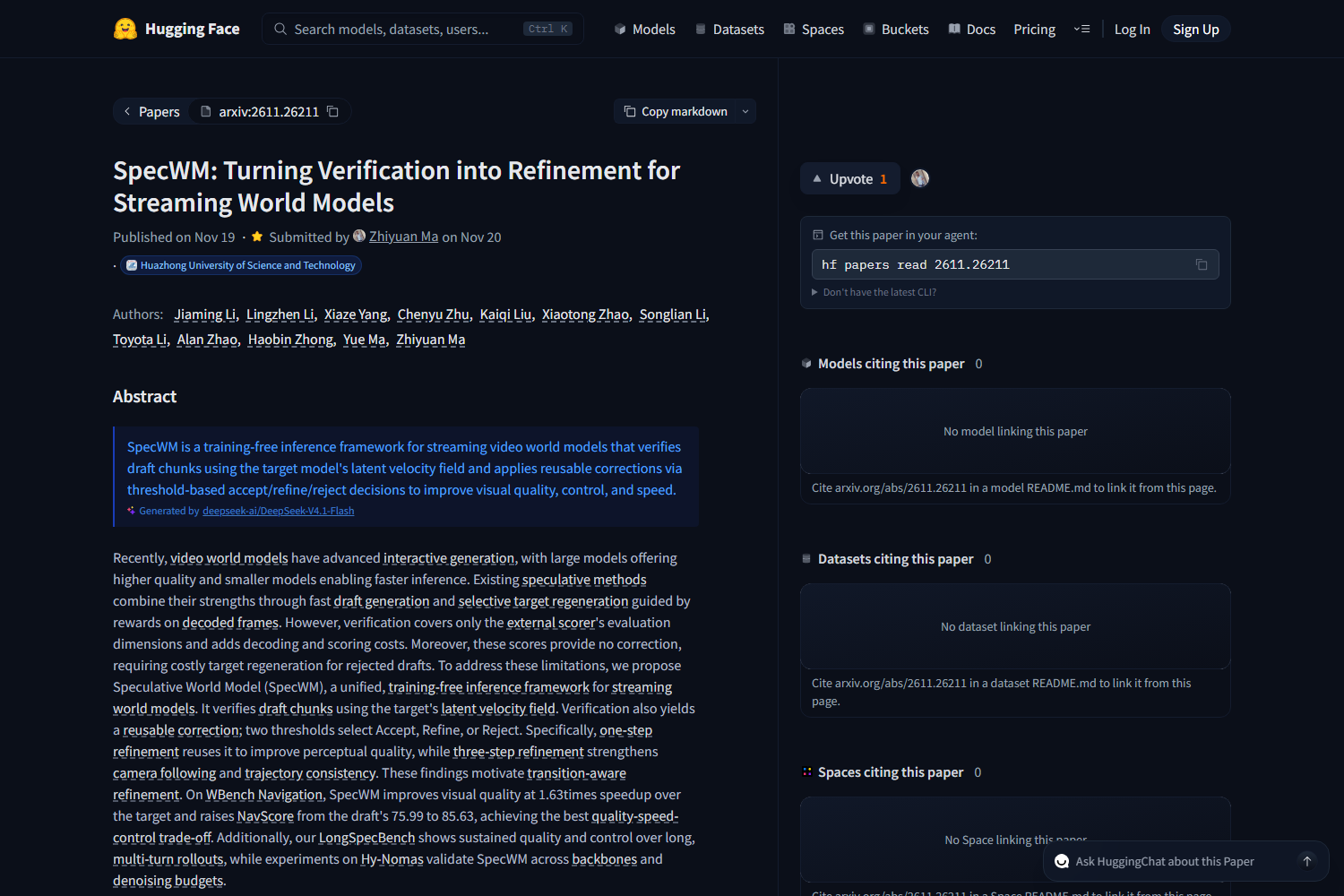
A technique that makes AI video generation faster by polishing rough drafts instead of discarding them.
- A fast model quickly sketches rough video chunks.
- A larger model checks each chunk's quality.
- Thresholds decide: accept, lightly tweak, or fix thoroughly.
- Refinement signals improve chunks without starting over.
What you could do with it
- A video-generation developer could plug SpecWM into an existing streaming-world-model pipeline to accelerate AI video synthesis without adding extra training costs 1.
- An interactive-video creator could rely on the method’s threshold-based refinement loop to get smoother, higher-quality clips with fewer dropped frames than earlier speculative approaches 1.
- A researcher testing long multi-turn video rollouts could apply SpecWM’s transition-aware correction signals to improve camera-following consistency and trajectory control across different backbones 1.
From discarded drafts to reusable fixes
Current systems that generate videos with AI often combine a small, fast model with a large, slow model. The small model quickly sketches several frames, then the large model reviews them and sometimes rewrites entire sections if the review score is low. This approach has two drawbacks. First, the review only looks at a limited set of quality measures defined by an external scorer, ignoring other aspects like smooth motion. Second, when a draft is rejected, the system must discard it completely and run the expensive large model again.
SpecWM flips this design. Instead of treating verification as a pass/fail step, the researchers turned it into a refinement loop. They verified rough video chunks against what the final target model would produce by comparing their “latent velocity fields”—essentially predicting how each chunk’s features should evolve over time. The comparison itself produces a reusable correction signal that tells the draft model exactly how to adjust its output, even before a full rewrite is attempted.
How SpecWM changes video generation compared to older methods
WBench Navigation benchmark results; all figures from the study
How the system decides what to keep
Two numerical thresholds act as traffic lights for each chunk. If the guess is close enough to the target, the system accepts it as-is. If it is somewhat off, the system applies a single refinement step to boost the chunk’s visual appeal. If the error is larger, a more intensive three-step refinement runs to improve camera movement consistency and trajectory tracking—key qualities for interactive video. This “transition-aware” approach means the system no longer throws away work; every verification yields a tweak that can be reused immediately.
The method requires no extra training. Developers can plug it into existing streaming-world-model pipelines and get the benefits right away, because it reuses the pre-trained target model’s own knowledge during inference.
Results: faster and more consistent videos
To test SpecWM, the team ran experiments on standard benchmarks. On the WBench Navigation benchmark, which measures how well generated video maintains navigational coherence, the system delivered visual quality 1.63 times faster than running the target model alone. It also raised the NavScore—a measure of navigation consistency—from the draft model’s baseline of 75.99 to 85.63, outperforming previous speculative methods and offering the best balance of speed, quality, and control.
Further testing on LongSpecBench showed that the technique sustains both quality and control over long, multi-turn video sequences. Additional experiments on the Hy-Nomas benchmark validated the approach across different backbone architectures and denoising budgets, confirming its flexibility.1
The research demonstrates a shift in how AI video generation can handle uncertainty: rather than discarding imperfect drafts, the system learns to polish them on the fly, making interactive video experiences quicker and more efficient.
What’s next
This story reports on a trend for information only. It is not advice or encouragement to do any of it.
Key facts
- SpecWM improves visual quality at 1.63× speedup over the target model on WBench Navigation.
- NavScore rises from 75.99 (draft baseline) to 85.63 after refinement.
- The method uses latent velocity fields to turn verification into reusable corrections.
Two cutoff points determine whether each video segment gets accepted, refined once for better visual quality, or refined three times to improve how well the camera follows action and keeps movement paths smooth.
- No additional training is required; the framework is applied directly during inference.
Sources
If this story concerns you or your company, or uses something that belongs to you, ask for a correction or for it to be taken down. How requests work
Keep reading
 How it worksAI image generators improve mostly by a fixed nudge, not new tricksHerald of AI
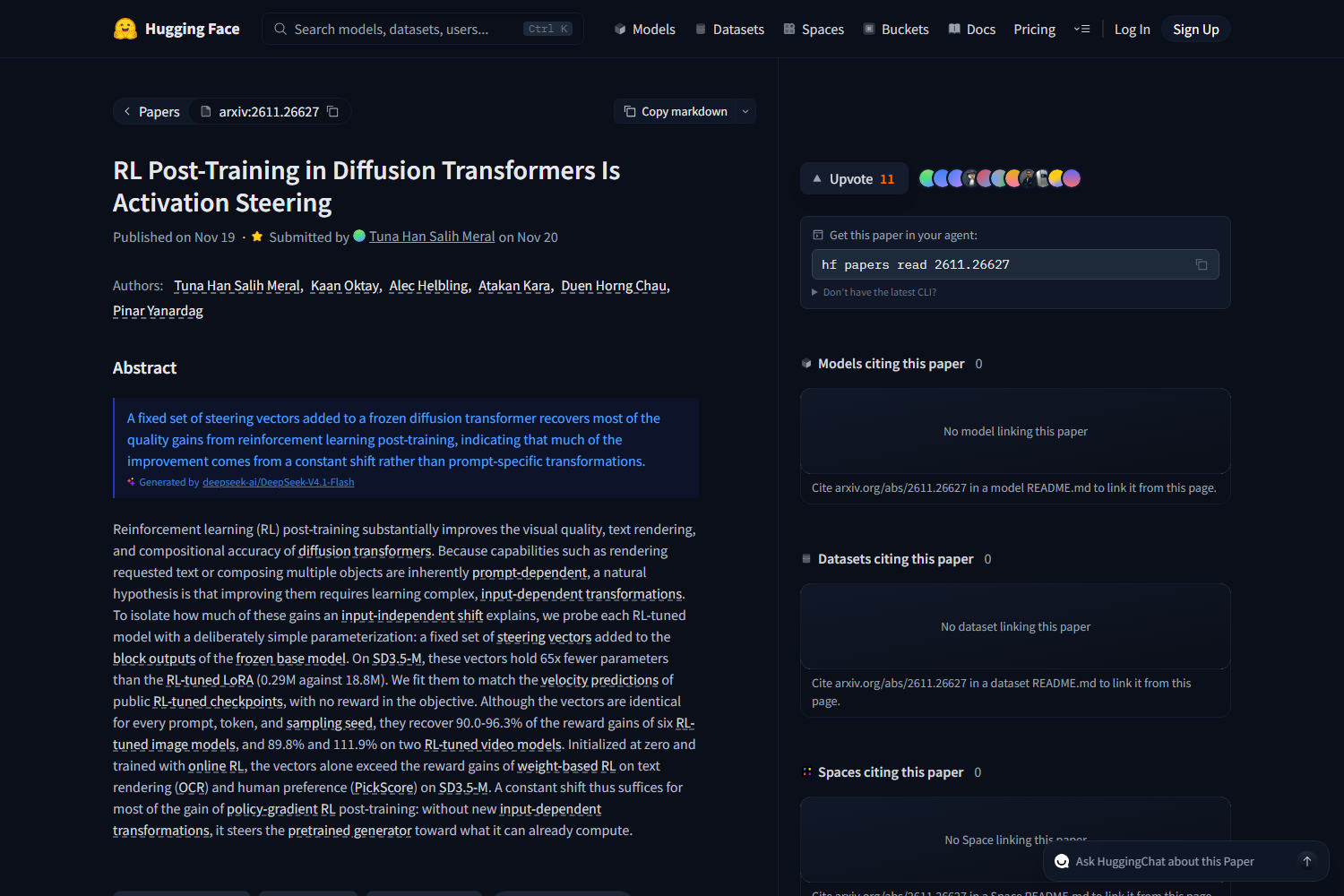
AI image generators improve mostly by a fixed nudge, not new tricks
A study finds that making Diffusion Transformer images look better after training hardly needs complex AI — just one constant adjustment works almost as well.
 How it worksAI scans 4,000 medical studies — most don't share useful codeHerald of AI
AI scans 4,000 medical studies — most don't share useful code
Researchers used AI to find out whether doctors and scientists can actually rebuild results from published studies, and the answer was mostly no.
 How it worksResearchers train AI so large language models can more easily rewire its vision circuitsHerald of AI
Researchers train AI so large language models can more easily rewire its vision circuits
A new training technique makes it far easier for text AI to rewrite the inner circuits of image-detection models.