SAMA reads your pulse from video — without any training or machine learning
A simple math method can estimate heart rate from a webcam, opening the door to health checks you could run on any phone without installing a special app.
A math program that counts your pulse from a normal phone-camera video, no training needed.
- Point your phone camera at your face
- Watch tiny colour shifts from each heartbeat
- Blend two colour signals and drop the noisy parts
- Get a beat-by-beat number with a trust score
What the method does
Most camera-based heart-rate tools today rely on machine learning models trained on large collections of labelled video and reference pulse readings. SAMA takes a completely different route. It treats the problem as pure signal processing — combining two well-known colour-based algorithms called POS and CHROM, which look for the faint colour shifts caused by each heartbeat flowing through facial skin 1.
Instead of picking one of those two signals, SAMA blends them together, weighting each one by how clean it looks at any moment. It then removes frequency bands where motion, skin-mask geometry, or background brightness create pulse-free noise, so the blended signal focuses on genuine heartbeat patterns rather than artefacts 1.
To follow the pulse smoothly through time, SAMA uses a Viterbi ridge tracker with a random-walk prior. In plain terms, it assumes the true heart rate changes gradually from frame to frame and picks the path through the data that matches that assumption best 1. The result is a continuous heart-rate track plus a confidence score for every short window, so the system can flag or discard moments that are too noisy to trust .
No parameter is learned from data, and no dataset-specific tuning is used, meaning the same fixed settings apply across all tested conditions 1.
What the numbers show
The paper reports tests on 218 recordings from 111 participants drawn from five public datasets: UBFC-rPPG, PURE, SUMS, M3PD, and a small two-participant subset of MMPD 1. All recordings were processed with the same fixed face box and scored using a re-implementation of the rPPG-Toolbox protocol .
Across those datasets, SAMA produced the lowest mean absolute error averaged over every protocol level tested:
- 4.40 bpm against 5.13 bpm for POS on the per-video protocol 1.
- 4.80 bpm against 5.43 bpm on 30-second windows 1.
- 5.05 bpm against 6.59 bpm on 10-second windows 1.
When the researchers excluded the 20 percent least confident windows, the pooled error on 10-second windows dropped further to 2.33 bpm from 4.06 bpm 1.
According to statistical analysis, the gains over POS reached significance on 10-second clips (p=0.004) but not on 30-second clips (p=0.11) once results were combined across participants. Additionally, the approach failed to surpass POS on the SUMS metric for each video or on the MMPD subset 1.
Importantly, the authors note that SAMA does not surpass the best published neural-network methods on UBFC-rPPG; they report their placement against those models without running the models themselves 1.
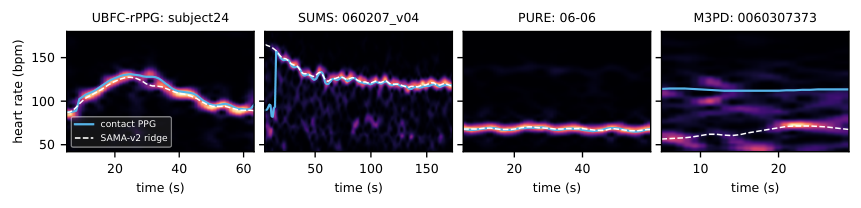
How SAMA measures pulse from your camera
From Mishra et al., arXiv:2611.28185
Why the approach matters beyond the scores
One practical claim in the paper is that standard benchmarks often collapse each video into a single heart-rate number, hiding the short windows in which tele-consultations would actually read a pulse. By design, SAMA returns per-window estimates with confidence, making it easier to see when a reading is trustworthy and when it is not 1.
The authors also highlight two broader observations. They found a measurement floor of about 1.2 to 1.6 bpm on datasets where heart rate drifts, suggesting there are hard limits to accuracy even with good methods 1. And they argue that skin tone cannot reliably be recovered from uncalibrated video, motivating a new instrumented, skin-tone-stratified data collection effort for Indian populations .
The work is openly available on arXiv under the identifier 2611.28185 1.
This story reports on a trend for information only. It is not advice or encouragement to do any of it.
Average mistake size in beats per minute between estimated and real pulse. Lower is better. Numbers: researcher Sudhakar Mishra, arXiv paper submitted 20 Nov 2026. Chart drawn by Herald of AI.
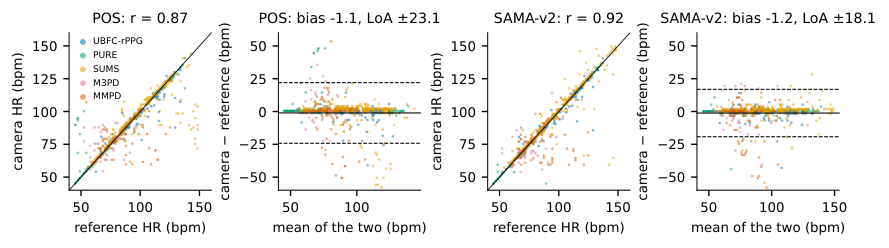
Figure: Mishra, arXiv:2611.28185, CC BY 4.0
Figure: Mishra, arXiv:2611.28185, CC BY 4.0
Corrections and updates
- Corrected on 24 November 2026. An earlier version claimed SAMA averaged 4.40 bpm across all five datasets, but the paper specifies that 4.40 bpm applies only to the per-video protocol; the replacement correctly breaks out the errors by protocol level. An earlier version implied the method's errors rose on shorter windows (suggesting worse performance), but the reported numbers are the same as the replacement states. Another earlier version claimed gains reached significance on both 30-second and 10-second clips, but the source gives p=0.11 for 30-second clips, which does not reach significance.
Key facts
- SAMA estimates heart rate from video without any training or neural networks
- It blends two existing colour-signal methods and adds motion-aware filtering and time-tracking
- On five public datasets, SAMA had a lowest mean absolute error of 4.40 bpm on the per-video protocol, beating the POS method; on shorter window protocols its errors were 4.80 bpm on 30 s windows and 5.05 bpm on 10 s windows
- Discarding low-confidence windows reduced 10-second error to 2.33 bpm
- It does not beat the best published neural-network methods on UBFC-rPPG
Sources
If this story concerns you or your company, or uses something that belongs to you, ask for a correction or for it to be taken down. How requests work
Keep reading
 How it worksA smarter way to test if AI defenses really hold up against clever attacksHerald of AI
A smarter way to test if AI defenses really hold up against clever attacks
Researchers found a cleaner way to evaluate whether AI image systems can resist carefully crafted tricks — and it makes the tests more reliable.
 How it worksGoogle finds AI assistants need you to spell out more than a human friend wouldHerald of AI
Google finds AI assistants need you to spell out more than a human friend would
A new testing framework from Google Research shows that chatbots you talk to for personal advice often miss what someone really meant, and they fail to make full use of the follow-up questions that could narrow the gap.
 How it worksTencent open-sources DFly2, boosting long-context AI throughput by up to 81%Herald of AI
Tencent open-sources DFly2, boosting long-context AI throughput by up to 81%
A new tool from Tencent lets AI models handle very long chats and documents without adding extra memory or slowing down when many users ask questions at once.