New AI agents switch between latent reasoning and text, cutting costs in tests
Researchers report that letting AI agents switch between internal latent reasoning and text can cut costs by more than half and speed up work.
An AI program that thinks in its own internal language and switches to words when needed, making it faster and cheaper.
- It thinks silently in its own internal language first
- When it needs a tool, it switches to writing words
- It keeps track of everything across the whole conversation
- It switches back and forth as needed to finish the task
A new kind of AI agent
A new paper argues that AI agents built on large language models do not have to choose between reasoning in their own internal form and acting through text: they can do both 1.
Modern AI agents reason and interact through text at every step 1. That keeps what they do readable, but it costs time and tokens. Latent reasoning, where a model works in its internal representations instead of words, is a more efficient medium, but on its own it has no built-in way to use tools such as search engines, and it is harder to see what the model is thinking .
Jiaru Zou and seven co-authors set out to combine the two. Their system, which the paper calls Hybrid Reasoning Agents or HybridAgent, moves between latent reasoning and text-based interaction within a single generation process 1.
How the switching works
The key piece is a lightweight component the paper calls HybridLink, which handles the transitions between text and latent modes 1. The agent also keeps a continuous working memory that, according to the paper, preserves the whole hybrid context without loss across several turns .
The authors say the design keeps the agent able to use tools while making its latent thoughts directly inspectable 1. So the internal reasoning is meant to be a faster way of thinking, not a hidden one.
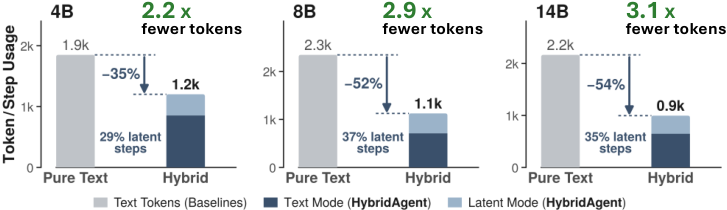
Switching between inner thought and text saves money and time
Author-reported results across 11 benchmarks in math, science, medicine, search and agentic reasoning; paper on arXiv, Oct 2026
Training methods
The researchers built two post-training steps for this. The first, HybridSFT, is supervised fine-tuning that teaches the underlying model to coordinate with HybridLink, so that hybrid generation with tools stays stable 1. The second, HybridRL, uses reinforcement learning to teach the model when to think in latent space and when to act through text .
Results
The paper reports tests at three model sizes across 11 benchmarks covering mathematics, science, medicine, search and agentic reasoning 1.
Compared with frontier LLM agents and agentic frameworks built on either text-based or latent methods, HybridAgent improved performance by 10.4 percent, according to the paper 1. It also used 35.5 to 54.7 percent fewer tokens, ran inference 1.8 to 2.6 times faster and cost 2.7 to 3.7 times less . These are the authors' own results, in a paper posted on arXiv on 13 October 2026 . The code and data are published on GitHub .
If the results hold up, they suggest agents can combine efficient internal reasoning with the text they need to act in the world, instead of having to pick one.
Corrections and updates
- Corrected on 20 October 2026. An earlier version said the paper mentioned 'web search' and 'agentic planning tasks'; the source says the benchmarks covered 'search' and 'agentic reasoning'.
- Corrected on 20 October 2026. That first correction also removed the statement that the code and data are on GitHub. It was wrong to: the paper's abstract gives the GitHub address, and the statement is back with the link. The story also described the lead author as a researcher at Stanford University, which the paper's page does not say, and presented the agent's internal reasoning as private, while the authors say it is designed to be directly inspectable. Both have been corrected, and a list of key facts that appeared twice has been removed.
- Corrected on 20 October 2026. The headline said the agents think in hidden code. Their internal (latent) reasoning is not code, and the authors say it is designed to be inspectable, so the headline now says what the paper describes.
Key facts
- HybridAgent switches between latent reasoning and text-based interaction in a single generation process
- A lightweight component, HybridLink, handles the switches between the two modes
- Training uses HybridSFT (supervised fine-tuning) and then HybridRL (reinforcement learning)
- Across 11 benchmarks the authors report a 10.4% performance gain, 35.5-54.7% fewer tokens and 2.7-3.7x lower cost
- The paper, by Jiaru Zou and seven co-authors, was posted on arXiv on 13 October 2026, with code and data on GitHub
Sources
Watch
If this story concerns you or your company, or uses something that belongs to you, ask for a correction or for it to be taken down. How requests work
Keep reading
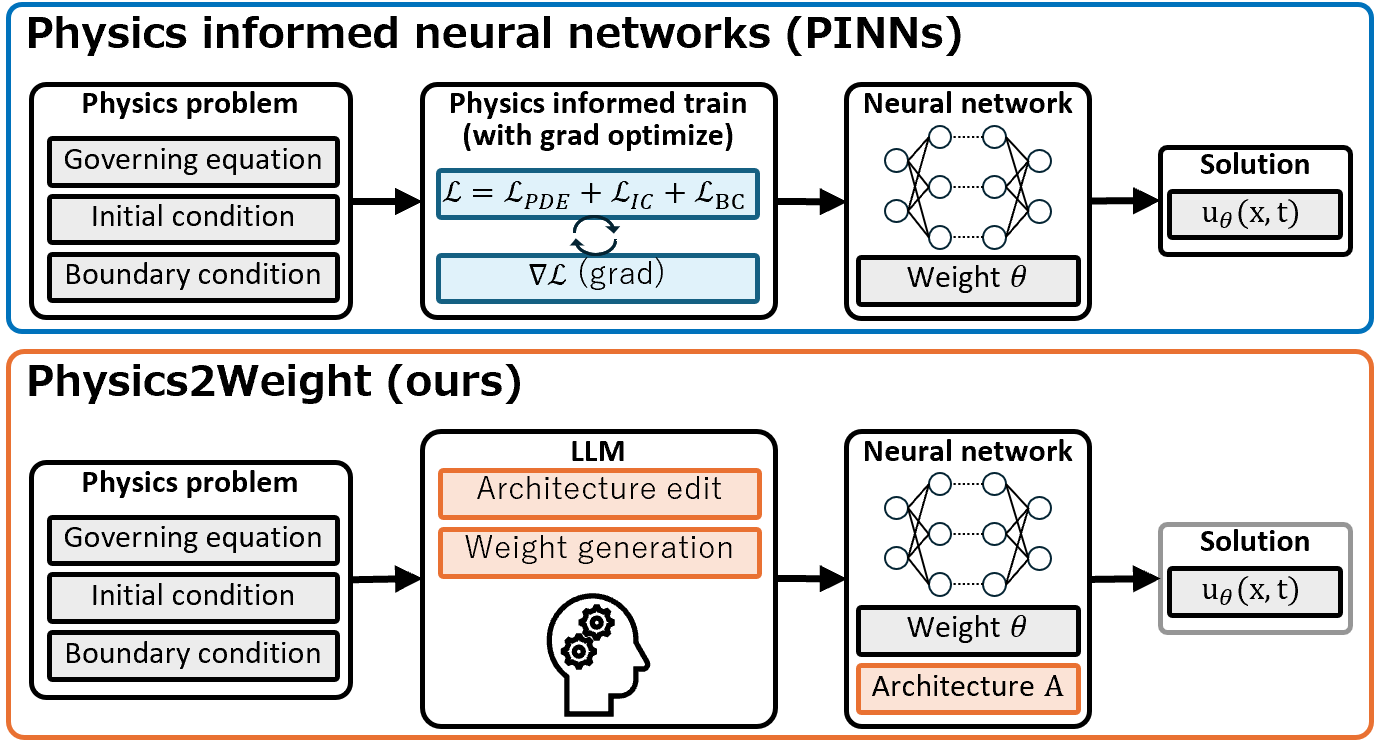 How it worksPhysicists now use AI to build neural networks directly from the laws of physicsHerald of AIFigure: Sato et al., arXiv:2611.12954, CC BY 4.0
Physicists now use AI to build neural networks directly from the laws of physics
A new method lets Physics2Weight create neural networks that solve real-world physics problems without the slow trial-and-error training most AIs need today.
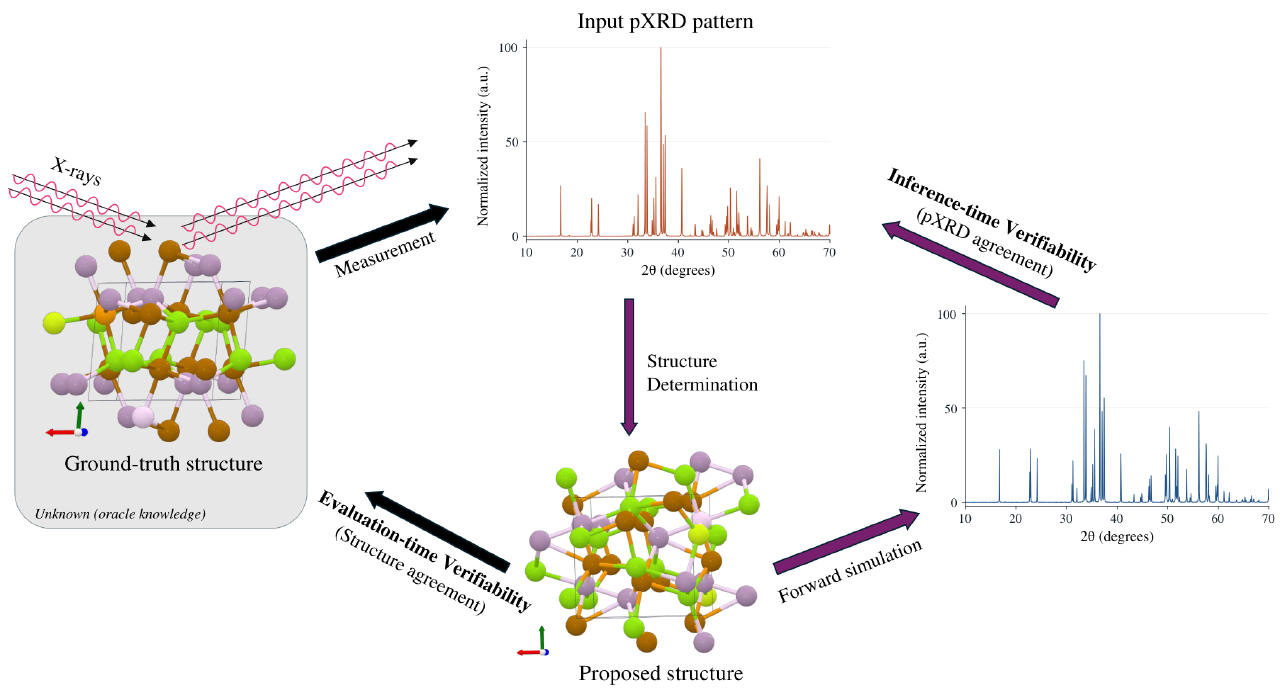 How it worksAI agents boost crystal structure recovery from 27% to 69%, potentially speeding up new material researchHerald of AI▶Figure: Chen et al., arXiv:2611.17539, CC BY 4.0
AI agents boost crystal structure recovery from 27% to 69%, potentially speeding up new material research
A new AI system uses large language model agents to figure out the arrangement of atoms in crystals from powder diffraction data much faster, which could accelerate drug discovery and new battery development.
LLM s make AI text harder to read because they optimize for info, not chat
A new study shows frontier GPT-6, Claude and similar models use complex grammar and rare words more than humans, making their output tougher to follow.