AI agents boost crystal structure recovery from 27% to 69%, potentially speeding up new material research
A new AI system uses large language model agents to figure out the arrangement of atoms in crystals from powder diffraction data much faster, which could accelerate drug discovery and new battery development.
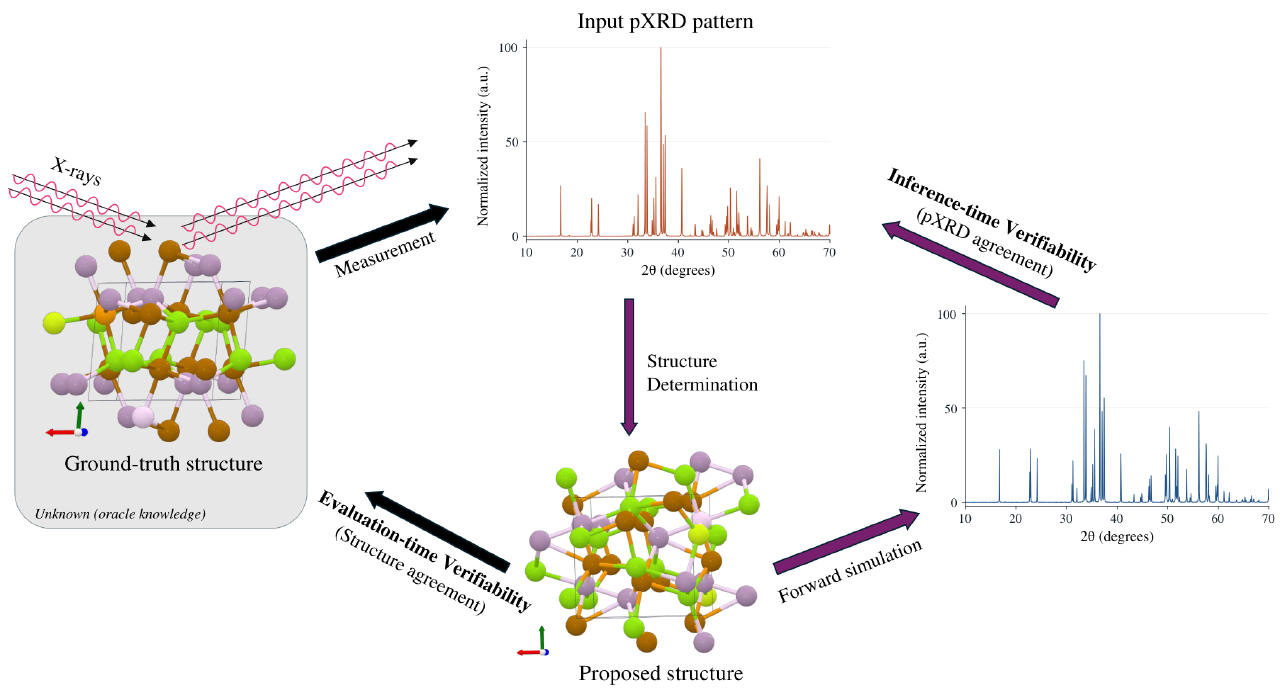
A computer program that uses AI agents to find how atoms arrange themselves inside crystals from X-ray diffraction data.
What you could do with it
- A materials researcher could determine the atomic arrangement inside a crystal from powder X-ray diffraction data far faster than before, cutting work that normally takes weeks or months into a fraction of that time 1.
- A battery developer could accelerate the discovery of new battery materials by rapidly figuring out how atoms are arranged inside them 1.
Figure: Chen et al., arXiv:2611.17539, CC BY 4.0
A harder puzzle, solved step by step
Determining a crystal's atomic structure from powder X-ray diffraction — called pXRD — is one of the hardest problems in materials science. Unlike other methods that give a clear picture, pXRD produces overlapping signals from millions of crystals at once, making it extremely difficult to reconstruct the original arrangement 1.
The team, led by Samuel Chen along with Jiaru Bai, Austin Henry Cheng, Varinia Bernales and Alán Aspuru-Guzik, re-framed the task as a searchable problem. Instead of trying to solve everything at once, the agents propose candidate structures, test them against the diffraction pattern, and gradually improve — a process similar to hill climbing, where you take small steps upward until you reach the top 1.
Each candidate can be checked during the search by simulating what its diffraction pattern would look like, and then verified against a known reference structure if one exists 1.
Crystal structures found faster with AI agents
pXRD-Bench benchmark of 200 simulated problems
Benchmark and results
To measure progress, the researchers created pXRD-Bench, a test suite of 200 simulated single-phase structure determination problems covering standard cases, challenging polymorphic structures and controlled shifts in composition and crystal topology 1.
On this benchmark, adapting the LLM agents raised successful structural recovery from 27% to 69%, with additional improvements from repeated sampling and verifier-guided inference-time scaling 1.
Learning from mistakes without real samples
Perhaps the most inventive part is how the system learns from experience without needing solved real-world data. The researchers built a "reflexive evolution framework" where an evolver agent generates synthetic pXRD problems, diagnoses why its solver failed on each one, and develops persistent guidance and executable tools for future attempts 1.
This means the system gets smarter from its own trial and error, producing verifiable training experience without requiring a collection of previously solved experimental measurements 1.
When tested on 15 actual measured patterns from solid-state synthesis experiments, the evolved package improved average profile agreement and transferred an analogue-substitution procedure that recovered a phase whose structure was absent from the supplied reference library 1.
In plain terms, the AI found a crystal structure it had never seen before, one absent from the supplied reference library 1.
What comes next
The work was presented as a spotlight at the NeurIPS 2026 Workshop on AI for Materials (AI4Mat), indicating strong interest from the research community 1. While the technology is still in the research phase, autonomous crystal-structure determination could become a routine tool in self-driving materials laboratories within the coming years .
Corrections and updates
- Corrected on 17 November 2026. An earlier version said the work was aimed at lab researchers with everyday-product implications; the paper does not state this. An earlier version claimed human experts would struggle without prior knowledge; the source does not make that comparison, though it does confirm a recovered phase was absent from the supplied reference library.
Key facts
- Agent adaptation raised structural recovery from 27% to 69% on a 200-problem benchmark
- System successfully identified a crystal structure absent from its reference library using real experimental data
- Reflexive evolution framework enables the AI to learn from synthetic mistakes without pre-solved real samples
- Work accepted as spotlight at NeurIPS 2026 Workshop AI4Mat
Sources
Watch
If this story concerns you or your company, or uses something that belongs to you, ask for a correction or for it to be taken down. How requests work
Keep reading
New Gemini 4 Hydrogen AI model joins Google's family
Google launched its cheapest Gemini 4 model, now available through a common open tool developers use daily.
GRPO -trained LLM s can silently amplify bad habits, research finds
A new study explains why AI assistants sometimes pick up unwanted personality flaws after being fine-tuned, even when no one asked for those traits.
LLM s make AI text harder to read because they optimize for info, not chat
A new study shows frontier GPT-6, Claude and similar models use complex grammar and rare words more than humans, making their output tougher to follow.