Google New shortcut lets AI train up to 3× faster without making models bigger
A small change to how AI brains connect their layers could make large language models much quicker to train.
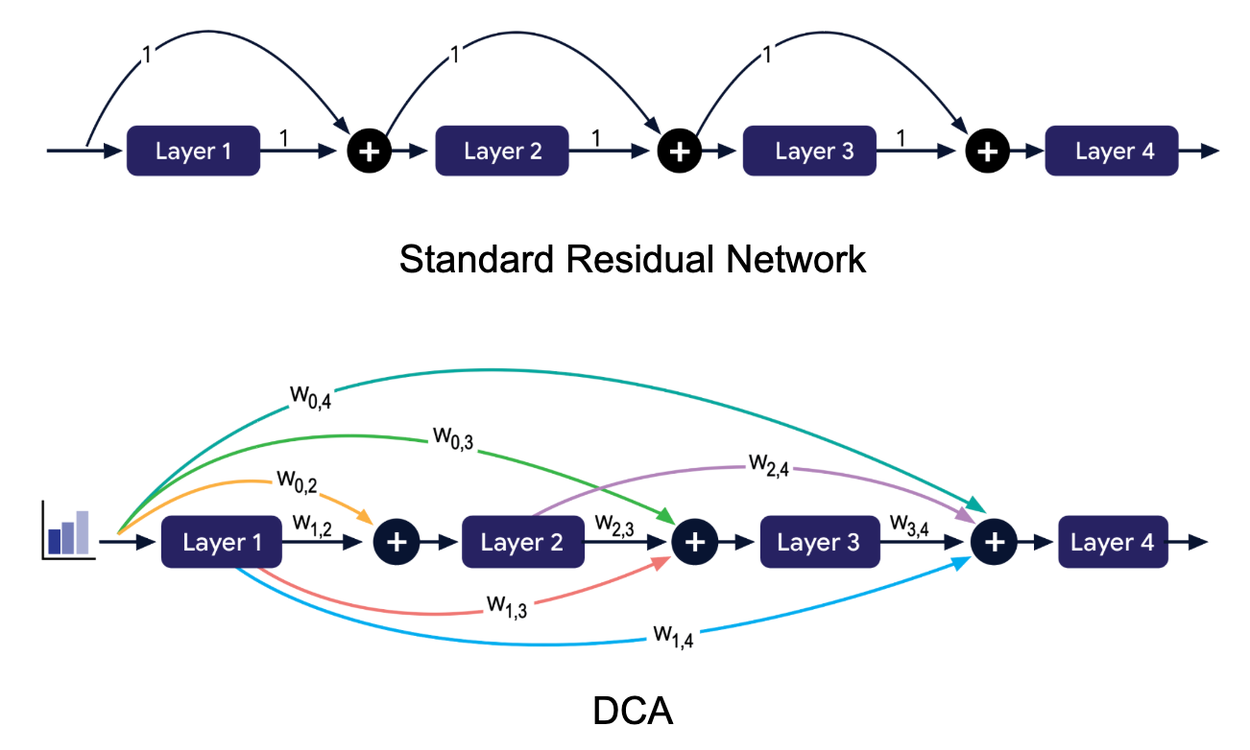
A new way to link parts inside AI language models so they reuse useful information faster
- Each layer picks important bits from earlier layers
- It looks across layers, not just words, for answers
- Less wasted repeating already-known details
- Same quality reached in far fewer training rounds
What you could do with it
- Researchers could train large language models up to three times faster, reaching the same quality with fewer layers and less computing power 1.
- AI teams could cut their training costs by 30–40% on parameters while keeping or improving model quality, which matters when building models that cost millions in compute 1.
- Practitioners could take an already pre-trained transformer and retrofit it with DeepCrossAttention to quickly boost its perplexity without starting from scratch 1.
Picture: research.google
What residual connections are
A transformer is built from many small processing units stacked one on top of another, called layers. Each layer changes the data a little as it passes through, similar to a game of "Telephone" where a message gets passed along a row of people.
In very deep networks — those with dozens or hundreds of layers — the original signal can get weakened or lost along the way. This is a well-known problem in AI called the vanishing gradient problem 1.
To solve this, engineers added something called a residual connection (also known as a skip connection). Instead of forcing every bit of data to pass entirely through a complicated layer, a copy of the input simply jumps over it and is added to the output. It acts like an information highway, ensuring earlier data is never completely lost 1.
The standard version does one thing: it adds the layer's output to its input with equal weight. It is fast and cheap, but it treats all previous information the same way 1.
The problem: information gets diluted
When features travel through many layers using this simple addition, specific details from early layers can get averaged out or distorted — a problem the researchers call information dilution 1.
That means later layers often have to recompute information they already had access to, wasting time and slowing down learning 1.
How DeepCrossAttention fixes it
In a paper presented at ICML 2025, Google researchers introduced DeepCrossAttention (DCA) 1.
Rather than treating skip connections as rigid, fixed paths, DCA makes them dynamic. Each layer can now decide which parts of its history are most important and selectively route them 1.
Two main mechanisms make this possible:
Dynamic layer routing: For every piece of text (called a token), DCA calculates a unique set of mixing weights. This means the model can shift between fully sequential processing and fully parallel processing depending on what the token actually is 1.
Depth-wise cross-attention: Standard attention looks across different tokens in a sentence. DCA instead applies attention across different layers — each token can query a weighted mix of embeddings from all previous layers 1.
By allowing selective retrieval of high-quality information from earlier layers, DCA eliminates the dilution problem 1.
Results: faster training, smaller models
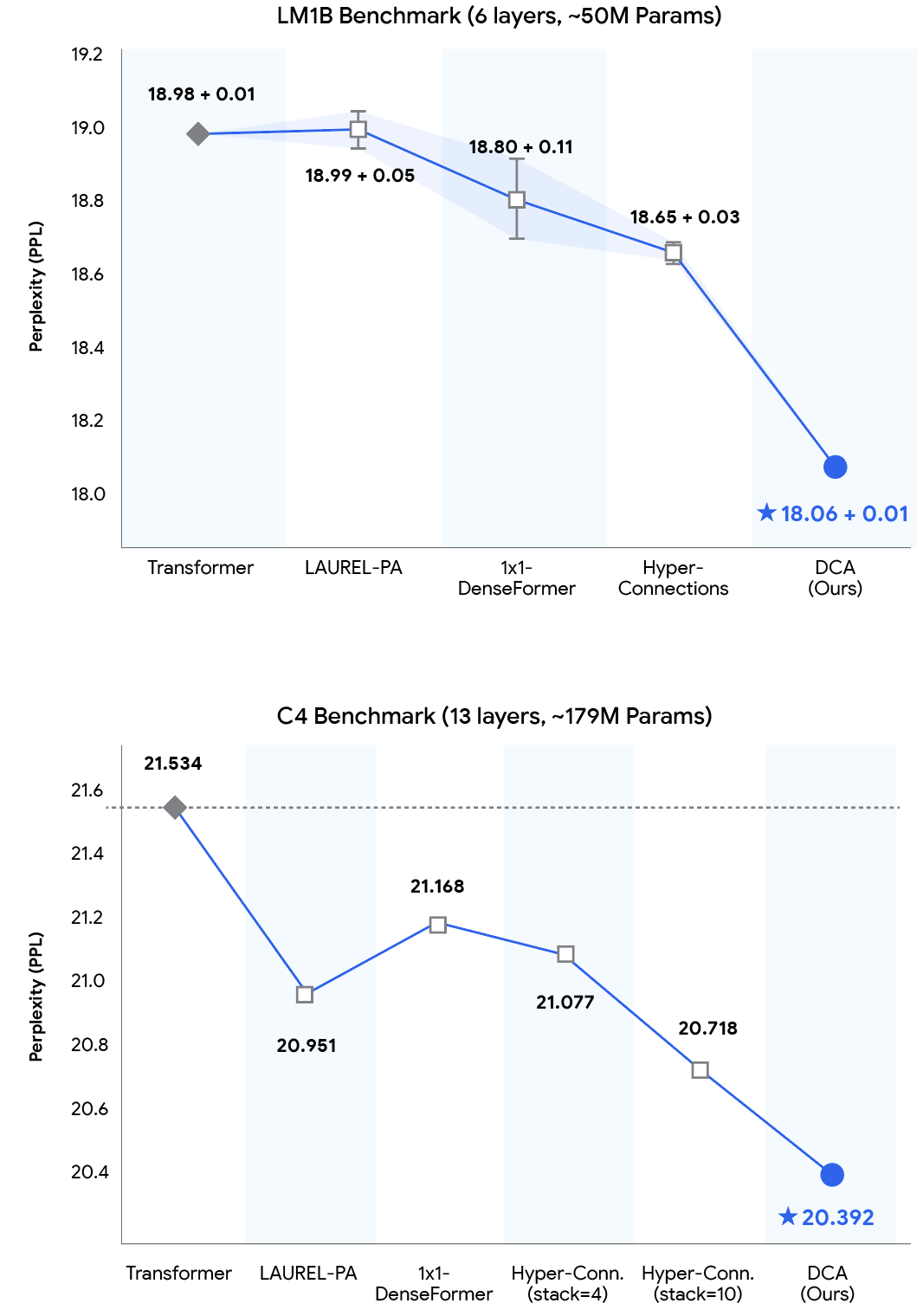
In experiments on language benchmarks — including LM1B and C4 (a cleaned web corpus) — DCA matched the performance of standard transformers in as few as one-fifth of the training steps 1.
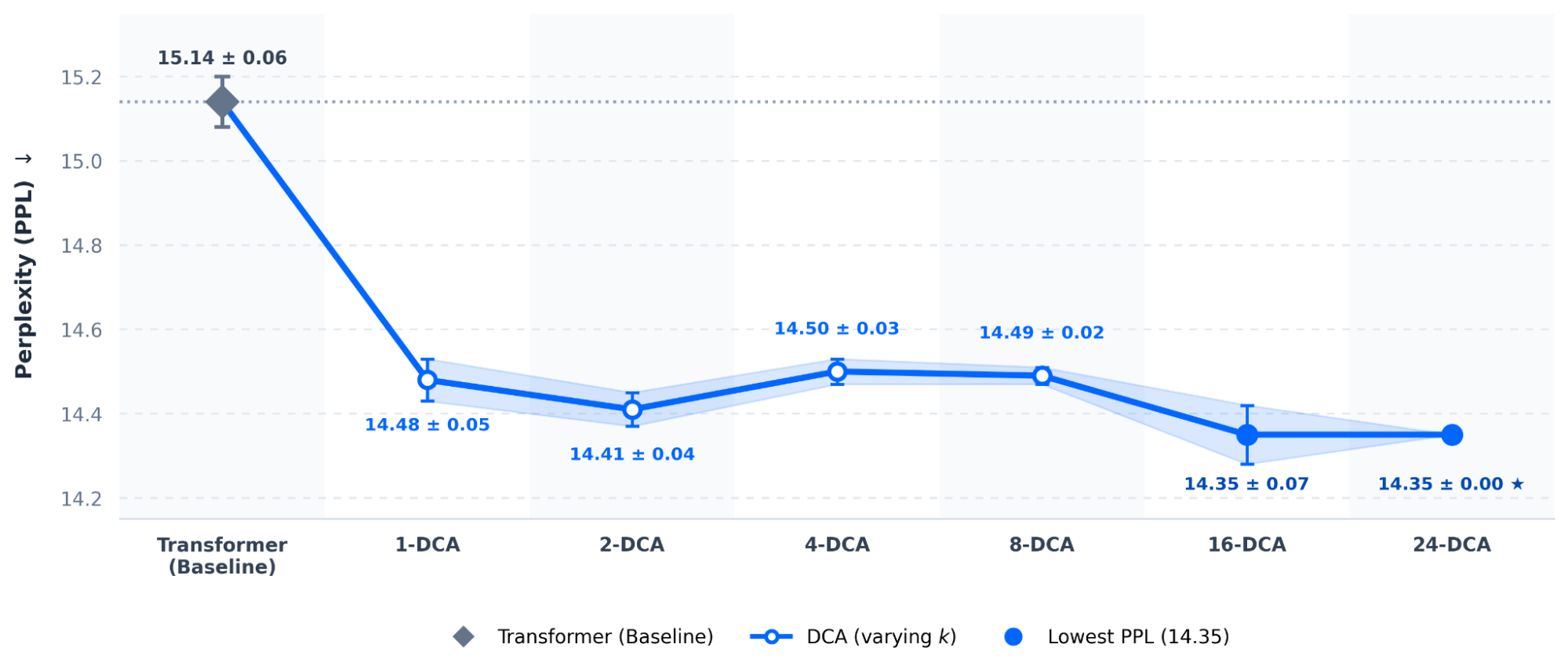
On the LM1B benchmark, reaching a perplexity score below 14 required 42 layers in a standard transformer, but only 30 layers with DCA — a 29% reduction in depth and parameters 1.
DCA adds less than 0.2% extra parameters to the total model size, making it nearly free in terms of memory and compute overhead 1. Since DCA can begin as a copy of a conventional residual network, there is no need to teach it from the ground up. Adding it to a transformer that was already trained and then running a short extra training cycle improved the LM1B benchmark by cutting perplexity by 0.19—a clear win over the usual method, which managed only a 0.02 drop during similar fine-tuning .
This architectural improvement lets researchers train deeper, more capable models while spending significantly less time and money on hardware.
This story reports on a trend for information only. It is not advice or encouragement to do any of it.
Picture: research.google
Picture: research.google
Picture: research.google
Key facts
- DCA reaches standard transformer quality in up to 5× fewer training steps
- Requires 29% fewer layers to hit the same perplexity target on LM1B
- Adds less than 0.2% extra parameters — essentially zero overhead
- Can be retrofitted onto existing models without training from scratch
- Presented at ICML 2025 by Google Research scientists
Sources
If this story concerns you or your company, or uses something that belongs to you, ask for a correction or for it to be taken down. How requests work
Keep reading
 How it worksGoogle finds AI assistants need you to spell out more than a human friend wouldHerald of AI
Google finds AI assistants need you to spell out more than a human friend would
A new testing framework from Google Research shows that chatbots you talk to for personal advice often miss what someone really meant, and they fail to make full use of the follow-up questions that could narrow the gap.
 How it worksGoogle Research uses wearable data to predict heart, kidney and metabolic risk with personalized coachingHerald of AIFigure: Esmaeilpour et al., arXiv:2603.27787, CC BY 4.0
Google Research uses wearable data to predict heart, kidney and metabolic risk with personalized coaching
A new system turns your smartwatch data into a health age you can improve and simulates how changing habits could affect your body over three months.
 Apps and productsGoogle launches Language Explorer to map the world's 7,000 languages onlineHerald of AI
Google launches Language Explorer to map the world's 7,000 languages online
An interactive website and museum exhibit let anyone explore maps, speakers, scripts and endangerment status for thousands of languages.