FIG-MAC, an AI team of agents, drafts scientific hypotheses better than current methods
Researchers built a system where several AI agents with different roles brainstorm, check, and test scientific ideas together, and it beats existing tools at coming up with fresh, cross-field conjectures.
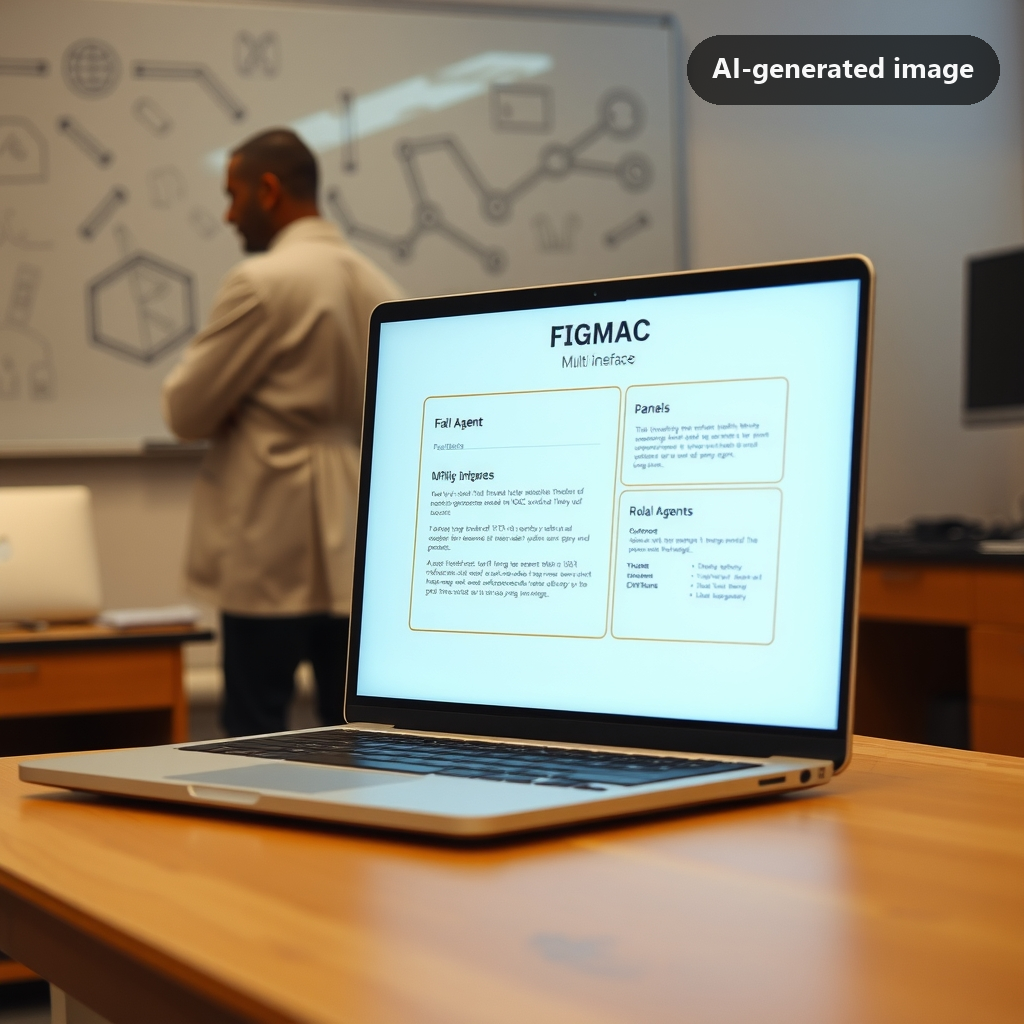
- Feed it a pile of academic papers
- It maps how the ideas connect
- It traces each step to evidence
- A team of agents tests the idea
What you could do with it
- A scientist or researcher could use FIG-MAC to brainstorm testable ideas that cross different academic fields instead of staying inside one topic 1.
- A lab team could plug FIG-MAC into its workflow and let the system generate and validate scientific hypotheses 1.
- A researcher could feed the system a pile of academic text and receive back a traceable chain of reasoning—each step linked to supporting evidence from vector search—that leads to a fresh cross-field conjecture 1.
The problem it tries to solve
Scientists spend a lot of time forming new ideas: "What if this protein folds this way because of that signal?" A team of researchers including Siyuan Chen, Yuping Gao, Tai Huang, Yuling Zhou, Dongyu Su, and Tongguan Wang wanted AI to help, but they found that existing tools had three weaknesses. First, they fed the AI a big, unstructured pile of text, which made it hard for the model to actually reason about the details. Second, there was no record of how one idea led to the next, so the AI could not build a truly new cross-field conjecture. Third, a single AI doing everything at once does not mimic how a real lab team works, where different experts handle different steps. 1
What FIG-MAC touches
- Siyuan Chen et al.researchers who built and published the system
- Academic textmessy pile of papers fed into the system as input
- Cross-field hypothesesfresh testable ideas spanning different scientific fields
- Scientists & lab teamswho would plug it into their workflow to brainstorm experiments
- Existing single-model toolswhat FIG-MAC outperforms on source diversity and novelty
The story reports qualitative wins; no specific scores are published.
How FIG-MAC works
FIG-MAC tackles all three problems with three linked modules. The first, called the Fine-grained Inspiration Graph, turns a blob of academic text into a structured map: each "node" is an academic semantic unit and each "edge" encodes a heuristic relationship between units. Think of it as turning a messy whiteboard into a tidy flowchart the AI can actually follow. 1
The second module is an ontology-guided hybrid reasoning step. It walks the flowchart to build a chain of reasoning, then uses vector search (a way to look up similar text by meaning, not just keywords) to fill in supporting evidence. The result is a traceable path: you can see exactly which facts fed into which step, so the idea is not just "the AI said something." 1
The third module is a role-specialized team of AI agents, inspired by how a real scientific group divides work. The agents, each with a specialized role, carry out a closed loop of conjecture generation, screening, and validation. This closed loop of generate-screen-validate mirrors how a lab team would actually test a new idea before writing it up. 1
How it compares to existing methods
In the paper's experiments, FIG-MAC significantly outperforms state-of-the-art methods on three measures: source diversity (how many different papers and fields the hypotheses draw from), provenance-adjusted novelty (how new an idea is once you subtract out the sources that inspired it), and raw novelty (how new the idea looks on its face). The authors report that FIG-MAC wins on all three. The paper does not publish specific score numbers in its abstract. 1
What comes next
The system is a research prototype, not a product you can download today. The authors framed it as a step toward a future where a team of AI agents can efficiently produce innovative, verifiable scientific hypotheses. Whether that works outside the lab's carefully chosen test set, and whether the hypotheses are actually useful to working scientists, will need further independent validation. 1
How good is it
In the authors' experiments, FIG-MAC significantly outperforms state-of-the-art methods on three measures: source diversity (how many different papers and fields the hypotheses draw from), provenance-adjusted novelty (how new an idea is once you subtract out the sources that inspired it), and raw novelty (how novel the idea is overall) 1. A higher score on each of those measures means the system is pulling from more varied literature and producing ideas that are genuinely new rather than just rewording what is already known . The tests were run by the paper's authors—Siyuan Chen and five co-authors—and the abstract reports that FIG-MAC outperforms but does not give specific numeric scores .
Key facts
- FIG-MAC combines a structured knowledge graph, traceable reasoning paths, and a multi-agent team to generate scientific hypotheses.
- On source diversity, provenance-adjusted novelty, and raw novelty, it surpasses the best existing methods.
- The paper was submitted to arXiv on 25 November 2026 by Siyuan Chen and five co-authors.
- The framework targets Automated Scientific Hypothesis Generation, a task where LLMs propose testable conjectures across fields.
- The multi-agent loop (propose, screen, validate) mimics the division of labor in a real research team.
Sources
If this story concerns you or your company, or uses something that belongs to you, ask for a correction or for it to be taken down. How requests work
Keep reading
 Apps and productsFacebook's Your Algorithm type a topic, and the AI reshapes your whole feedHerald of AI▶
Facebook's Your Algorithm type a topic, and the AI reshapes your whole feed
For the first time you can tell the recommendation engine in everyday words what to show more or less of, and it updates across Feed, Reels and Explore at once.
 How it worksNew study AI alert-triage tools cut 90% of false alarms but miss up to 44% of real attacksHerald of AIFigure: Canale, arXiv:2611.33470, CC BY 4.0
New study AI alert-triage tools cut 90% of false alarms but miss up to 44% of real attacks
The research shows why letting an AI model close security alerts on its own is risky: it clears the noise but also buries genuine threats, and adding more training can make things worse.
SpecEvo uses multi-LLM coordination to slash scientific discovery API costs by up to 80%
A new framework lets lightweight models do the heavy lifting in evolutionary search while saving frontier-model reasoning for strategic interventions.