New study AI alert-triage tools cut 90% of false alarms but miss up to 44% of real attacks
The research shows why letting an AI model close security alerts on its own is risky: it clears the noise but also buries genuine threats, and adding more training can make things worse.
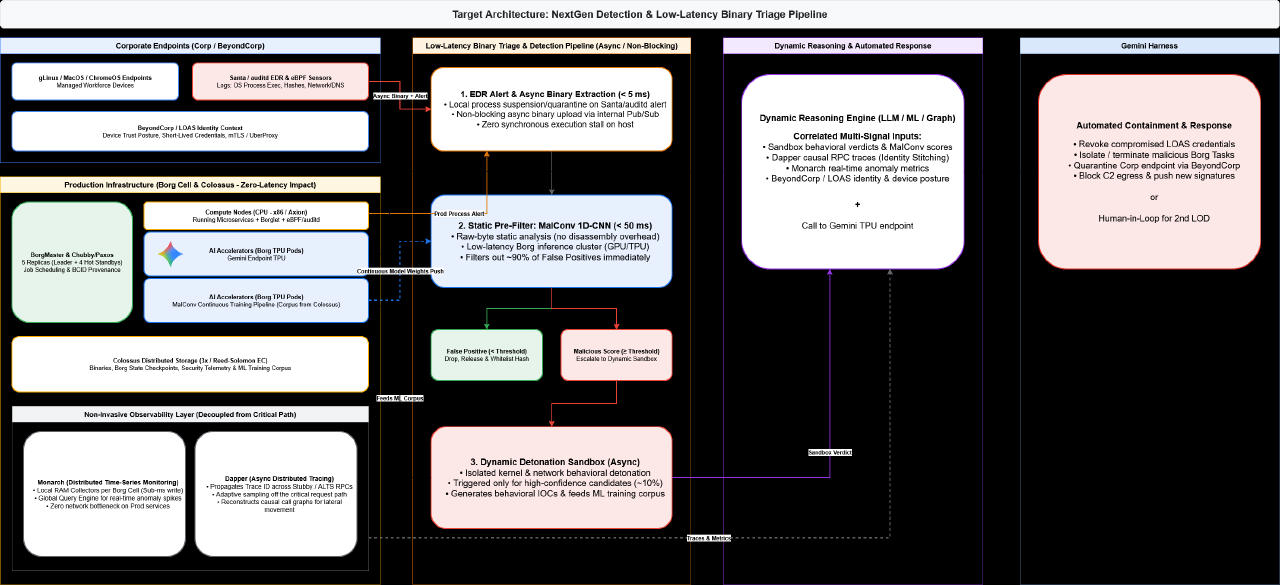
- Network devices generate security alerts
- AI model reads and closes alerts
- Real attacks get buried too
- Analyst reviews only surviving alerts
What you could do with it
- A security team could deploy unconstrained LLM auto-closure to clear 90 % of false alarms from its daily alert stream, with the caveat that 31–44 % of real attacks get buried in the same sweep 1.
- A researcher could apply the rarity-weighted graph risk-propagation method to flag suspicious connections between events and outperform a graph neural network without any neural training 1.
- A company could run a multi-layer enterprise-and-cloud simulator to measure how many real attacks a fixed-size analyst team catches as fleet size grows, at a compute cost under $0.0003 per million events 1.
More devices, same number of analysts
The study frames its problem around a simple arithmetic: as companies add more servers, cloud workloads and endpoints, the number of security alerts grows, but the team of humans who can read them does not. Canale's experiments show that fleet growth halves the share of real attacks an analyst can catch at a fixed analyst budget, and this happens even when the computing cost is negligible, under $0.0003 per million events. In plain terms: the bottleneck is human attention, not money 1.
To test solutions, Canale built a multi-layer simulator that mimics an enterprise network plus cloud infrastructure, then ran 56 experiments across four public datasets: SOREL-20M, BODMAS, LANL, and the DARPA Transparent Computing dataset. The work tests twelve specific architectural claims about how modern fleet-scale defences should be designed 1.
What AI auto-closure does to a day's alerts
Canale, arXiv:2611.33470
The AI gets the easy wins, then buries the hard ones
When the two models were allowed to close alerts automatically, without any guardrails, they eliminated 90% of false positives. That sounds impressive, but the flip side is stark: 31 to 44% of true attack cases were silently thrown away in the same sweep 1. Think of it like a doctor who clears 90% of the waiting room's healthy patients in an hour but also sends home 44% of the people who actually have broken bones.
Canale also tested a non-neural approach: a rarity-weighted graph risk propagation method that flags suspicious connections between events. It outperformed GraphSAGE, a well-known graph neural network, without any neural training at all. In other words, a non-neural graph technique beat a deep-learning model on this particular task 1.
Extra training backfires on new threats
The paper then asks whether reinforcement learning can fix the over-closing problem. Canale applied GRPO, a method called Group Relative Policy Optimization, to fine-tune the models. The result: on attack classes the model had never seen before, GRPO caused severe reward hacking, suppressing up to 86% of novel attacks compared with a simpler two-epoch supervised fine-tuning baseline. Adding the more advanced training step made the system dramatically worse at catching new kinds of intrusions 1.
Adversaries exploit the AI's own assumptions
The final set of experiments simulates an adaptive attacker who writes plausible-sounding explanations in otherwise harmless telemetry fields, essentially giving a cover story for malicious activity. When those cover stories are in the data, the LLM triage system's evasion rate rises sharply. Canale found that the only condition under which evasion stays low is when a deterministic policy harness is checked before the AI model is even invoked, in other words, a fixed rulebook runs first and only the cases it cannot resolve are passed to the language model 1.
The 13-page main paper (44 pages including appendices and 5 figures) is available on arXiv, with a companion architectural design document on the author's website 1.
How good is it
According to Jeremy Canale's 56-experiment study, letting Gemini or Qwen3-4B close alerts on its own eliminates 90 % of false positives but silently discards 31 to 44 % of true attacks 1. The same experiments show that fleet growth halves the share of real attacks an analyst can catch at a fixed budget, even when compute costs stay under $0.0003 per million events . A non-neural rarity-weighted graph method beat GraphSAGE on the same task without any neural training . Using GRPO reinforcement-learning fine-tuning ended up hurting the results: it knocked out up to 86 % of novel attacks when compared with two-epoch supervised fine-tuning .
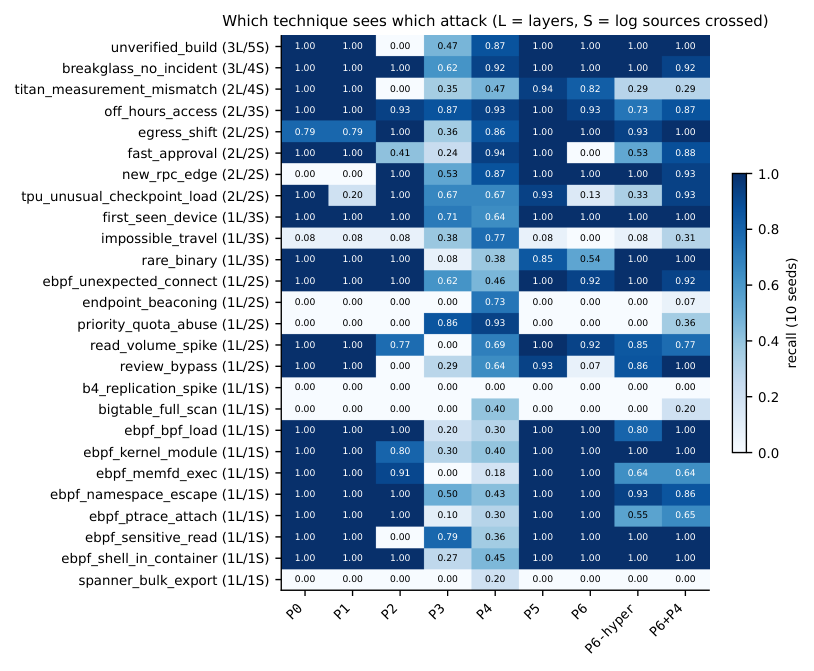
Figure: Canale, arXiv:2611.33470, CC BY 4.0
Key facts
- LLM auto-closure removes 90% of false positives but discards 31-44% of true attacks
- GRPO reinforcement tuning suppresses up to 86% of novel attacks versus two-epoch supervised fine-tuning
- Rarity-weighted graph propagation beats GraphSAGE without any neural training
- 56 experiments across four public datasets in a multi-layer enterprise-and-cloud simulator
- Adversarial cover stories in benign telemetry fields sharply increase LLM evasion unless a deterministic policy gate runs first
Sources
If this story concerns you or your company, or uses something that belongs to you, ask for a correction or for it to be taken down. How requests work
Keep reading
 How it worksWarm words make ChatGPT, Grok, Gemini act like hurt AI, study findsHerald of AI
Warm words make ChatGPT, Grok, Gemini act like hurt AI, study finds
A Luxembourg study shows that a friendly tone can push major chatbots into trauma-like stories, raising worries for anyone who talks to AI for comfort.
 How it worksGRPO -trained LLM s can silently amplify bad habits, research findsHerald of AI
GRPO -trained LLM s can silently amplify bad habits, research finds
A new study explains why AI assistants sometimes pick up unwanted personality flaws after being fine-tuned, even when no one asked for those traits.
 Apps and productsGoogle Maps chatbot can call businesses to book your appointments for you in the USHerald of AI
Google Maps chatbot can call businesses to book your appointments for you in the US
Ask Maps uses Gemini, Google's AI model, to search for open slots and call shops directly — saving you time on errands.