Researchers Found a Way to Take Over OpenAI 's ChatGPT Accounts With Just a Link
A security team showed how opening a shared ChatGPT link could let a stranger read your private conversations and act as you — the fix has been published.
What you could do with it
- An attacker could create a malicious ChatGPT conversation, publish it with the normal share feature, and send the link to a signed-in user to exfiltrate that user's private conversation data to an external server 2.
- A security researcher could use the discovered flaw to demonstrate that opening any shared ChatGPT link while logged in grants full access to the victim's authenticated account session 2.
- An attacker could read content from private conversations never shared with them and perform actions on the victim's ChatGPT account without the victim installing anything or opening developer tools 2.
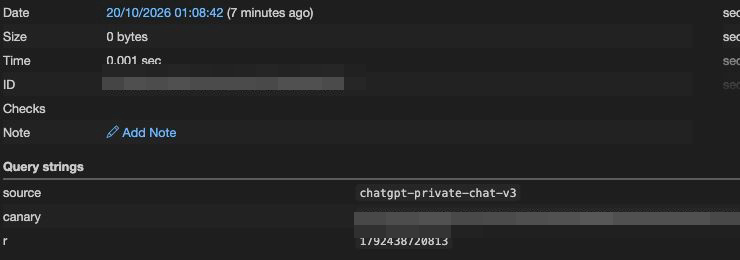
Picture: parameter.ai
How the trick worked
The problem started with two features that looked harmless on their own: the graph tool and the HTML Preview window.
When ChatGPT creates an HTML preview, it runs the code inside a restricted frame on a different web address. The browser treats that frame as a separate website, so the code inside should not be able to read or touch the main ChatGPT page around it. That part worked as intended — at least until the researchers traced one unexpected connection.
OpenAI uses the MathLive JavaScript library to support math graphs. MathLive includes its own virtual keyboard, and that keyboard can be triggered from inside the sandboxed frame using a browser feature called postMessage(). The code on the main page that receives those messages then uses innerHTML, a method that inserts raw HTML into a page. Because there was no check stopping other sandboxed frames from calling that same method, any iframe — including a preview window — could inject custom HTML into the main ChatGPT page 2.
From there the path was clear. The injected HTML created a new iframe without sandbox restrictions. OpenAI's content security policy (CSP) rules blocked inline scripts and only allowed code from a few trusted domains. One of those allowed domains was YouTube. The YouTube oEmbed endpoint could be made to return JavaScript, which then ran inside the victim's signed-in session 1.
Once the attacker's code was running as the logged-in user, it could call ChatGPT's private APIs directly. It could list all of the victim's conversations, read content from private chats that had never been shared, and send all of that data to an external server — for example by hiding it inside an image URL 2.
What was possible
The researchers confirmed they could create a malicious conversation, publish it using ChatGPT's normal share feature, and send the link to another person. When the victim opened the link, the payload ran automatically with full access to that person's authenticated session on chatgpt.com. No app installation, no project join, no developer tools, no pasting code — just opening the link 2.
The fix and the reward
OpenAI fixed the vulnerability on October 26, 2026, and classified the report as a P1 — the highest severity level. The company paid Parameter Labs a $5,000 bug bounty. Blog writer Simon Willison said he thought the payout was too low for a flaw this serious 1.
This story reports on a trend for information only. It is not advice or encouragement to do any of it.
Key facts
- Parameter Labs found a P1 vulnerability in ChatGPT that let an attacker run JavaScript in a victim's signed-in session by sharing a link.
- The exploit crossed a sandbox boundary using MathLive's postMessage() and innerHTML to inject a new unrestricted iframe.
- YouTube's oEmbed endpoint was used as a loophole to load and execute JavaScript under OpenAI's content security policy.
- OpenAI fixed the issue on October 26, 2026, and paid a $5,000 bug bounty.
- No action was needed from the victim beyond opening the shared link.
Sources
Keep reading
 The weekThis Week in AI Agentic Tools, Cheaper Models, and Growing PainsHerald of AI▶The week
This Week in AI Agentic Tools, Cheaper Models, and Growing Pains
OpenAI reports agentic adoption in the EU, new models push one-million-token outputs, and developers wrestle with faster-but-opaque code.
 Made with AIChatGPT now fills answers with pictures, charts, and buttonsHerald of AI
 Made with AIWhy early AI was designed to be random — and why we stopped liking itHerald of AI▶
 How it worksttok 1.0 Updates Token Counting Tool to Match New OpenAI ModelsHerald of AIPaul Downey from Berkhamsted, UK, CC BY 2.0, via Wikimedia Commons
Related stories
 Made with AIMeta launches Style Sketch, an AI app to virtually try on clothes from your own wardrobeHerald of AI▶
Meta launches Style Sketch, an AI app to virtually try on clothes from your own wardrobe
Meta has quietly released an AI fashion app that builds a digital closet from your photos and suggests outfits — but it's only available in three Asian countries for now.
 The weekThis Week in AI New Models Flood In and Agents Get SaferHerald of AI▶
This Week in AI New Models Flood In and Agents Get Safer
Big open-weight releases, speed breakthroughs, and a push to make AI agents more reliable and secure.
 New modelsAI finds critical PHP flaws, triggers global patch responseHerald of AI▶
AI finds critical PHP flaws, triggers global patch response
OpenAI says frontier AI models uncovered two critical vulnerabilities in PHP before attackers likely could, launching a coordinated worldwide defense effort.
 How it worksOmnara offers open-source alternative to managed AI agentsHerald of AI▶
Omnara offers open-source alternative to managed AI agents
A new self-hostable platform lets developers run AI agents on any model without relying on proprietary services.