Simon Willison Updates llm-gemini to Support New Gemini 4 Argon Model
The developer behind the popular llm plugin adds Google's latest low-cost model, which promises strong performance at a fraction of rival prices — at least until December.
New model support for a favorite tool
Simon Willison has updated his llm-gemini plugin, adding support for Google's newest offering: Gemini 4 Argon. The model launched through the Gemini API on October 13, 2026, and is available to subscribers of Google's $100 per month plan 1.
Willison called the new model "excellent" after testing it across multiple difficulty levels using SVG image generation tasks — a category where Google's labs have historically excelled. He noted that Google is the only AI lab he knows of that has invested specifically in SVG quality and has publicly showcased its pelican illustrations before 1.
Pricing that may not last
At launch, Gemini 4 Argon costs $2 per million input tokens and $10 per million output tokens. That makes it half the price of Claude Opus 5.5 and one-fifth the cost of Claude Fable 5.1, GPT-6 Astra and GPT-6 Sol 1. But those rates are temporary: on December 1, the price doubles, bringing Argon in line with Opus 5.5's pricing tier.
Willison warned that list prices alone don't tell the full story. What really matters in practice is how many tokens a model needs to complete a task inside an agentic system — the kind of setup where AI tools plan and execute multi-step workflows autonomously.
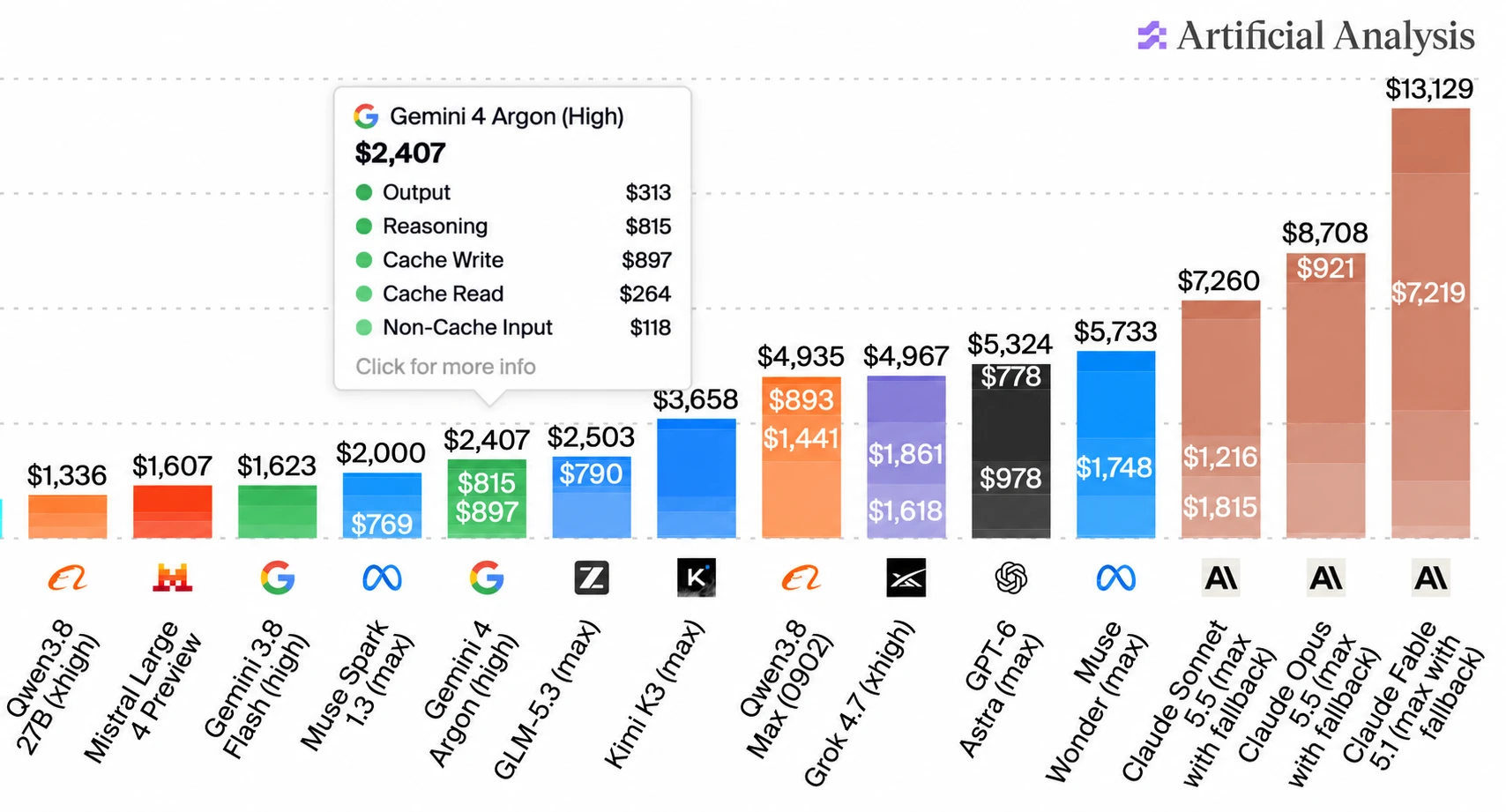
Data from Artificial Analysis, which tracks real-world benchmark costs, puts Gemini 4 Argon at $2,407 to run its test suite — significantly cheaper than the latest models from OpenAI, Anthropic and Meta 1. Even after the December price increase, Argon would remain cheaper than GPT-6 Astra.
Gemini 4 Argon's price will double on December 1
Artificial Analysis real-world benchmark data; launch October 13, 2026
Creative outputs and community sharing
Willison shared several examples generated with Argon, including an SVG of an armadillo in fishnet tights walking across Mars and a Blender-based rendering of a Fabergé egg. A DeepMind staffer known as @fofrAI also posted a video of a pelican riding a bicycle created using fourier epicycles — a mathematical technique that builds complex shapes from rotating circles 1.
The update highlights how individual developers continue to shape the AI landscape, quickly adapting open tools to incorporate the latest proprietary models as they arrive.
Key facts
- llm-gemini 0.35 adds support for Google's Gemini 4 Argon model
- Argon launches at $2 per million input and $10 per million output tokens
- Prices double on December 1, 2026, removing the discount against rivals
- Artificial Analysis benchmarks Argon at $2,407, cheaper than OpenAI, Anthropic and Meta models
- Simon Willison tested the model on SVG generation and called it excellent
Sources
If this story concerns you or your company, or uses something that belongs to you, ask for a correction or for it to be taken down. How requests work
Keep reading
 The weekThis Week in AI New Models Flood In and Agents Get SaferHerald of AI
This Week in AI New Models Flood In and Agents Get Safer
Big open-weight releases, speed breakthroughs, and a push to make AI agents more reliable and secure.
 New modelsMeta's Muse Wonder Brings It Back to the AI FrontierHerald of AI
Meta's Muse Wonder Brings It Back to the AI Frontier
Meta's newest models rival the best from OpenAI and Anthropic, marking a major comeback after years of falling behind.
 Business and rulesMirendil raises $1 billion to use AI agents for faster model developmentHerald of AI
Mirendil raises $1 billion to use AI agents for faster model development
A new startup founded by former Google DeepMind and Anthropic researchers says its automated platform lets small teams build large AI models quickly and cheaply.