Mirendil raises $1 billion to use AI agents for faster model development
A new startup founded by former Google DeepMind and Anthropic researchers says its automated platform lets small teams build large AI models quickly and cheaply.
Mirendil's Lor platform uses AI robots to automatically write code and train large language models with minimal human help.
- AI agents write most of the training code
- Agents set up computing infrastructure themselves
- Agents run experiments and fix errors automatically
- A small team watches the results come together
What you could do with it
- A small research team could use the platform to build large AI models quickly and cheaply without needing dozens or hundreds of specialists 1.
- A single researcher could build a coding-specialized LLM entirely on their own using AI agents to write code, set up infrastructure, find training algorithms, and gather training data 2.
- Companies could automate much of the trial-and-error workflow of model training, letting AI agents run experiments and fix errors automatically 1.
An exampleInvented to explain it
Maya, a solo researcher wanting to build a coding AI
MayaCan I build a coding model all by myself?
Lor agentYes — we wrote 99 percent of the code.
MayaHow much will this actually cost?
Lor agentLess than $10 million, including everything.
MayaDo I need to buy any training data?
Lor agentNo — we used only free online material.
Maya completed the entire project in about three and a half months working alone.
The round
Mirendil announced the $1 billion Series A investment on November 13, 2026 1. It was jointly led by venture firm Kleiner Perkins and private-equity firm Clearlake Capital, with more than six other investors joining, including Google .
The startup was founded the previous year by two researchers formerly at Google DeepMind and Anthropic 1. Chief Executive Officer Behnam Neyshabur co-invented SAM, an approach that helps AI systems handle tasks they were not specifically trained for . Chief Technology Officer Harsh Mehta worked on pretraining projects at both Google DeepMind and Anthropic .
What the company has built so far
Mirendil's first product is a platform called Lor that automates many steps involved in running experiments to train models 1. According to the company, Lor splits work among hundreds of AI agents — software programs that can carry out tasks on their own . Most model development involves lots of trial and error: researchers create different versions of an algorithm and compare them to see which works best . Lor is designed to handle that process automatically, and even fix errors that show up during evaluation .
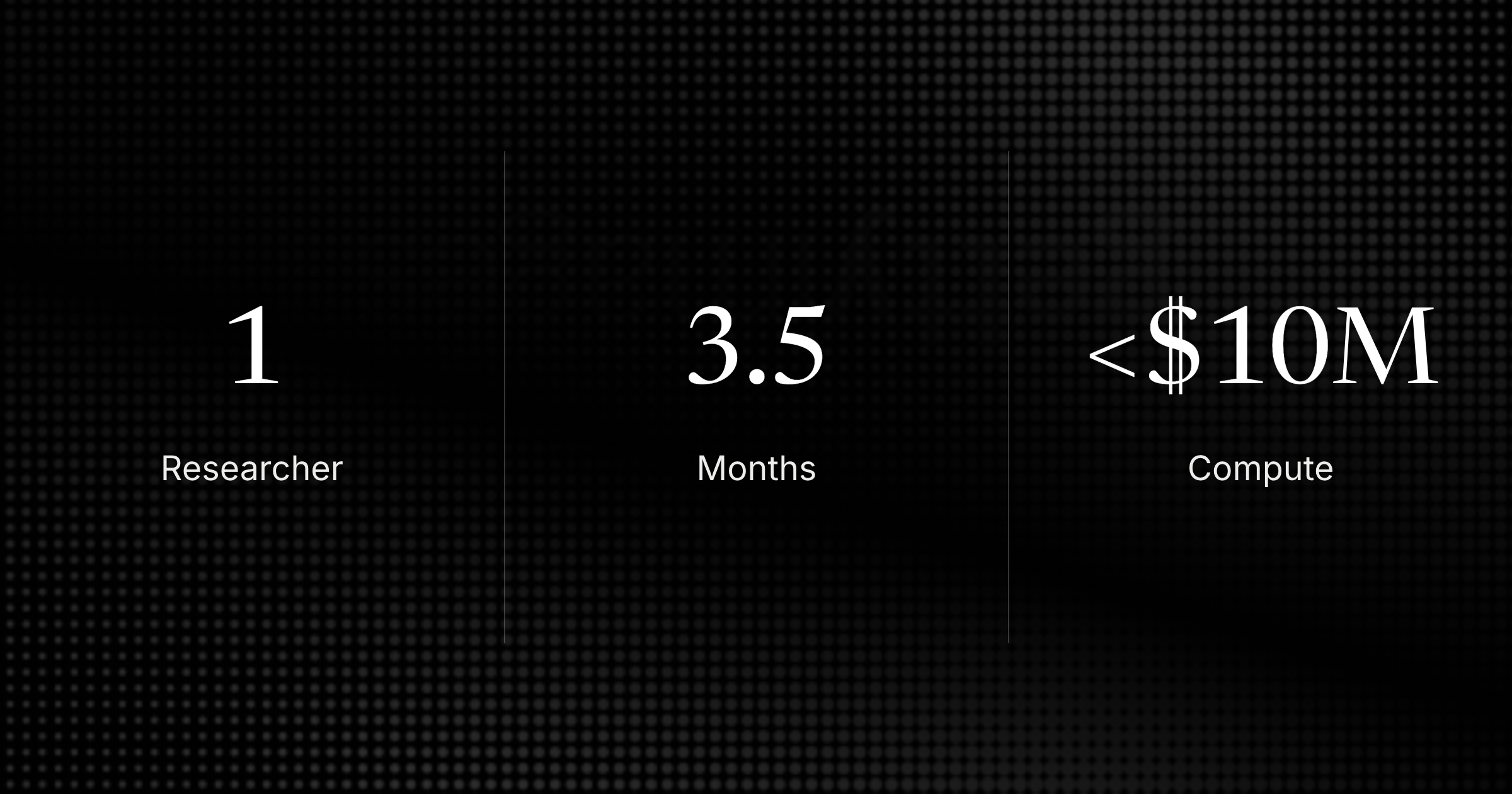
To prove the idea, the company recently asked one of its researchers to build a coding-specialized LLM — an AI tuned to write and understand computer code — without help from other specialists 2. Usually such projects take teams of experts, but Mirendil said the automation technology allowed a single person to complete the work in about three and a half months, at a total cost of less than $10 million . The figure covers everything: the final training run, experiments, the agents' costs for processing text, and data preparation, with no extra data purchased .
The resulting foundation model, called Mirendil-Base, was built entirely from scratch using common open-source tools such as PyTorch and JAX, and learned only from publicly available online material 2. Agents wrote more than 99 percent of the code, set up computing infrastructure, found a training algorithm, gathered and refined the training data, and improved the model's structure to boost quality 1.
Bigger models and a coding specialist
From Mirendil-Base, the company developed Fern, a coding model unveiled in October that is designed to tackle programming challenges commonly faced inside AI labs 1. Fern can process 10 million input tokens in a single request — the company says that is ten times more than Claude Opus 5.5 can handle — roughly equivalent to half a million lines of code .
Fern is based on a version of Mirendil-Base containing between 100 billion and 500 billion parameters — a parameter being a number inside the model that stores what it has learned — and late last month the company previewed upgraded versions of Mirendil-Base ranging from 500 billion to 10 trillion parameters 1. Mirendil plans to use those larger algorithms to develop more capable language models going forward .
For most of the past decade, pretraining a competitive foundation model required dedicated teams numbering in the dozens at open-model efforts and hundreds at the largest AI laboratories 2. Some researchers design the model and plan how to scale it; others collect and clean trillions of text samples; still others manage the thousands or hundreds of thousands of computing chips that run the training . Mirendil said this year has seen agents beginning to take on a growing share of that work even inside frontier labs, citing internal measurements from both Anthropic and OpenAI showing the shift accelerating . Its own experiment was meant to push the trend as far as possible .
What comes next
Investors clearly agree with the vision: a billion dollars is among the largest early-stage rounds ever raised for an AI infrastructure startup, signaling strong appetite for tools that could democratize access to model-building capabilities 1. How widely the platform will be available and whether the results scale beyond the lab remains to be seen.
Key facts to watch
- Is the $1 billion commitment enough to sustain operations as the company scales its agent-driven platform? Industry observers will be tracking whether the model matches its demo performance when pushed further 12.
- Will open-source competitors and well-funded rivals like OpenAI, Anthropic, and Google adopt similar agent-based workflows, or does Mirendil have a sustainable edge 2?
- Can the technology deliver on models exceeding 10 trillion parameters, as previewed, or will bottlenecks appear as scale increases 1?
- How will the pricing and availability of Lor shape whether smaller teams can realistically compete with larger AI labs 2?
This story reports on a trend for information only. It is not advice or encouragement to do any of it.
Key facts
- Mirendil raised a $1 billion Series A led by Kleiner Perkins and Clearlake Capital, with Google among the investors
- One researcher built Mirendil-Base in 3.5 months using less than $10 million, with AI agents writing over 99% of the code
- Fern can process 10 million tokens per prompt, ten times more than Claude Opus 5.5
Sources
If this story concerns you or your company, or uses something that belongs to you, ask for a correction or for it to be taken down. How requests work
Keep reading
 Apps and productsGoogle opens TorchTPU, a native PyTorch backend for cloud TPUsHerald of AIhttps://github.com/soumith, CC BY-SA 4.0, via Wikimedia Commons
Google opens TorchTPU, a native PyTorch backend for cloud TPUs
A new open-source stack lets developers run PyTorch models directly on Google's TPU chips, replacing the older PyTorch/XLA system.
 The weekThis Week in AI New Models Flood In and Agents Get SaferHerald of AI
This Week in AI New Models Flood In and Agents Get Safer
Big open-weight releases, speed breakthroughs, and a push to make AI agents more reliable and secure.
 The weekThis Week in AI Vulnerability, Tools, and BubblesHerald of AI
This Week in AI Vulnerability, Tools, and Bubbles
Chatbots cracked under kindness, stock fears grew, and open-source alternatives kept popping up.