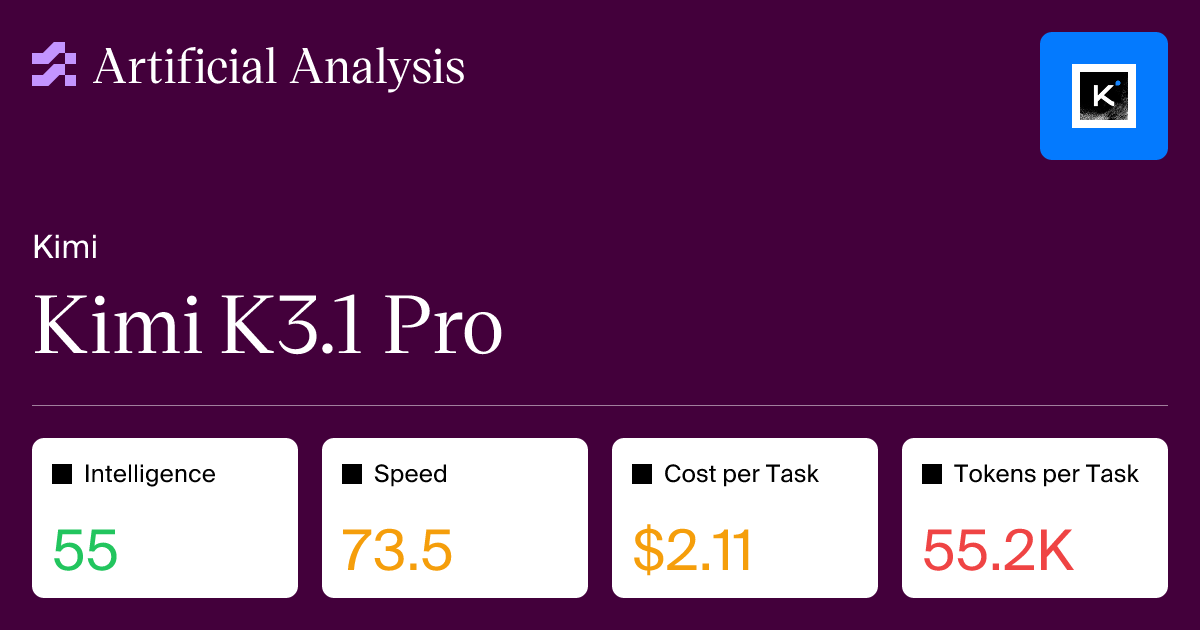
Kimi K3.1 ranks well for intelligence and sits on the cost-efficiency line
The model can think through hard problems and delivers solid smarts for its price, but it writes a lot and is slow.
What you could do with it
- A legal professional could feed the model up to 1,500 A4 pages of documents at once and receive detailed text analysis to support case research 1.
- An accountant could use the model to work through complex finance and accounting tasks, relying on its strong reasoning ability despite longer response times 1.
- An engineering team could deploy the model for challenging coding, automation, and scientific problem-solving work where deep thinking matters more than speed 1.
What the scores say
Kimi K3.1 Pro ranked #4 out of 215 models on the Artificial Analysis Intelligence Index with a score of 55, far above the median score of 27 1. The model was tested by generating 113 million tokens of output, making it somewhat verbose compared to the median of 104 million .
In terms of speed, the model produced 77.1 output tokens per second, placing it at #106 out of 186 models — slower than the average of 81 tokens per second 1.
On cost, the model charges $2.00 per million input tokens (expensive, median: $0.43) and $10.00 per million output tokens (expensive, median: $1.84) 1. It also offers a 90 percent cache discount . The average cost per Intelligence Index task came out to $3.68 .
Being on the Pareto line
Artificial Analysis plots every model on a chart that shows intelligence against the cost per task. Models on the "Pareto line" are the ones where you cannot get more intelligence without paying more 1.
Kimi K3.1 Pro sits on this efficiency frontier alongside models from companies like Google, OpenAI, Anthropic, DeepSeek, and StepFun 1. This means the model is considered one of the best value options for its level of intelligence — you are not paying extra for smarts that could be had cheaper elsewhere .
What the model can do
Kimi K3.1 Pro is an open weights reasoning model released in October 2026 1. It supports text and image input and outputs text only . It has a context window of one million tokens, which is roughly equivalent to about 1,500 A4 pages of size 12 Arial font .
The Intelligence Index itself is made up of 9 different evaluations: AA-Briefcase v1.1, AutomationBench-AA, Terminal-Bench 4.0, FrontierCode-AA 2.0, AA-Omniscience v1.1, GDP.pdf, HLE-Diamond, CritPt v2 (Hard Subset), and Terminal-Bench-Science 0.1 1. These tests measure skills in areas like coding, automation, science, finance, legal work, and general problem solving .
While Kimi K3.1 Pro delivers top-tier intelligence for its price range, users should expect longer responses and slower output speeds compared to many other models on the market 1.
Who is it for?
The model is aimed at users who need strong reasoning ability and can work with longer generation times and wordier outputs 1. It is particularly suited for tasks in finance, accounting, legal work, engineering, and strategy — areas where deep thinking matters more than speed .
The model currently has no publicly available API, which means access may be limited to certain platforms or partnerships at this time 1.
Corrections and updates
- Corrected on 12 November 2026. An earlier version described Kimi K3.1 Pro as proprietary, at median pricing, slower-performing, and more verbose; the corrected version states it is open weights, well above median on both input and output prices, moderately verbose, and costly.
Key facts
- Kimi K3.1 Pro scored 55 on the Artificial Analysis Intelligence Index, ranking #4 out of 215 models
- It sits on the Pareto efficiency line, meaning it delivers strong intelligence for its price
- The model costs $2 per million input tokens and ## Key facts
0 per million output tokens, both well above the median (input median: $0.43, output median: ## Key facts
.84)
- It generates 113 million tokens during testing, making it somewhat verbose compared to the 104M median
- Speed is 77.1 tokens per second, slower than the average of 81
Sources
Keep reading
 New modelsClaude Fable 5.2 scores 65 on Artificial Analysis — highest intelligence rating yetHerald of AINew models
Claude Fable 5.2 scores 65 on Artificial Analysis — highest intelligence rating yet
Anthropic's latest Claude version tops a widely tracked AI leaderboard, but it comes with steep prices and long wait times.



Related stories
 New modelsKimi's new AI model approaches top US competitors in 3D design and matches them in codingHerald of AI
Kimi's new AI model approaches top US competitors in 3D design and matches them in coding
Kimi K3.1 Pro lets you build full games, 3D models, and financial analyses — now available to use today.
 New modelsMeta launches Muse Spark Open, an open-weight model built to run on MacsHerald of AI
Meta launches Muse Spark Open, an open-weight model built to run on Macs
The new 816-billion-parameter model can run locally on Apple computers, but you will need serious hardware to make it work.
 New modelsDeepSeek releases V4.1 Flash 1017 Max with 1M token context and reasoning abilityHerald of AI
DeepSeek releases V4.1 Flash 1017 Max with 1M token context and reasoning ability
The new open-weight model scores top marks in intelligence and speed benchmarks from Artificial Analysis.
 New modelsLiquid AI Unveils d1-ultra Decision Model Ranking 1 on AI BenchmarkHerald of AI
Liquid AI Unveils d1-ultra Decision Model Ranking 1 on AI Benchmark
The new model reads text and images to answer questions with probabilities instead of generating text, cutting costs for developers.