New AMD dashboard shows exactly how fast your PC can run AI models
A public tool lets anyone pick an AMD chip, a model, and a version, then watch in real numbers how quickly it reads a prompt and writes the answer — no guesswork.
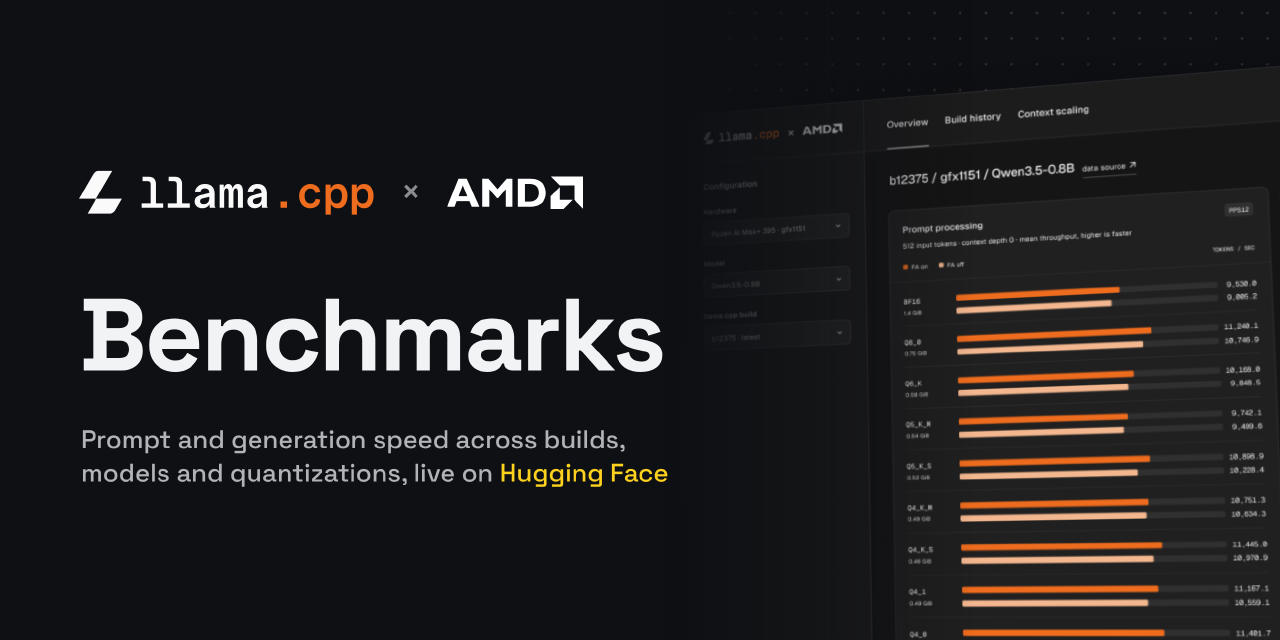
- Pick a chip, model, and version.
- See read and write speeds side by side.
- Scroll through older builds to compare.
- Download raw data for your own charts.
What you could do with it
- A person buying an AMD laptop could pick a chip, a model, and a software build on the dashboard and see real tokens-per-second numbers for reading and writing before committing to a purchase 1.
- An AMD developer could open the public data bucket, inspect how each benchmark was run, and build their own charts to track performance across new builds 1.
- A researcher running a local model could pull the same public results and compare them against their own machine's output to check for discrepancies 1.
What the dashboard is and who it is for
The llama.cpp × AMD Benchmark dashboard went live on November 26, 2026, on Hugging Face, built by the ggml-org team, the same group that maintains llama.cpp 1. The idea is simple: pick a piece of hardware, pick a model, pick a build (a specific version of the software), and see how fast the whole thing runs. The two AMD hardware choices right now are the Radeon 8060S and the Radeon AI Pro R9700S, identified by their internal graphics codes gfx1151 and gfx1201 .
The dashboard has three tabs. The Overview tab lines up every quantization for one model on one chip and shows two charts side by side. The Build history tab scrolls back through every recorded software version for that same combination, so you can see whether the latest update is faster or slower. The Context scaling tab shows how generation speed changes as the model's "memory" of the conversation grows 1.
Same model, two sizes: smaller means faster on the Radeon 8060S
Qwen3.5-0.8B on Radeon 8060S, as shown on the AMD dashboard
The two tests and what the numbers mean
Every chart reports two separate measurements, both in tokens per second:
- PP512 – the software is asked to read 512 input tokens (about 512 words) with no existing conversation behind it. The result tells you how quickly the model gets its first "thinking" done, like how fast a person opens a book and starts reading 1.
- TG128 – the model generates 128 new tokens from no prior context. This is the writing part: how fast words appear on your screen 1.].
Both tests start at context depth zero, meaning no prior conversation, so they are clean reference numbers. The context-scaling tab then shows what happens when the conversation is already long 1.
For example, on the Radeon 8060S running the small Qwen3.5-0.8B model, the dashboard shows the least-compressed version (BF16, about 1.4 GB of memory) hitting roughly 9,833 tokens per second on the read test, while the most-compressed version tested (Q3_K_S, about 0.4 GB) reaches about 12,117 tokens per second — the smaller file reads faster because the chip has less to move 2. On the writing test, the same pair swings from 103 to about 240 tokens per second .
How the benchmarks are run and where the data lives
The team benchmarks the pre-built binaries that ship with llama-install.sh, the installer behind llama.app. For the two AMD graphics codes, a public workflow runs every week, executing the standard llama-bench tool with a feature called Flash Attention turned both on and off, and repeating each configuration ten times 1. The model set keeps growing and currently covers dense and mixture-of-experts (MoE) architectures, including Inkling 2 Mini, Qwen, Gemma, gpt-oss, and LFM models, in GGUF formats from BF16 down to Q3_K_S .
All raw results are stored in a public storage bucket on Hugging Face under the ggml-org name. Anyone can download the JSON files, redraw the charts, or run the same test on their own machine and compare 1. The team also thanked the AMD team for providing test infrastructure and helping validate the setup .
Corrections and updates
- Corrected on 26 November 2026. An earlier version described the Radeon 8060S as "a GPU inside a Ryzen AI laptop" and the Radeon AI Pro R9700S as "a workstation-class GPU"; the source names both chips with their gfx codes but gives no such category descriptions. Another earlier version said the AMD team provided "test hardware"; the source actually says "test infrastructure." An earlier version said TG128 runs after the read step, implying the prompt-processing phase feeds into it; in reality TG128 is measured independently at context depth zero, with no pre-existing context at all.
Key facts
- The dashboard is public on Hugging Face, maintained by the ggml-org team behind llama.cpp.
- It currently covers two AMD GPUs: Radeon 8060S (gfx1151) and Radeon AI Pro R9700S (gfx1201).
- Two headline tests: PP512 (read 512 tokens) and TG128 (write 128 tokens), measured in tokens per second.
- Benchmarks run weekly with 10 repetitions, Flash Attention on and off; data is open for anyone to download.
- Model set includes Inkling 2 Mini, Qwen, Gemma, gpt-oss, and LFM, in quantizations from BF16 to Q3_K_S.
Sources
- Introducing the llama.cpp benchmark dashboard for AMD Ryzen and Radeon
- llama.cpp × AMD — ggml-org-llamacpp-amd-bench.static.hf.space
If this story concerns you or your company, or uses something that belongs to you, ask for a correction or for it to be taken down. How requests work
Keep reading
 Apps and productsllama.cpp v1.0.0 brings stability to the growing world of local AIHerald of AI
llama.cpp v1.0.0 brings stability to the growing world of local AI
The popular open-source tool that lets anyone run AI models on their own computer has reached version 1.0, making it more reliable for developers building private AI apps.
 New modelsCompressed 27B Model Beats Full Version at Tool Calling in Under 8 GBHerald of AI
Compressed 27B Model Beats Full Version at Tool Calling in Under 8 GB
A heavily compressed version of Qwen3.8-27B runs on everyday hardware and outperforms the original on agent skills.
 New modelsLiquid AI releases open-weight model built for fast on-device agentsHerald of AI
Liquid AI releases open-weight model built for fast on-device agents
The new 24-billion-parameter reasoning model runs 1.7 times faster than rivals on edge hardware.