MIT's IRIS Model Decodes How Cells Talk to Each Other
An AI system learns the chemical language cells use during development, unlocking faster stem cell engineering.
What you could do with it
- Researchers could identify which signal combinations drive a stem cell toward a specific fate, then recreate those exact signals in the lab 1.
- Scientists could reconstruct the complete signaling history of every cell inside a mouse or human embryo at an unprecedented scale 1.
- Researchers could build improved 3D organoid models of lung tissue to study diseases like asthma, lung cancer, and pulmonary fibrosis, and test potential therapies on them 1.
A Hidden Language in Your Cells
Your body starts as a tiny cluster of stem cells — blank slates that don't know yet whether they'll become brain, liver, or muscle. As they divide, each cell needs to figure out its role. It does this by sending and receiving chemical signals to its neighbors, like whispers in a crowded room.
For years, scientists assumed these conversations were too messy to decode. Every cell type seemed to interpret signals differently, meaning researchers would need to map each pathway separately — an exhausting process 1.
Then came IRIS.
What IRIS Actually Does
IRIS is a neural network-based model developed at MIT and the Whitehead Institute. Instead of treating each cell type as unique, the researchers discovered something surprising: signaling pathways leave behind consistent "fingerprints" — distinctive patterns of gene activity that reflect which signals a cell received.
These fingerprints are the same across different cell types for the same pathway. That means once you learn the language of one pathway, you can apply it everywhere.
"Think of voice recognition systems like Siri, which are trained mainly in English, but then use that training to help them recognize other languages," says Pulin Li, MIT assistant professor of biology 1. "This is called transfer learning, and this is why IRIS can work across many different cell types."
The team trained IRIS on thousands of human embryonic stem cells exposed to dozens of combinations of six major signaling pathways at multiple development stages. They then tested it on mouse embryos during gastrulation — when cells rapidly branch into heart, gut, muscle, and spinal cord tissues.
IRIS predicted exactly when and where specific pathways activated, even for cell types it had never seen before.
Why This Matters
The ability to reconstruct a cell's signaling history at scale opens doors that were previously impossible. Researchers can now identify which signal combinations drive a stem cell toward a specific fate — and recreate those signals in the lab.
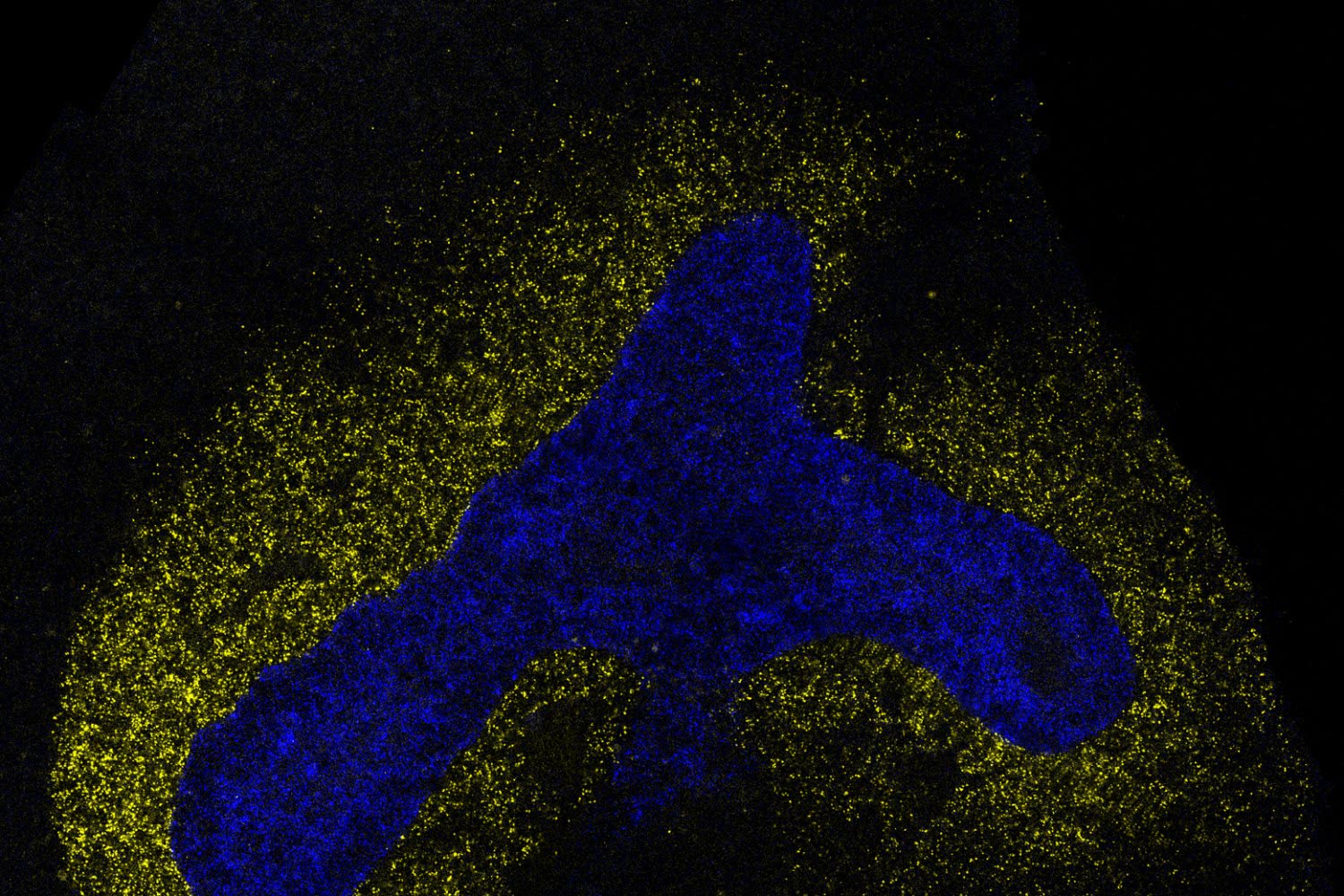
When the team used IRIS to study lung development, the model predicted that activating a particular pathway would encourage lung-specific growth. Experiments in mouse embryos confirmed the prediction 1.
This could speed up stem cell engineering for regenerative medicine and enhance the development of organoids—small 3D models that resemble real organs and are used to study conditions such as asthma, lung cancer, and pulmonary fibrosis.
"In these ways, IRIS is helping us decode the language cells use to talk to each other at a much faster rate than we could realistically achieve through experiments," says graduate student Nicholas Hutchins 1.
The findings appeared in Nature Methods on September 8, 2026.
How good is it
The model was trained on thousands of human embryonic stem cells exposed to dozens of combinations of six major signaling pathways at multiple development stages 1. It was then tested on single cells from mouse embryos during gastrulation, where it could accurately predict when and where specific signaling pathways would activate in cells destined to become heart, gut, muscle, and spinal cord tissue . In a separate experiment, IRIS predicted that activating a specific signaling pathway would encourage lung-specific development, and experiments in mouse embryos confirmed the prediction . No rival models or numerical benchmark scores were reported .
Picture: news.mit.edu
Key facts
- IRIS uses transfer learning to recognize cell signaling fingerprints across different cell types
- Signaling pathway fingerprints are consistent regardless of cell type
- Model predicted lung development signals confirmed in mouse embryo experiments
- Published in Nature Methods on September 8, 2026
Sources
Related stories
 The weekThis Week in AI New Models Flood In and Agents Get SaferHerald of AI
This Week in AI New Models Flood In and Agents Get Safer
Big open-weight releases, speed breakthroughs, and a push to make AI agents more reliable and secure.