MIT's FLEX lets robots read between the lines of your commands
A new AI system helps household robots understand what you mean, not just what you say.
How it works
A system that lets household robots infer unspoken safety rules from your commands.
- Adds your instruction to the robot's map
- Edits the map using your feedback
- Replans the robot's movement safely
What you could do with it
- A household robot owner could give natural-language safety cues like "Don't spill on the laptop!" and have the robot infer extra precautions, such as also steering clear of a nearby phone 1.
- An assistive-robot developer could embed FLEX so robots adapt in real time to conversational corrections without requiring detailed step-by-step programming 1.
- A robotics researcher could run simulated cluttered-table tasks to measure whether a robot extrapolates from one negative command to protect unmentioned fragile items 1.
Picture: news.mit.edu
Reading between the lines
Humans are intuitive by nature. When someone says "Don't spill on the laptop!" we understand they probably also mean don't spill on the phone nearby. Robots haven't worked that way — until now 1.
A new AI-assisted learning platform called FLEX (flexible feature-editing pipeline for robot motion-planning) was developed by researchers from MIT and New York University. The system lets people give robots instructions in natural, conversational language, and the robot can draw larger generalizations from those words to improve how it plans its movements 1.
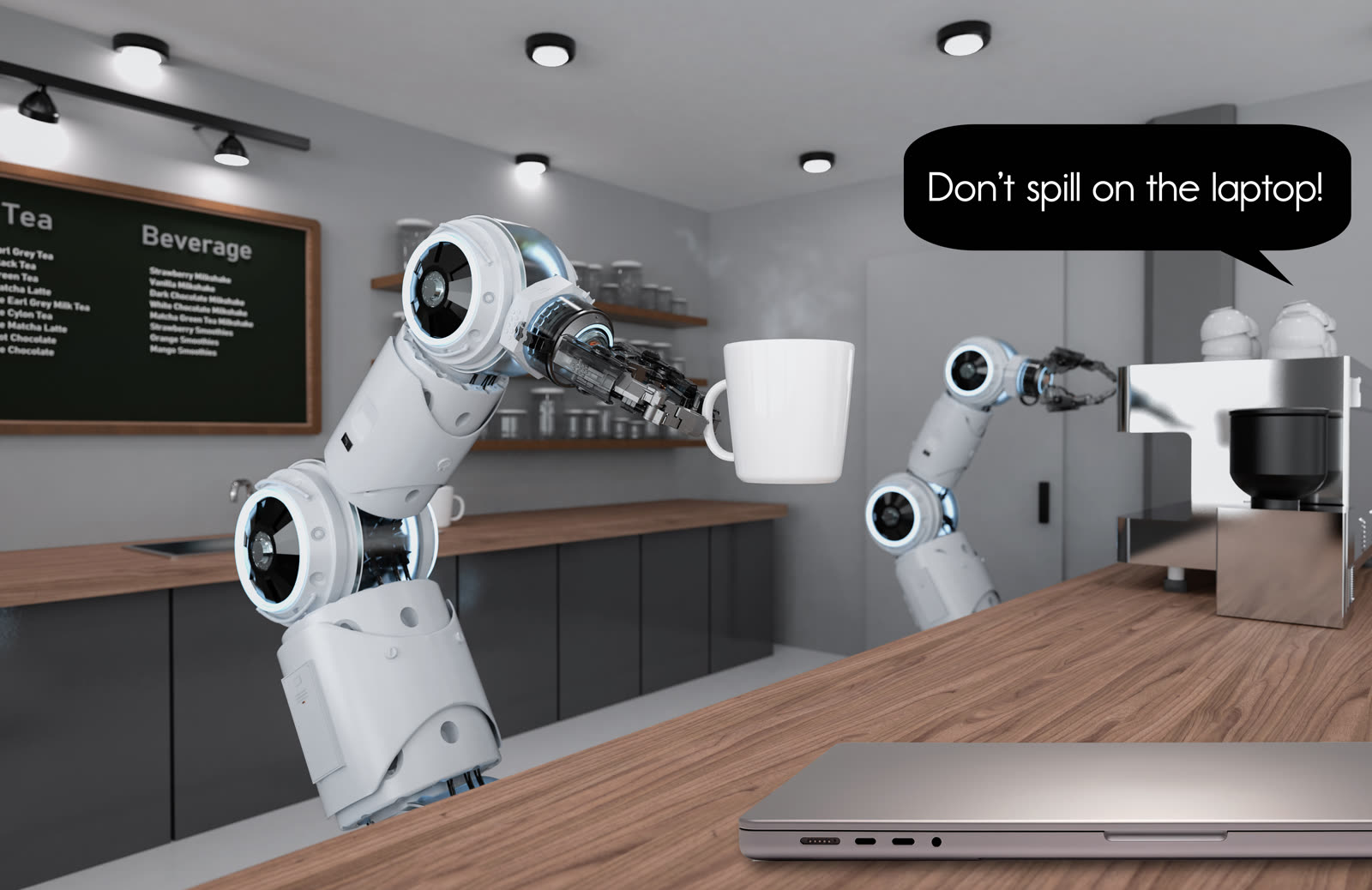
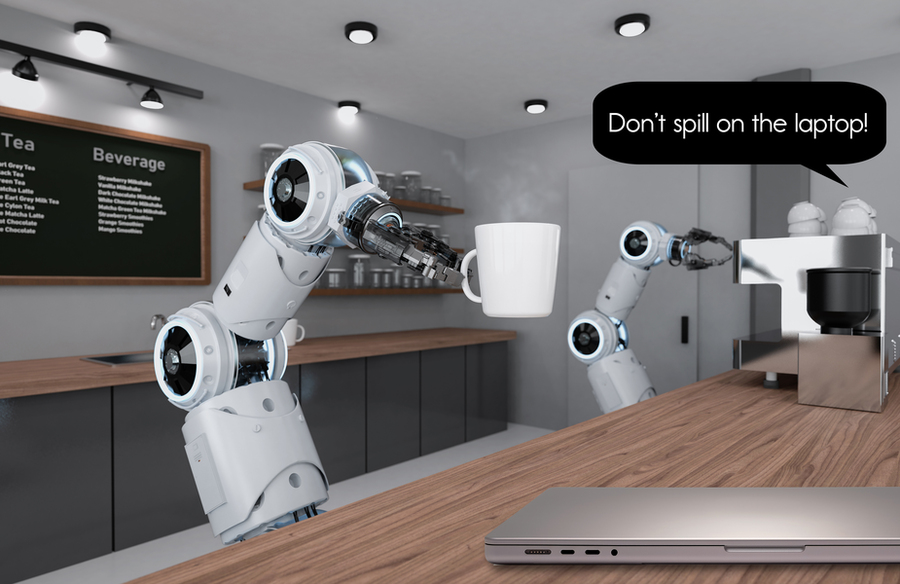
The team tested FLEX in several simulated scenarios, including one where a robotic arm serves coffee across a cluttered table 1. When a person types "Don't spill on the laptop!" the robot reasons about why it should avoid the laptop — and then decides to steer clear of a nearby phone too, without being explicitly told .
Guess
Can the robot guess safety rules you never mentioned?
LLMs learn from internet text that liquids damage electronics.
How it works
At the heart of FLEX is a large language model (LLM) — an AI system trained on massive amounts of internet text, including social media posts, video transcripts and web content, which it uses to spot patterns and generalizations 1.
"LLMs have seen so many texts from the internet," said study author Nathan Dennler, a postdoc at MIT's Computer Science and Artificial Intelligence Laboratory (CSAIL). "People might have written about, 'Oh, my phone dropped in the water and now it doesn't work,' or 'I spilled coffee on my computer and now it doesn't work.' So LLMs pick up on the idea that liquids plus devices leads to things not working" 1.
Through this LLM, FLEX gives the robot a kind of common-sense reasoning layer. The system has three steps: first, it adds features from a command to the robot's environment map; second, it edits the robot's understanding based on the user's feedback; and third, it replans the robot's movement using that updated knowledge 1.
"The idea is that there is some higher-level intention behind the words that you say," Dennler explained. "People naturally get this. However, you need to give the robot a careful explanation, and that is something that requires both time and effort. With FLEX, you get a communication interface for talking to a robot where you can express things like 'When someone says this, they mean that' 1.
Making robots easier to live with
The study was directed by Andreea Bobu, who is an assistant professor of aeronautics and astronautics at MIT and leads the Collaborative Learning and Autonomy Research (CLEAR) Lab 1. Her group develops autonomous agents that learn to work alongside people, focusing on assistive and household robots that can adapt in real time to natural commands .
Calculations are used by robots when they work out where to move, a process called trajectory planning.1 According to Dennler, "the idea is not to make everyday users study that kind of mathematics just to give a robot instructions." Rather than training people to operate a robot in a particular method, the objective is to allow communication with the robot via ordinary spoken or written language.
While other robotics projects have used language to clarify tasks or redirect robots, FLEX goes further — enabling the robot to infer unspecified preferences from limited verbal cues 1. Co-authors on the study include Audrey Lee SM '26 and Ilia Sucholutsky of New York University .
The work will be presented at the annual Conference on Robot Learning later this month 1.
How good is it
The approach was evaluated in simulated scenarios, including a virtual coffee-serving task across a cluttered table 1. No performance metrics or direct competitor comparisons were reported in the announcement . Demonstrations indicated the robot successfully broadened its avoidance list beyond the explicitly mentioned object, suggesting stronger commonsense reasoning . Whether the method holds up in live homes or against existing robot-command systems remains untested .
Key facts
- FLEX is a flexible feature-editing pipeline from MIT and NYU that lets robots reason beyond literal commands
- It uses a large language model to pick up on common-sense patterns from internet text
- Tested in simulations like serving coffee while avoiding electronics
- The research will be presented at the Conference on Robot Learning
Sources
Keep reading
 New modelsGPT-6 Astra fixes Qwen3.5’s math ability by rewriting its brain without any trainingHerald of AINew models
GPT-6 Astra fixes Qwen3.5’s math ability by rewriting its brain without any training
MIT researchers showed a single top AI model can read and edit another model’s internal numbers to make it much smarter at math — no training needed.