A rolling cart-style robot helps warehouse workers carry loads instead of walking miles each day
Robust AI's mobile robot, called Carter, rides alongside humans in factories and warehouses, carrying items so workers save thousands of steps every day.
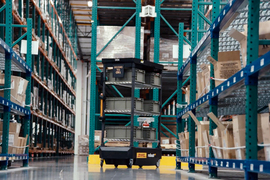
A robot shaped like a utility cart that follows warehouse workers and carries their loads so they walk far less.
- Worker loads the cart with items
- Says "done" to start it moving
- Robot drives itself to another station
A robot shaped like a utility cart
Carter moves on holonomic wheels, which let it slide sideways or rotate instantly without turning, much like a shopping cart in a wide supermarket aisle 1. It has a force-sensitive handlebar, meaning a person can steer it with light touches — one hand is enough to push, pull, or redirect it .
An AI-powered vision system keeps track of its surroundings, and workers can also direct Carter using simple gestures or an onboard touchscreen 1. This mix of senses and controls means Carter doesn't require a separate control room or operator; it works right beside the people handling shelves and packages.
Currently, Carter robots are deployed in logistics warehouses and on factory floors, helping with tasks such as picking orders, stocking shelves, and transporting items across large spaces 1.
An exampleInvented to explain it
Maria, a warehouse picker
MariaLoad these bins and take them to Station 7.
CarterTap the touchscreen to confirm destination.
MariaDone. Take care of it.
CarterGoes autonomously to Station 7 now.
Maria walked far fewer steps that day while Carter delivered the load on her behalf.
From disinfection to collaboration
Anthony Jules ('92, SM '92) and Rodney Brooks, a former director of MIT's Computer Science and Artificial Intelligence Laboratory (CSAIL), met as graduate students in the 1990s and stayed in touch after Jules graduated 1. Brooks previously co-founded iRobot, maker of the Roomba vacuum, and later Rethink Robotics, another collaborative-robot company . Jules co-founded Sapient, which went public before being acquired by Publicis in 2015 .
In 2019, Brooks approached Jules about building a robotics software company, describing it as something like a video game engine for training robots 1. Robust AI was founded that year. According to The New York Times, when the COVID-19 pandemic hit, the team temporarily shifted focus to robots that could autonomously disinfect surfaces, but soon realized the market had changed once surface transmission of the virus proved unlikely .
That pivot forced the founders to reconsider where their technology fit best. Jules recalled telling Brooks he had an idea that would solve real customer problems — but would require building actual hardware 1.
How many steps a warehouse worker saves a day
Roughly 30,000 steps per shift saved when Carter delivers items across facilities
Filling the gap in partially automated factories
Most factories don't run with multi-million-dollar fully automated lines, Jules pointed out. Many still lack even basic conveyor belts, making them unlikely candidates for expensive total overhauls 1. Robust AI chose to target these environments instead.
In one common setup, Carter guides workers to specific spots to retrieve items. In another, it follows humans to loading areas and picks up finished goods 1. The idea is simple: if a worker loads Carter with materials and says "done," the robot autonomously delivers them to another station — sometimes hundreds of feet away — saving the worker from walking roughly 30,000 steps in a single shift across large facilities .
Integration is flexible. Customers decide how deeply to weave Carter into their workflows 1. Jules serves as chief innovation officer and Brooks as chief technology officer .
This story reports on a trend for information only. It is not advice or encouragement to do any of it.
Key facts
- Carter is a mobile robot shaped like a wheeled utility cart, made by Robust AI
- It uses holonomic wheels for movement in any direction and a force-sensitive handlebar for easy human guidance
- Workers in large warehouses often walk ~30,000 steps daily; Carter carries loads to reduce that distance
- The company was co-founded by MIT alum Anthony Jules and MIT Professor Emeritus Rodney Brooks
- Carter is currently deployed in logistics warehouses and factory floors for picking, stocking, and transport
Sources
If this story concerns you or your company, or uses something that belongs to you, ask for a correction or for it to be taken down. How requests work
Keep reading
 Apps and productsCanva lets you turn off most AI tools and reduce AI images in searchesHerald of AICC BY-SA 3.0, via Wikimedia Commons
Canva lets you turn off most AI tools and reduce AI images in searches
Design tool users can now disable generative AI features or limit how many AI-made pictures show up in searches.
 Apps and productsGemini lets you skip AI training while keeping your chat history intactHerald of AI
Gemini lets you skip AI training while keeping your chat history intact
Google splits chat saving and AI data use into two switches so you can save conversations without letting them train its models.
 Apps and productsGoogle lets Gemini users skip AI training without losing chat historyHerald of AIJi-Elle, CC BY-SA 4.0, via Wikimedia Commons
Google lets Gemini users skip AI training without losing chat history
A new privacy option in Gemini means you can stop your conversations from being used to train AI while still keeping all your chats saved.