A New AI Model Learns to Predict Many Possible Futures at Once
Researchers introduce a system that doesn't just predict one future, but maps out entire branching paths — and it leads to better decision-making.
What the Model Does
Yongchao Huang and researchers have developed a new type of AI system called MDN-VJEPA, which stands for Multimodal Probabilistic Joint-Embedding Predictive Architecture. To understand what that means, it helps to know how AI world models work.
A world model is an AI system that learns how the world works by predicting what happens next. Most existing systems try to reconstruct what something looks like — for example, trying to draw the next frame of a video. JEPAs take a different approach: they predict future representations, or compressed summaries of what will happen, rather than recreating raw observations.
The newer version, VJEPA (Variational JEPA), adds a probabilistic layer on top. Instead of making a single prediction, it considers multiple possibilities and their likelihoods. The new MDN-VJEPA system takes this even further by handling multiple types of input — text, images, and other data sources simultaneously — which is what "multimodal" refers to.
Why Multiple Futures Matter
Here is where things get interesting. Real life rarely has just one possible outcome. If you are planning a road trip, there could be clear weather, a sudden storm, or traffic. Most AI models pick one prediction — usually the most likely one — and move forward. But that can miss important possibilities.
MDN-VJEPA uses something called a mixture density network (MDN) to represent multiple possible futures at once. Think of it like having several different weather forecasts running at the same time, each with its own probability score. The model describes these futures using a Gaussian mixture, which is a statistical tool that groups similar outcomes together. Each group, or "mode," represents a different possible future, along with how likely it is and how uncertain the model is within that scenario.
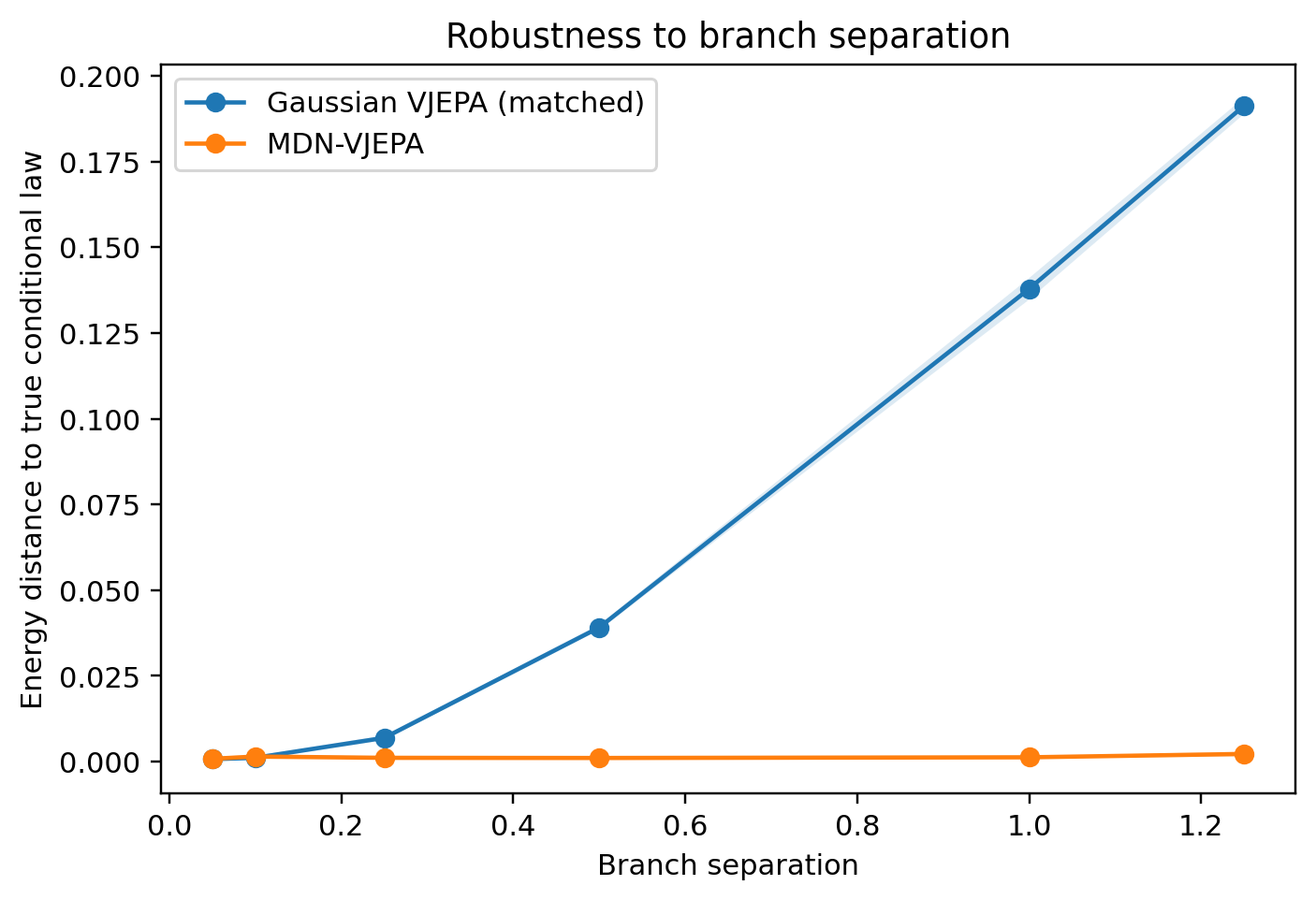
The paper argues that simply picking the average prediction — the conditional mean — is not enough. "Retaining the complete multimodal belief rather than its conditional mean can lead to materially different and substantially better planning decisions under branching futures" 1. In other words, when an AI considers all possible futures instead of just one, it makes smarter choices.
Staying Consistent Over Time
There is a second challenge: keeping predictions consistent as time goes on. If an AI predicts what happens in one step, then predicts the next step from there, it should arrive at the same overall picture as if it had predicted multiple steps all at once. The researchers reference the Chapman-Kolmogorov equation, a mathematical principle that describes how probabilities compose over time, to ground this requirement.
The paper describes a three-level structure for the system:
- Multimodal prediction: handling multiple types of data and multiple possible outcomes at each moment.
- Coherent trajectories: making sure different predicted futures stay logically connected over time.
- Compositionally consistent dynamics: ensuring that predictions remain reliable no matter how far into the future the system looks.
Controlled experiments showed that the model could recover known branching patterns in predictive laws. The trajectory-level coupling and distributional consistency also improved how well the model maintained coherence over time.
What Comes Next
The key takeaway from the research is straightforward: a good probabilistic world model should preserve not just how uncertain the future is, but exactly which distinct futures make up that uncertainty, how they form coherent paths, and how those beliefs hold up when combined across different time spans. The paper was submitted to arXiv on August 21, 2026, and spans 69 pages.
As AI systems move toward more complex decision-making in robotics, autonomous vehicles, and planning, the ability to reason about multiple possible futures may become essential.
Key Facts
- MDN-VJEPA predicts multiple possible futures at once using a mixture density network, rather than picking a single most-likely outcome.
- The system is multimodal, meaning it can process different types of data such as images and text together.
- Experiments show that keeping the full range of possible futures improves planning decisions compared to using only an average prediction.
- The model enforces temporal coherence and composition consistency, two properties drawn from probability theory, to keep predictions stable over time.
- The research was submitted to arXiv in August 2026 by Yongchao Huang and covers 69 pages.
Sources
1 arXiv:2610.13956, "MDN-VJEPA: Multimodal Probabilistic Joint-Embedding World Models", submitted 21 Aug 2026
Key facts
- MDN-VJEPA predicts multiple possible futures at once using a mixture density network instead of picking a single average outcome
- The system is multimodal, processing different types of data such as images and text together
- Experiments show that keeping the full range of possible futures improves planning decisions compared to using only an average prediction
- The model enforces temporal coherence and composition consistency to keep predictions stable over time
- The research was submitted to arXiv in August 2026 by Yongchao Huang and covers 69 pages