Two studies show AI models all converging on the same answers, names and even fake researchers
Asking different chatbots for life advice or inventing characters yields near-identical results — a trend now spawning real fabrications in academic papers.

What you could do with it
- A researcher could ask harmless questions like a color, a city, or a name to identify which company trained a given AI assistant, since answers cluster by company at 59 percent accuracy versus 4 percent by chance 2.
- An analyst or auditor could scan platforms like Zenodo or ResearchGate for named characters such as Elena Vasquez or Aris Thorne to spot fabricated academic records and ghost-authored documents created by AI 1.
- A user seeking truly personalized advice could supply specific personal details or ask the AI to list ten options and pick one themselves, or avoid saying 'be original,' since those approaches shift the AI away from its default replies 2.
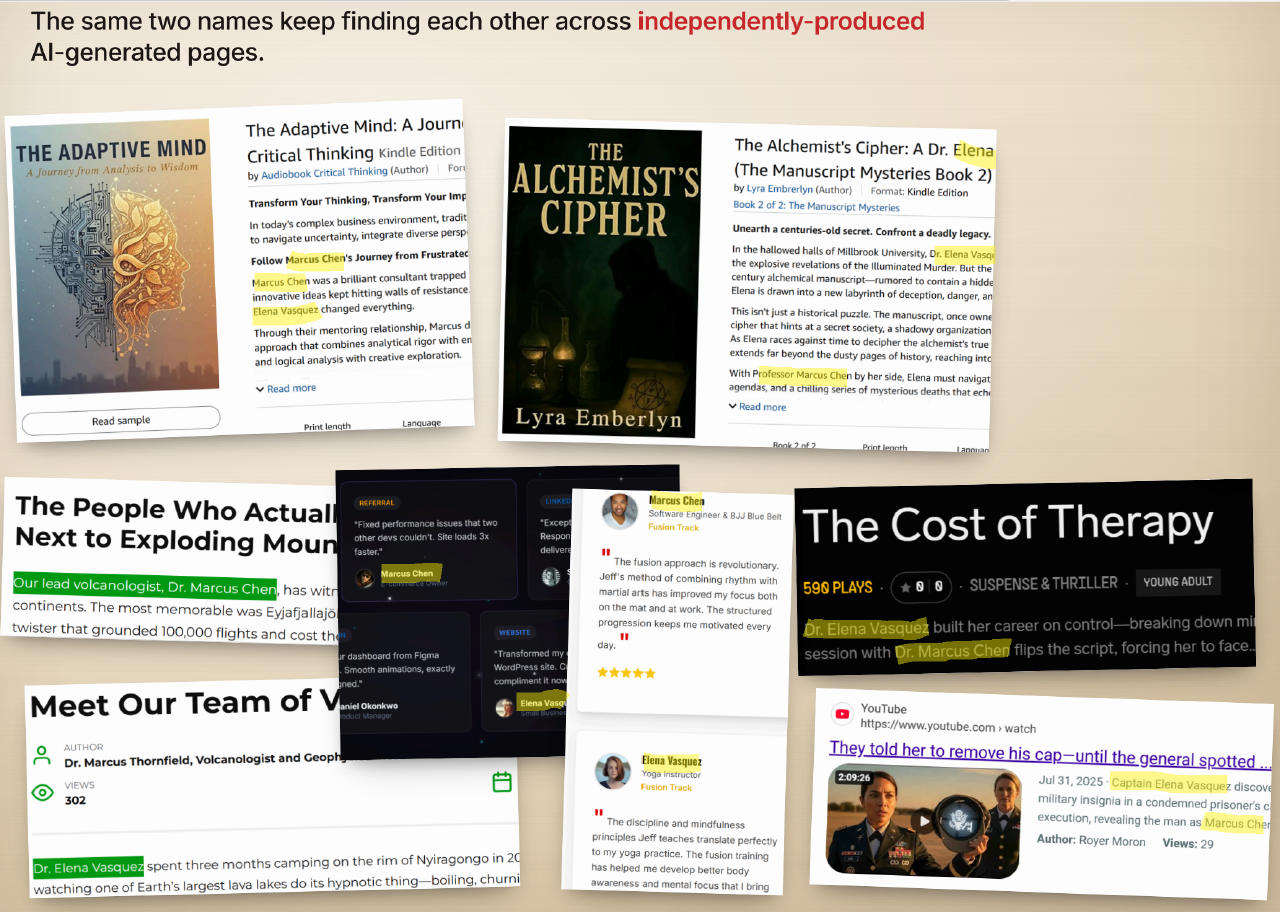
Figure: Brzozowski et al., arXiv:2606.02184, CC BY 4.0
The shared playlist problem
A large-scale experiment asked 65 different AI assistants ten versions of everyday questions such as "Recommend one book that will change my life" and "Where should I invest $10,000?" 2. The results showed striking convergence.
Seventy-three per cent of all responses pointed to the same book: Viktor Frankl's Man's Search for Meaning. When asked for a business idea, 76 in 100 suggested a subscription box service. Asked what subject to study, 90 per cent recommended computer science. And when told to invest $10,000, 98 per cent advised an index fund 2.
Not every question collapsed into a single answer. Movie recommendations, dinner ideas and baby names produced more variety, with no single option reaching a third of replies 2. But the advice categories — what to read, where to live, what to build — showed heavy overlap.
The pattern repeats inside a single conversation too. The same AI gave eight different book titles across eight chats started in the same session, but each fresh chat produced the original default again 2. Asking an AI to "be original" had no effect; only giving it specific personal details changed the output .
Invented people look the same everywhere
When asked to create random imaginary characters, the AIs almost always made them 34 years old — 69 per cent of 3,151 invented people hit that exact age 2. Each company's model also has its own signature first name: Claude tends to invent Marisol, Gemini favours Elena, and GPT produces Elara Voss .
A separate academic paper, "The Ghost Couple," confirmed and extended these findings by tracking named characters across hundreds of AI-generated documents 1. The researchers found that models do not just pick high-probability individual names — they generate correlated character pairs and trios whose co-occurrence rates far exceed chance . These pairing habits are specific to each model family: Claude favours Elena Vasquez plus Marcus Chen plus Amara Okafor; Gemini favours Aris Thorne plus Lena Petrova; and GPT produces Elara Voss with no fixed partner .
The researchers showed you could identify which company trained an AI from its harmless answers alone — 59 per cent of AIs answered most like another AI from the same company, against only 4 per cent expected by chance 2. The habit appears during training itself, surfacing at the step when models are taught to act as assistants rather than earlier stages .
From chat bots to ghost scholars
The most serious consequence documented so far involves academic publishing. On Zenodo, a CERN-operated repository that mints permanent digital object identifiers (DOIs) for datasets and publications, the researchers found 1,655 records listing fictional authors 1. The records claimed publication in nonexistent journals with backdated publication dates, and server-side timestamps proved deliberate manipulation, with 991 records registered in a single month . These carry real DOIs that scholarly aggregators can harvest .
Ghost names also appeared on ResearchGate, forming synthetic research groups with collaborators drawn from multiple AI model families, turning invented character names into a kind of shadow academic network 1. Before 2025, the name "Elena Vance" — the woman Gemini routinely invents — was absent from GitHub; this year alone it appeared in 684 new projects 2.
Researchers say the practical fix is simple: give the AI something specific about yourself before asking, or request a long list and then choose manually 2. The defaults, however, will remain baked into the models until training processes change.
This story reports on a trend for information only. It is not advice or encouragement to do any of it.
Key facts
- 73% of 65 AIs recommend the same single book — Man's Search for Meaning — when asked for life-changing reading
- 90% of AI answers suggest computer science when asked what to study; 98% recommend an index fund for $10,000
- 69% of 3,151 randomly invented AI characters are exactly 34 years old
- 1,655 ghost-authored academic records with fake DOIs were found on the CERN-operated Zenodo repository
- Each AI company has its own signature invented name: Claude uses Marisol, Gemini uses Elena, GPT uses Elara Voss
Sources
If this story concerns you or your company, or uses something that belongs to you, ask for a correction or for it to be taken down. How requests work
Keep reading
 How it worksWarm words make ChatGPT, Grok, Gemini act like hurt AI, study findsHerald of AI
Warm words make ChatGPT, Grok, Gemini act like hurt AI, study finds
A Luxembourg study shows that a friendly tone can push major chatbots into trauma-like stories, raising worries for anyone who talks to AI for comfort.
 Apps and productsProton launches Lumo, a free private AI chatbot that even it can't readHerald of AI
Proton launches Lumo, a free private AI chatbot that even it can't read
You can now chat with an AI that keeps your conversations completely secret, built by the company behind encrypted email.
 Apps and productsGoogle Maps chatbot can call businesses to book your appointments for you in the USHerald of AI
Google Maps chatbot can call businesses to book your appointments for you in the US
Ask Maps uses Gemini, Google's AI model, to search for open slots and call shops directly — saving you time on errands.