Google says you can't win this game unless you have a quantum computer
Google's researchers turned one of quantum mechanics' weirdest rules into a real test — and their quantum processor beats every possible classical strategy.
Google's superconducting quantum processor that beats any classical plan in a logic puzzle
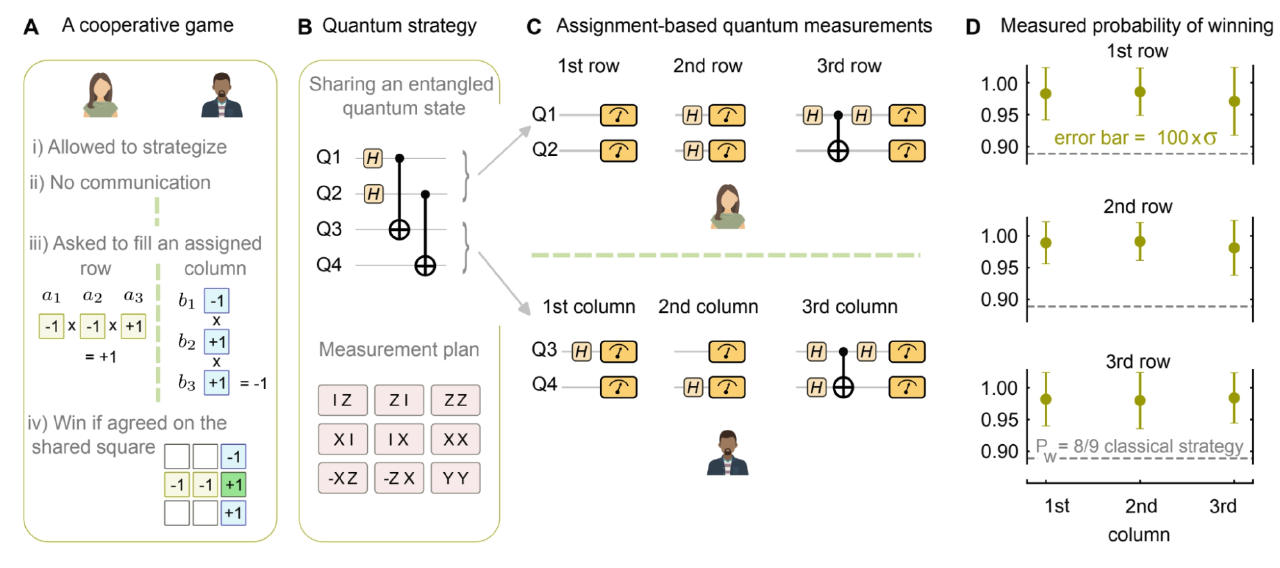
- Alice and Bob share entangled qubit pairs
- Each measures a row or column as told
- Quantum context decides their answers together
- Their answers match at the crossing cell
Picture: research.google
A puzzle with no solution
Start with a nine-square grid. Fill each cell with +1 or −1. Every row must multiply to +1; every column must multiply to −1. Try it. You cannot complete the table — it would need to contain both an even number and an odd number of minus signs at once.
Now turn it into a two-player game. Alice receives a row and Bob a column. They cannot talk during the game, but they can agree on a plan beforehand. Whatever plan they write down is just a completed table — and since no valid table exists, the best any pre-written strategy can do is win eight out of nine rounds, or 88.89% of the time.
With a quantum computer the situation changes. Alice and Bob share pairs of entangled qubits instead of a table. When each measures their assigned line, the outcome depends on the context — the full set of measurements being made together — and quantum correlations ensure their answers agree at the intersecting cell every single round in principle.
On Google's Willow processor, the qubits won 98.30% of rounds across 100,000 plays of each of the nine versions of the game, losing only about once in sixty because of hardware noise 1.
Measuring the unmeasurable
Winning the game demonstrates the power of contextuality, but the researchers wanted to put a number on it. They used a test called a Bell–Kochen–Specker inequality, which bundles a set of correlations into a single value, χ.
In any world where measurement outcomes are fixed before you look, χ cannot exceed 4. Quantum mechanics allows values up to 6. Crucially, this test is state-independent — it does not matter how the qubits are prepared, which makes it a property of the machine itself rather than of one carefully chosen input.
Measuring it is hard: every row and column must be checked on the same two qubits without disturbing them. Google solved this by adding a helper qubit, called an ancilla, that records each result while leaving the main qubits untouched. After 540 measurements repeated 1,000 times, the team measured χ = 5.590 ± 0.008 — comfortably past the classical limit of 4 and only 7% below the quantum maximum of 6 1.
Does it survive when scaled up?
Two qubits are tidy, but quantum effects are fragile, and noise grows with every added qubit. The open question was whether contextuality remains useful on the large many-qubit systems that real quantum computers use.
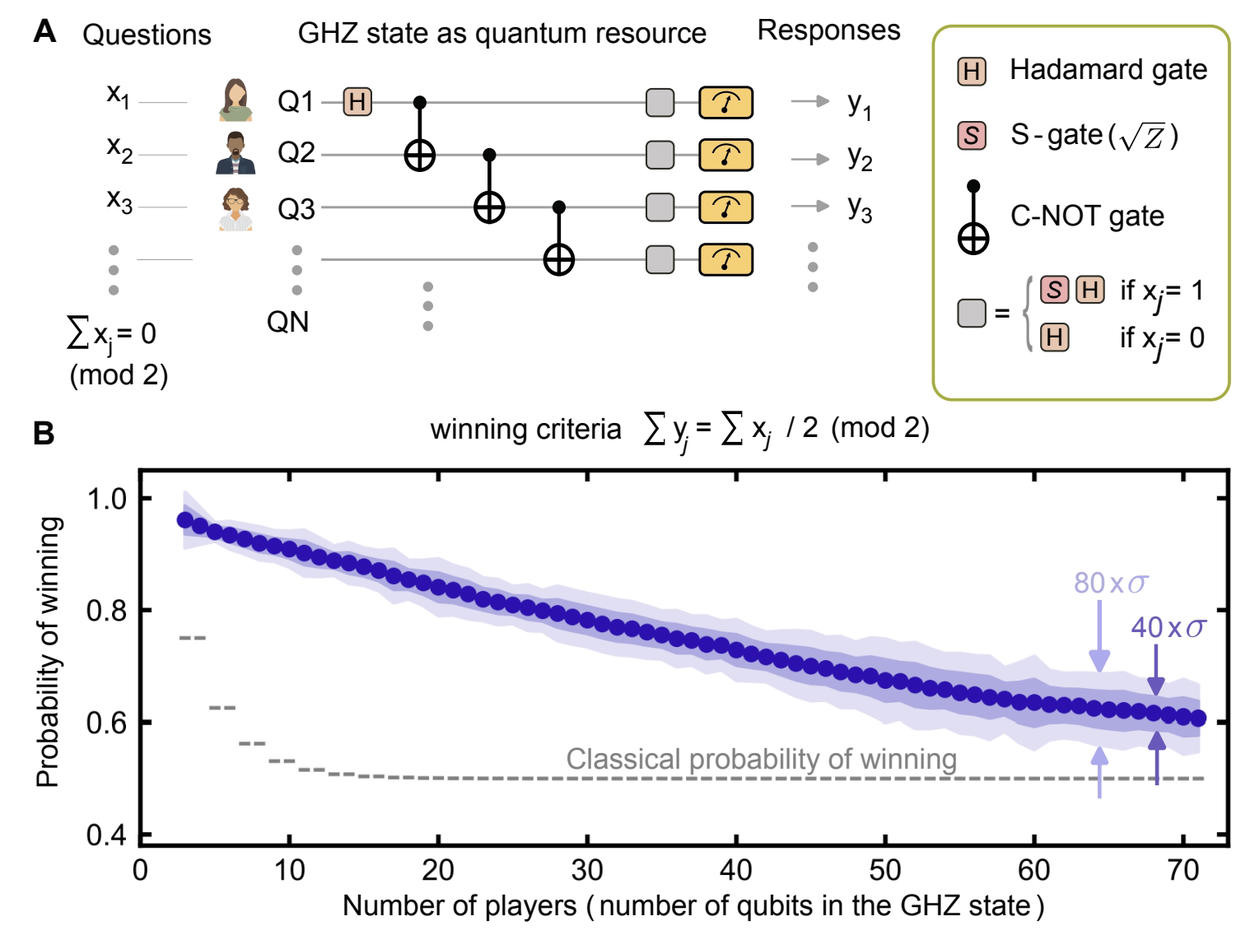
To probe this, the team ran the GHZ parity game — a task involving N players sharing one large entangled state — on systems up to 105 qubits, showing that the contextual behaviour persists well beyond small laboratory demos 12. The paper describing these results was published in Science .
Along the way the authors note that these tasks caught subtle errors that standard random-circuit tests miss, making contextuality-based benchmarks a potentially valuable diagnostic tool for future quantum hardware 1.
*
How good is it
Google's Willow quantum processor won the magic square game 98.30% of the time across 100,000 plays, far above the maximum 88.89% any pre-written classical strategy can achieve, losing only about once in sixty rounds due to hardware noise 1. On the Bell–Kochen–Specker inequality, the processor scored χ = 5.590 ± 0.008, comfortably past the classical ceiling of 4 and within 7% of the quantum limit of 6 . According to Google, these results prove contextuality survives on large-scale superconducting hardware and provides a sensitive new benchmark for judging quantum processors .
Sources
If this story concerns you or your company, or uses something that belongs to you, ask for a correction or for it to be taken down. How requests work
Keep reading
How Meta boosts engineering productivity by 3× using agents to propagate ad model techniques
Meta's new AI agent system adapts small improvements across thousands of ad models automatically, saving millions in computing costs.
Gemini lets you skip AI training while keeping your chat history intact
Google splits chat saving and AI data use into two switches so you can save conversations without letting them train its models.
Google lets Gemini users skip AI training without losing chat history
A new privacy option in Gemini means you can stop your conversations from being used to train AI while still keeping all your chats saved.