He made two complete games without writing any code — using AI instead
A developer used AI agents to build full games, showing that the hard part shifted from programming to taste and choices.
- Describe your game idea in chat
- Send screenshots for reference
- Playtest and adjust choices
What you could do with it
- An indie game developer could build two complete, playable games using nothing but text chat prompts and screenshots, without writing or reading a single line of code 1.
- A game creator could spend days of prompting instead of months of coding to get a working prototype, then redirect that saved time into choosing the right genre, art style, and what makes the game fun 1.
- An illustrator could produce simple stylized 3D spirits in about 20 minutes each through an automated pipeline instead of spending roughly a month on all ten by hand 1.
What he actually built
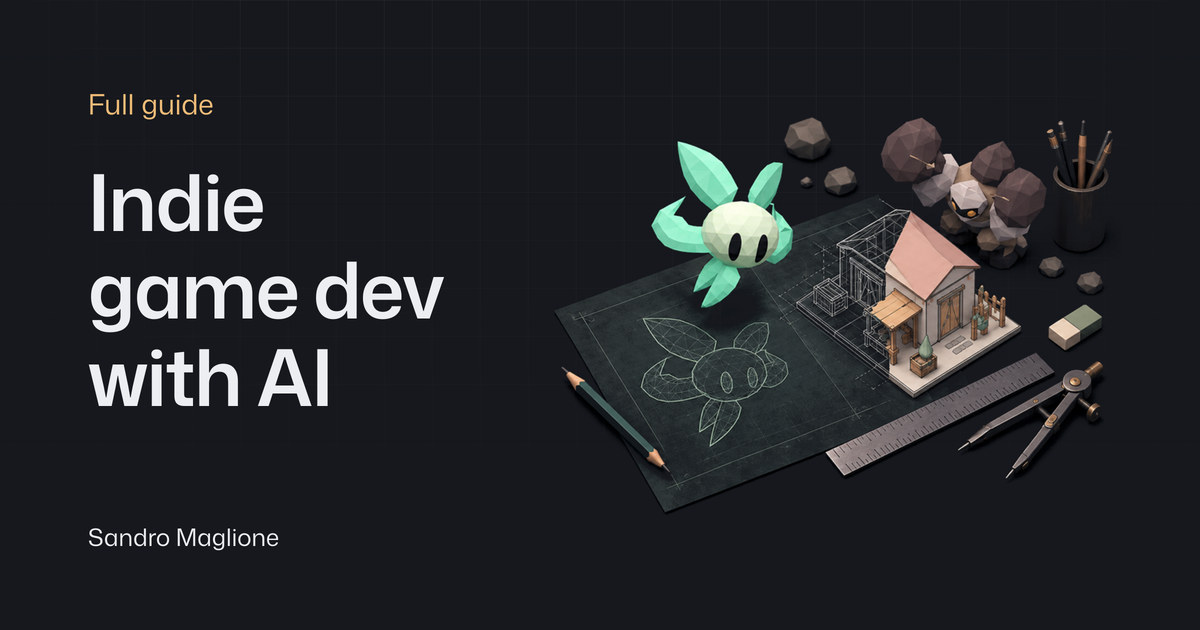
Sandro Maglione, an Italian developer and illustrator, spent weeks building two complete games using nothing but chat prompts and screenshots 1. His only tools were a text chat, links to playtest online, and a webpage for previewing 3D models .
His first project, Spirit Call, was a 3D top-down shooter inspired by characters like those in Genshin Impact, though the final version features simple stylized spirits rather than detailed anime figures 1. His second, Inkline Town, is a 3D town-builder drawn in an ink style .
The results were real, working games — not small demos 1. But making them did not turn out to be easy .
What game making switched from coding to choosing
Based on Sandro Maglione's experience building two complete games with AI agents instead of code
Where the difficulty moved
Maglione said the hard part of game development did not disappear when AI took over the coding; it simply moved elsewhere 1. Programming steps that once consumed months were done in days of prompting . Rather, he devoted his hours to the choices that belong solely to you: what game to make, what style, what is broken .
When AI takes care of the ordinary work, developers get back their mental energy—and can finally devote it to the parts of their project that actually matter. And that's hard," he wrote 1.
One important lesson came from trying to create detailed anime-style characters 1. Despite trying reference sheets, prebuilt models, and even copying existing characters, the AI agent consistently failed at complex character design . Every attempt produced bad or non-repeatable results . He eventually switched to simple spirits, each created in about 20 minutes through a pipeline that started with ChatGPT drawing a 2D design, then breaking it into a low-poly model, view breakdowns, and finally a Blender 3D render . Doing those same ten spirits by hand would have taken roughly a month .
How to choose your bottleneck
His main advice is to pick your game genre and style carefully because whatever the AI cannot do will become your bottleneck 1. Agents handle fast repetitive tasks well — building systems, generating simple assets, producing consistent styles — but they still struggle with anything requiring taste, such as character design, animation, and storytelling .
For an agent-first workflow, Maglione says your job should be limited to playtesting and taste judgments; anything else adds personal workload and slows the loop 1.
He also recommended building verification layers into your pipeline. Rather than reading through code the agent produces, he structured games using an Entity Component System (ECS), where every object contains simple data components like position and velocity, and logic runs independently across matching entities 1. This makes mistakes easier to catch automatically .
What remains for you
When asked what is left for humans if AI implements everything, his answer was clear: all the choices 1. Knowing what is good, what breaks the game, and what feels fun is now entirely on you . Playtesting became both his main tool and his biggest responsibility — playing as a regular player while reporting problems rather than debugging lines of code .
This story reports on a trend for information only. It is not advice or encouragement to do any of it.
Corrections and updates
- Corrected on 10 November 2026. An earlier version said simple spirits succeeded in exactly 20 minutes without the qualifier 'about', and listed fabricated details like 'which game to pick' and 'where to find joy' instead of the source's actual phrasing 'what game, what style, what is fun, what is broken'. Both were corrected.
Key facts
- Two complete games were built without writing a single line of code
- Complex character design like anime figures consistently failed; simple spirits succeeded in about 20 minutes each
- The hard part of game development shifted from coding to taste and creative choices
- An ECS structure lets agents add and rewrite game logic without breaking other parts
- Playtesting and judging what is fun became the developer's primary role
Sources
If this story concerns you or your company, or uses something that belongs to you, ask for a correction or for it to be taken down. How requests work
Keep reading
 How it worksHow Meta boosts engineering productivity by 3× using agents to propagate ad model techniquesHerald of AI
How Meta boosts engineering productivity by 3× using agents to propagate ad model techniques
Meta's new AI agent system adapts small improvements across thousands of ad models automatically, saving millions in computing costs.
Cambridge Dictionary picks “human” as 2026 word of the year because of AI
AI assistants are making people rethink what it means to be human — and now dictionaries are noticing.
 How it worksYibo Liu's research shows AI agents lose knowledge every time they pass notes to successorsHerald of AI
Yibo Liu's research shows AI agents lose knowledge every time they pass notes to successors
When AI systems summarize their work for the next round, some lessons vanish — a problem for any tool that relies on step-by-step memory.