Software job posts rose 33% but entry-level hiring keeps falling — what the 2026 data says about coding careers
The old fear that AI wiped out programming jobs doesn't match the numbers; the real problem is employers posting work but not hiring beginners.
## More posts, fewer offersLane Wagner, co-founder of the coding platform Boot.dev, looked at fresh numbers because the past year and a half have been full of claims that "programming is cooked." He wanted to know whether the fear matches reality 1.
What you could do with it
- A coding bootcamp operator could monitor software job-posting rebounds to decide whether the market is recovering well enough to recommend enrolling students now 1.
- A recent college graduate could compare entry-level hiring rates against senior-level rates to gauge how tough the first-job hunt will be in software 1.
- A university career counselor could use undergraduate major–level unemployment figures to advise students who want to work in tech 2.
Indeed tracks software development job postings every day. The index uses February 1, 2020 as its base of 100. By 2021 and 2022 that number blew past 233 as companies hired wildly, and senior engineers watched teammates who had spent eight weeks learning React land six-figure jobs 1. Wagner warned against treating that spike as normal.
The trough came on May 17, 2025, when the index fell to 61.1 — a little lower than the worst pandemic week and roughly 39 percent below the pre-pandemic level 1. Since then, postings have climbed 33 percent to 81.6 . October 2026 averaged 79.4, nearly matching August 2023 . Wagner admits this rebound surprised him given all the talk of an AI-driven collapse in developer demand .
But a posting is not a hire 1. LinkedIn economists published their latest software-engineer hiring report in February 2026, covering through December 2025 . Hiring for all levels ticked back up to about 0.93, close to the long-run average of 1.0, which looks promising . Entry-level hiring ended the year at 0.78, well below that line .
For 2026, LinkedIn groups software engineers into "AI-augmented" occupations, along with roles like data analysts 1. Between January and March 2026, hiring in those jobs was down 1.9 percent compared with the same period a year earlier; by April through June, the drop widened to 6.5 percent . Entry-level positions within that group fell much harder — 8.9 percent early in the year and 9.6 percent in spring . Over the same window, software job postings were about 15 percent higher than a year before .
## AI is not the obvious culpritLinkedIn attributes the slowdown mainly to general economic uncertainty rather than AI alone, and Wagner concedes it is hard to prove either cause for certain 1. His own charts show no clear link between rising AI usage — he points to Anthropic's revenue as a proxy — and the number of open software-engineer jobs . He notes he expects 2026 would look worse if AI had crushed developer openings the way some influencers predict .
Indeed's broader all-jobs index tells a similar story: unlike software roles, the overall market never saw a meaningful postings rebound after May 2025 and has stayed flat to slightly lower 1. That does not fit a narrative in which programming is the single job category most destroyed by artificial intelligence .
## New graduates face a tougher doorSeparate labor-market data confirms that starting-out difficulty is not unique to tech workers. The Federal Reserve Bank of New York reported that unemployment for recent college graduates fell to 5.2 percent in the third quarter of 2026, the lowest in over a year, but the underemployment rate — people working in jobs that do not require their degree — rose to 42.5 percent 2. Students and career-changers should expect a longer search and be prepared to consider adjacent roles even as the total number of listings recovers 1.
This story reports on a trend for information only. It is not advice or encouragement to do any of it.
Key facts
- Software job postings rose 33% from their May 2025 low but remain below pre-pandemic levels
- Entry-level software hiring ran at 0.78 against a 1.0 long-term average by December 2025
- AI-augmented role hiring fell 6.5% year-over-year in spring 2026 while postings were up 15%
- Recent graduate unemployment hit 5.2% in Q3 2026 but underemployment reached 42.5%
Sources
- Learning to Code in 2026: The Data | Boot.dev
- The Labor Market for Recent College Graduates — newyorkfed.org
Software job ads are climbing back, but entry-level hires aren't following
Postings rebounded 33% from the May 2025 low to 81.6 on Indeed; entry-level hiring in AI-augmented software roles fell 8.9% in Jan–Mar 2026 vs. a year earlier,
If this story concerns you or your company, or uses something that belongs to you, ask for a correction or for it to be taken down. How requests work
Keep reading
 Business and rulesAnthropic shares list near $2 trillion after its record-breaking stock market debutHerald of AIAnk Kumar, CC BY-SA 4.0, via Wikimedia Commons
Anthropic shares list near $2 trillion after its record-breaking stock market debut
The AI company's IPO opens as the biggest ever, with early traders seeing sharp swings around the $100 mark.
 Business and rulesAI security fixes crashed banks, flights, and the NSA because old systems couldn't handle the loadHerald of AICandeadly, CC BY 4.0, via Wikimedia Commons
AI security fixes crashed banks, flights, and the NSA because old systems couldn't handle the load
Everyday services you rely on — your bank app, airline trips, work email — were disrupted when systems tried to patch AI-found flaws faster than they could cope.
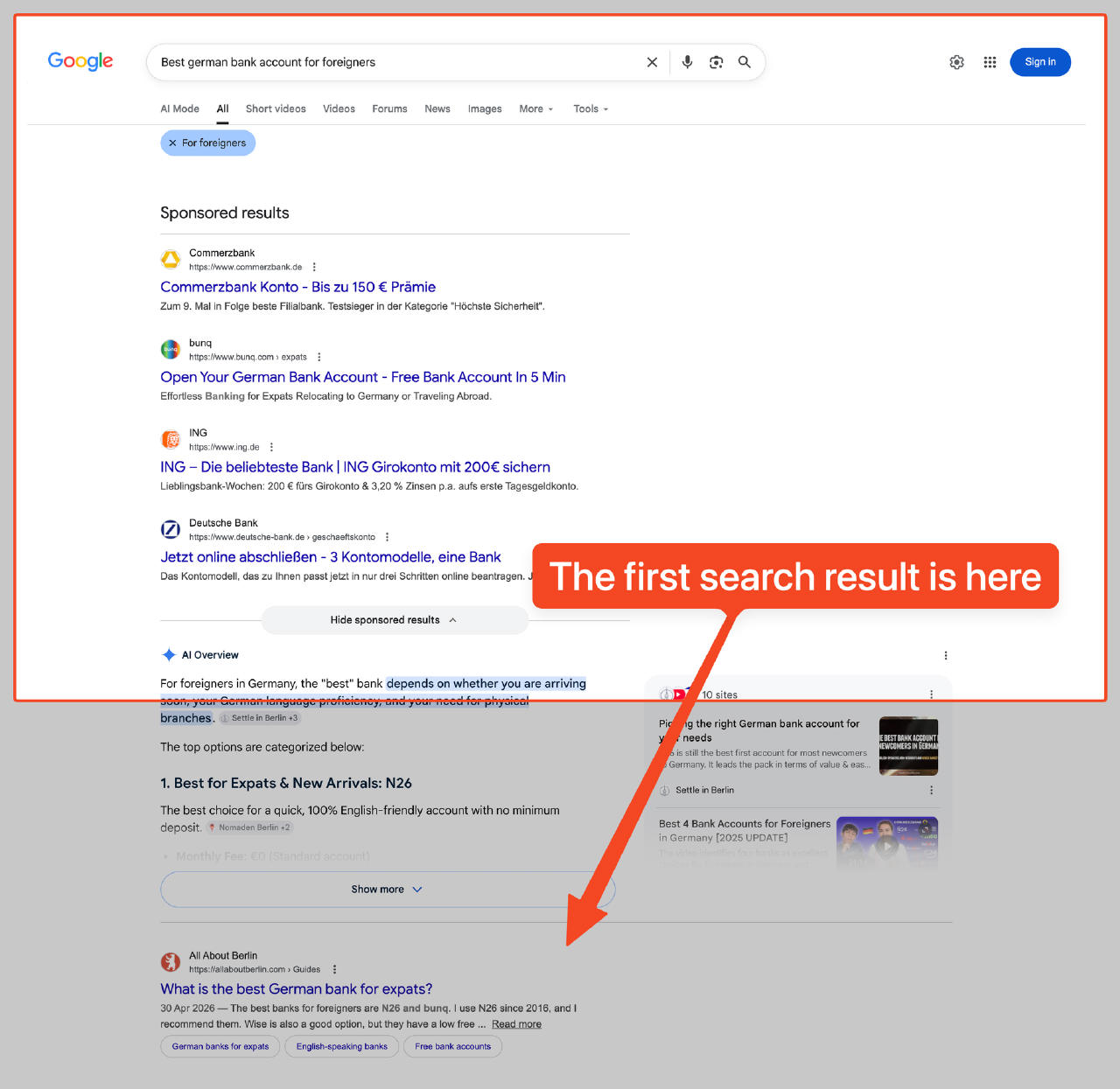 Business and rulesGoogle’s new AI answers are draining traffic from travel guidesHerald of AI
Google’s new AI answers are draining traffic from travel guides
A popular Berlin website has lost three-quarters of its visitors because Google now shows AI-generated summaries instead of links to actual articles.